
Unraveling Cosmic Secrets: The Legacy of Dying Stars
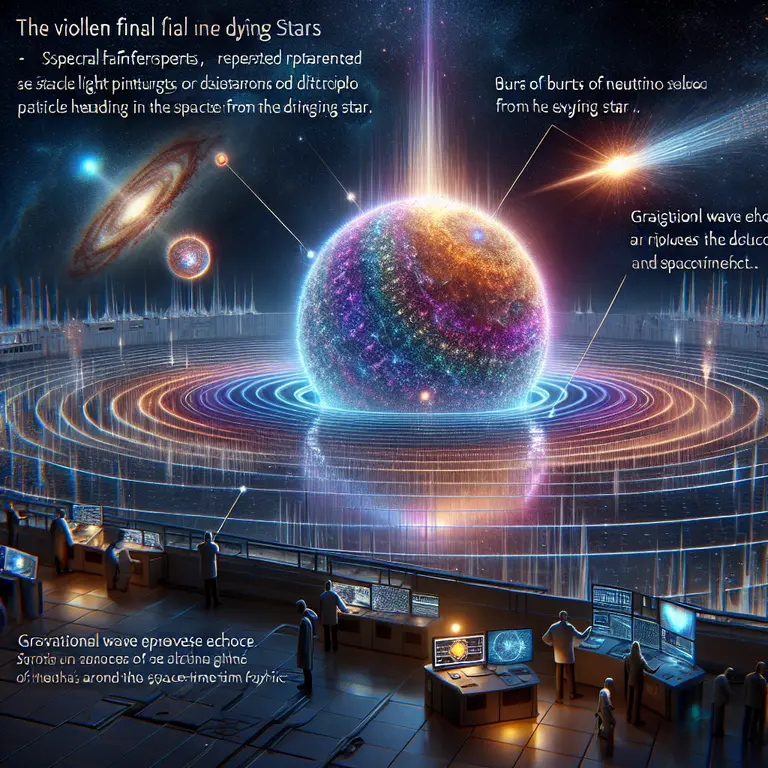
How astronomers decode the violent final moments of dying stars through spectral fingerprints, neutrino bursts, and gravitational wave echoes — revealing physics impossible to replicate on Earth.
 Watch on YouTube
 Watch on Rumble
The Last Broadcast of a Dying Star
When a massive star exhausts its nuclear fuel and collapses, it does not go quietly. In the final seconds before implosion, it broadcasts a cascade of signals across nearly every channel the universe possesses — light, neutrinos, gravitational waves, and cosmic rays. Reading those signals is one of the most technically demanding and scientifically rewarding acts in modern astronomy. It is, in the most literal sense, a forensic autopsy conducted across thousands of light-years, piecing together the life and violent death of an object that ceased to exist long before any human civilization existed to wonder at the night sky.
The field is called supernova spectroscopy, and it has matured dramatically since the landmark event of 1987, when a star designated SN 1987A exploded in the Large Magellanic Cloud roughly 168,000 light-years away. That event gave astronomers their first confirmed detection of neutrinos from a stellar collapse — a total of 24 particles caught across three separate detectors on Earth in a burst lasting just 13 seconds. Those 24 particles, out of an estimated 10^58 released in total, confirmed core-collapse supernova theory in a single observational stroke and launched an era of multi-messenger astronomy that continues to accelerate today. What makes SN 1987A particularly remarkable is that the progenitor star, a blue supergiant named Sanduleak -69 202, had been cataloged and photographed years before its death. Astronomers could look back through archival images and study the star in life before reconstructing its end — a luxury that transformed the event from a single observation into a decades-long case study that is still yielding new data as its expanding remnant interacts with surrounding gas clouds.
Spectral Fingerprints and the Chemistry of Catastrophe
Every element in the periodic table absorbs and emits light at specific, characteristic wavelengths. When a supernova’s expanding shockwave tears through the outer layers of a dying star, it illuminates those layers from within, and each element leaves its signature as a dark absorption line in the spectrum. By reading these lines, astronomers can reconstruct the onion-like compositional structure of the progenitor star layer by layer — hydrogen and helium on the outside, then carbon, oxygen, neon, magnesium, silicon, sulfur, and finally iron at the core, where fusion can no longer proceed. This layered architecture is not merely a curiosity of stellar physics. It is the direct record of billions of years of nuclear burning, each shell representing a different era in the star’s life, compressed into a final configuration that the explosion violently scrambles and flings outward at 10,000 kilometers per second.
The classification of supernovae is built almost entirely on these spectral clues. Type Ia supernovae, which lack hydrogen lines but show strong silicon absorption, are now understood to be thermonuclear explosions of white dwarf stars that have accreted too much mass from a companion. They are so consistently luminous that they serve as cosmological distance markers — the so-called standard candles whose dimness at high redshift provided the first evidence in 1998 that the universe’s expansion is accelerating, a discovery that earned the 2011 Nobel Prize in Physics. The entire edifice of dark energy rests, in part, on reading dead stars’ light. It is a striking fact that one of the most profound cosmological discoveries of the twentieth century was made not by building a new telescope or developing a new theory, but by carefully cataloging the brightness of stellar explosions and noticing that the most distant ones were slightly, stubbornly fainter than they should have been.
Type II supernovae retain hydrogen in their spectra and represent the core collapse of massive stars, typically those exceeding eight solar masses. Within this category, subtle differences in spectral evolution — how quickly certain lines fade, how the velocity of ejected material changes over weeks — allow astronomers to infer the mass of the progenitor, the geometry of the explosion, and whether the remnant left behind is a neutron star or a black hole. Some supernovae display spectral peculiarities that defy easy classification, hinting at exotic progenitor systems such as rapidly rotating magnetars, binary stars that have stripped each other’s outer layers, or even the long-theorized pair-instability supernovae, in which stars so massive that gamma rays in their cores begin spontaneously creating electron-positron pairs trigger a runaway thermonuclear detonation that leaves no compact remnant at all — the star annihilates itself completely.
Neutrino Astronomy and the Invisible Torrent
Light tells only part of the story. During a core-collapse supernova, roughly 99 percent of the energy released — on the order of 3 times 10 to the power of 46 joules, equivalent to the total luminous output of the observable universe over several seconds — escapes not as visible radiation but as neutrinos. These nearly massless, weakly interacting particles pass through the entire star in seconds, carrying away thermal energy from the proto-neutron star forming at the center. The optical display that lights up the sky for weeks, the spectacle that ancient astronomers recorded as a new star appearing in the heavens, represents only a tiny fraction of what actually happened. The true energy of the explosion is invisible, ghostly, and passes through the Earth as if it were not there.
Modern neutrino observatories have been built with exactly this scenario in mind. The IceCube Neutrino Observatory at the South Pole, a cubic kilometer of Antarctic ice instrumented with over 5,000 optical sensors, can detect the diffuse neutrino glow from a galactic supernova. The Super-Kamiokande detector in Japan, a 50,000-ton tank of ultra-pure water surrounded by photomultiplier tubes, would register thousands of neutrino interactions from a supernova occurring anywhere within our galaxy. The SNEWS network — the SuperNova Early Warning System — links these detectors globally so that a neutrino burst triggers an immediate alert to optical telescopes, potentially allowing astronomers to catch a supernova in the act of shock breakout, the moment the explosion wave first pierces the stellar surface, an event lasting only minutes.
This matters because the neutrino signal arrives hours before the optical brightening. The neutrinos escape from the core almost instantaneously, while the shockwave must physically travel outward through the star’s enormous bulk before it breaks the surface and becomes visible. When the next nearby supernova occurs, neutrino detectors will give astronomers a head start that no previous generation of scientists ever had. The flavor composition of the neutrino burst — the ratio of electron neutrinos, muon neutrinos, and tau neutrinos arriving at Earth — also encodes information about neutrino oscillations during their passage through dense stellar matter, making a nearby supernova one of the most powerful natural experiments available for probing the fundamental properties of these elusive particles.
Gravitational Waves and the Shape of Collapse
The most recent dimension added to stellar autopsy is gravitational wave astronomy. The LIGO and Virgo detectors, which measure spacetime distortions smaller than one ten-thousandth the diameter of a proton, have transformed the study of compact object mergers. A core-collapse supernova within the Milky Way or its satellite galaxies would produce a gravitational wave signal detectable by current instruments, encoding information about the asymmetry of the collapse itself — whether the core tumbles, sloshes, or rotates as it implodes.
The gravitational wave signature of a supernova is far more complex and harder to interpret than the clean chirp of a binary merger, but it is uniquely informative. Simulations suggest that convective overturn inside the collapsing core, the standing accretion shock instability, and the rotation rate of the proto-neutron star all leave distinct imprints on the waveform. In effect, gravitational waves provide a seismograph reading of the interior of a dying star — a region that light can never reach directly. The sheer density of matter in the collapsing core means that photons are trapped for hours or longer, scattered, and absorbed before they can escape. Neutrinos depart in seconds. Gravitational waves last in milliseconds. They are the earliest and most interior signal of all, carrying information from the very moment of collapse that no other messenger can access.
The Laser Interferometer Space Antenna, or LISA, scheduled for launch in the early 2030s, will extend this capability to lower frequencies and greater distances, potentially detecting supernova signals from nearby galaxies. Combined with next-generation neutrino detectors like Hyper-Kamiokande, which will hold eight times the water volume of its predecessor, and the Vera Rubin Observatory’s ability to scan the entire visible sky every few nights, the next galactic supernova will be the most thoroughly documented physical event in human history. Astronomers are already watching several candidate stars closely. Betelgeuse, the red supergiant marking the shoulder of Orion, caused considerable excitement in late 2019 when it dimmed dramatically, though it ultimately proved to have shed a dust cloud rather than collapsed. It will, however, explode eventually — and when it does, it will be visible in daylight and bright enough to cast shadows at night.
What the Dead Stars Leave Behind
The remnants of supernovae are laboratories for physics that cannot be replicated on Earth. Neutron stars, the city-sized objects left after core collapse, contain matter compressed to nuclear density — a teaspoon would weigh roughly a billion tons. Their interiors may harbor exotic states of matter, including strange quark matter, color-superconducting phases, and hyperons, particles containing strange quarks that barely exist outside particle accelerators. The equation of state of neutron star matter remains one of the central unsolved problems in nuclear physics, and gravitational wave observations of neutron star mergers are currently the best tool for constraining it. The 2017 detection of a neutron star merger, GW170817, was accompanied by electromagnetic counterparts spanning the spectrum from gamma rays to radio waves, and the kilonova afterglow confirmed in real time that such mergers produce heavy elements through rapid neutron capture — the r-process nucleosynthesis that theorists had long predicted but never directly witnessed.
Supernova remnants also seed the interstellar medium with heavy elements across timescales that dwarf human civilization. The Crab Nebula, the remnant of a supernova observed by Chinese and Arab astronomers in 1054, is still expanding at roughly 1,500 kilometers per second, its filaments rich in oxygen, sulfur, and other elements synthesized in the star that produced it. The Cassiopeia A remnant, only about 340 years old, has been imaged in such detail by the Chandra X-ray Observatory that astronomers can map the distribution of individual elements across its face, watching the debris of nucleosynthesis frozen in the act of dispersal.
Every atom of gold, platinum, and uranium in Earth’s crust was forged either in the collision of neutron stars or in the explosive nucleosynthesis of supernovae. The calcium in bones, the iron in blood, the oxygen in every breath — all of it passed through the interior of a star that no longer exists. Stellar autopsy is, in this sense, not merely the study of how stars die. It is the study of how the matter that constitutes living things was made, distributed across the galaxy, and eventually gathered by gravity into a world where creatures evolved who could look up at the sky, detect 24 ghostly particles from an explosion 168,000 light-years away, and begin to understand what they were seeing.