
Stellar Necromancy: Neutron Stars That Reboot Themselves
Some neutron stars, long thought dead, are being spun back to life by companion stars — resurrected as millisecond pulsars that defy our understanding of stellar death.
 Watch on YouTube
 Watch on Rumble
Introduction
In the graveyard of stellar evolution, neutron stars occupy a peculiar position. They are the compressed remnants of massive stars that exploded as supernovae, objects so dense that a teaspoon of their material would weigh roughly a billion tons on Earth. The physics governing them sits at the boundary of what human instruments can probe and what human mathematics can fully describe. Their surfaces are thought to be composed of a crystalline lattice of atomic nuclei so rigid it makes steel seem fragile by comparison, while their interiors may contain matter in states that have no analog anywhere else in the observable universe.
For decades, astronomers assumed neutron stars followed a predictable arc: born spinning rapidly, they gradually slow down over millions of years, losing energy through electromagnetic radiation, dimming, and eventually going dark. The story was supposed to end there, the way all stories about dead things are supposed to end. But a growing class of objects called millisecond pulsars has forced a radical revision of that narrative. These neutron stars spin hundreds of times per second, far faster than freshly born pulsars, and they should not exist at all under the old model. What is actually happening is something far stranger than simple decay: stellar necromancy, in which a dead star is dragged back to life by a companion. To understand why this matters, it helps to first understand what a pulsar actually is and why its resurrection is so physically improbable.
A pulsar is a neutron star that emits beams of electromagnetic radiation from its magnetic poles. As it rotates, those beams sweep across space like a lighthouse, and if Earth happens to lie in the path of the beam, astronomers detect a regular pulse of radio waves. The timing of those pulses encodes a great deal of information about the object that produces them. Newly formed pulsars spin fast because the collapsing stellar core that created them conserved angular momentum, the same principle that causes a spinning ice skater to accelerate when pulling in their arms. But they steadily lose rotational energy, and within tens of millions of years, most pulsars slow below the threshold for producing detectable pulses. They cross what astronomers call the death line and go silent. The discovery that some pulsars spin not more slowly with age, but dramatically faster, demanded an entirely new explanation.
The Recycling Mechanism
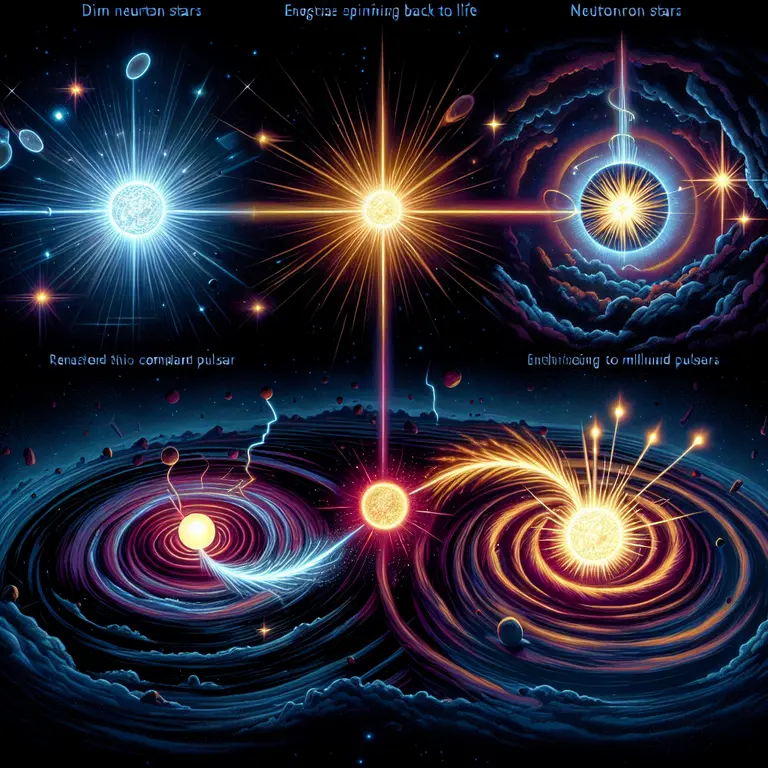
The process by which a neutron star is reanimated is called accretion-induced spin-up, and it requires a binary system, meaning two stars orbiting each other. When the companion star ages and expands into a red giant or subgiant phase, its outer layers begin to spill across the gravitational boundary between the two objects, a region called the Roche lobe. This material does not fall directly onto the neutron star. Instead, it forms a swirling accretion disk, spiraling inward over thousands or millions of years, losing energy through friction and radiation as it descends deeper into the neutron star’s gravitational well.
As the infalling gas strikes the neutron star’s surface, it transfers angular momentum, essentially torquing the dead star like a cosmic top being wound up by an invisible hand. The effect accumulates gradually, but the timescales of stellar evolution are sufficiently long to allow extraordinary results. Over time, a neutron star that had slowed to perhaps one rotation per second can be spun up to 716 rotations per second, as in the case of PSR J1748-2446ad, the fastest known millisecond pulsar, discovered in 2006 inside the globular cluster Terzan 5. At that rotation rate, its equator is moving at roughly 24 percent the speed of light. For context, the International Space Station orbits Earth at about 0.0025 percent the speed of light. The difference in scale is almost impossible to hold in mind.
The accretion disk itself is not a passive structure. It radiates X-rays as material heats up during its inward spiral, which is why binary systems in the process of recycling a neutron star are often detected first as low-mass X-ray binaries. Astronomers have watched some of these systems in real time, observing the neutron star’s spin rate increasing incrementally as accretion continues. This provides direct observational confirmation of the recycling mechanism rather than merely inferring it from the final product. The transition phase between active accretion and the emergence of a fully recycled millisecond pulsar has also been caught in the act in a handful of systems, objects that switch between X-ray binary behavior and pulsar behavior on timescales of weeks, giving researchers a rare window into the transformation itself.
Redbacks, Black Widows, and Stellar Cannibalism
The recycling process creates some of the most violent and bizarre systems in the known universe. Two subcategories of millisecond pulsars have been named after spiders notorious for consuming their mates, a naming convention that reflects both the dark humor of the astronomical community and the genuine brutality of these systems. Black widow pulsars are systems in which the revived neutron star’s intense radiation and particle winds are actively evaporating what remains of the companion that resurrected it, a kind of cosmic ingratitude that would be poetic if it were not so physically extreme. Redback pulsars are similar but involve more massive companions that have not yet been fully consumed, sitting at an earlier stage in the same grim process.
In both cases, the neutron star is essentially destroying the star that gave it new life. The companion in a black widow system can be reduced to a few percent of the Sun’s mass, a bloated, irradiated husk orbiting its former beneficiary in a state of continuous ablation. The system PSR B1957+20, discovered in 1988, was the first black widow pulsar identified and remains one of the most studied. Its companion completes an orbit every nine hours and is being ablated at a rate that will likely destroy it entirely within a few billion years. When that companion is finally gone, the millisecond pulsar will be left spinning alone in space, its origin story erased, with no companion remaining to testify to how it was revived.
This erasure of evidence has complicated the field's history. Isolated millisecond pulsars, those with no detectable companion, were initially puzzling precisely because they had consumed or evaporated the very objects responsible for their existence. It was only by studying systems caught mid-process that astronomers could reconstruct the full sequence of events. The black widow and redback systems are, in a sense, the crime scenes that revealed the mechanism. They are also a reminder that the universe does not tend toward preservation. It tends toward transformation, and the objects that survive are often those that consume what made the transformation possible.
What Millisecond Pulsars Are Teaching Us About Fundamental Physics
Beyond their dramatic life histories, millisecond pulsars have become extraordinary instruments for probing the laws of physics under conditions that no laboratory on Earth can replicate. Because they spin with such extraordinary regularity, some rivaling atomic clocks in their precision, arrays of millisecond pulsars distributed across the galaxy are being used as a natural gravitational wave detector. This technique, called pulsar timing arrays, works by monitoring tiny deviations in the arrival times of radio pulses from dozens of these objects simultaneously. Any ripple in spacetime passing through the galaxy would create a correlated pattern of early and late arrivals across the array, a signature distinguishable from instrumental noise or local interference.
In 2023, multiple independent collaborations, including NANOGrav, the Parkes Pulsar Timing Array, the European Pulsar Timing Array, and the Indian Pulsar Timing Array, announced compelling evidence for a gravitational wave background, a low-frequency hum of spacetime distortions likely produced by pairs of supermassive black holes in merging galaxies distributed across the cosmos. The signal was detected not with any conventional observatory, not with laser interferometers or space-based instruments, but with the collective ticking of recycled stellar corpses scattered across thousands of light-years. The irony is considerable. Objects that were once considered evolutionary dead ends have become among the most sensitive detectors of the universe's largest-scale processes.
Millisecond pulsars are also providing the tightest observational constraints yet on the equation of state of nuclear matter, one of the deepest unsolved problems in physics. The interior of a neutron star is a regime where quantum mechanics and general relativity both apply simultaneously, and where the behavior of matter under pressures exceeding anything achievable in particle accelerators remains genuinely unknown. Depending on how matter behaves at those densities, the interior might consist of pure neutrons, a superfluid mixture of neutrons and protons, exotic quark matter in which quarks roam freely rather than being bound inside particles, or phases of matter that current theory does not yet have names for. Precise mass measurements of millisecond pulsars, combined with data on their radii from X-ray observatories, are gradually narrowing the range of viable equations of state, eliminating some theoretical possibilities and placing pressure on others.
A Universe That Refuses Simple Endings
The existence of millisecond pulsars challenges a deeply intuitive assumption: that death, in the universe, is permanent. Stars that have exhausted their fuel, collapsed under their own gravity, and shed their outer layers in catastrophic explosions are not necessarily finished. Given the right companion and the right geometry, they can be rewound, accelerated, and returned to a state of violent activity that rivals their youth. The universe, it turns out, is an aggressive recycler. Material, energy, and angular momentum flow between objects across vast timescales, blurring the line between the living and the dead in ways that early stellar models did not anticipate and could not easily accommodate.
This has broader implications for how astronomers think about stellar populations and galactic evolution. If neutron stars can be revived, the accounting of compact objects in any given galaxy becomes more complicated. A neutron star that has crossed the death line and gone silent is not necessarily gone from the energetic inventory of the galaxy. It may simply be a matter of waiting for the right circumstances. Globular clusters, which are dense collections of old stars with high rates of close stellar encounters and binary formation, are thought to be particularly efficient factories for millisecond pulsars for exactly this reason. The proximity of stars in those environments increases the probability of binary configurations that enable recycling.
As pulsar timing arrays grow more sensitive with the addition of new facilities like the Square Kilometre Array, currently under construction across sites in South Africa and Australia, the catalog of known millisecond pulsars will expand dramatically. Each new detection is both a data point in the analysis of the gravitational wave background and a reminder that the endpoints of stellar evolution are far more varied, reversible, and strange than any early model of the cosmos anticipated. The stars that were supposed to simply die have instead become clocks, detectors, laboratories, and cannibals. Whatever else the universe is, it is not a place that allows its most extreme objects to rest quietly.