
Inca Quipus: Unraveling the Knot-Based Information System
The Inca Empire ran a civilization of millions without a single written word — using knotted strings called quipus to record taxes, census data, and possibly entire narratives.
 Watch on YouTube
 Watch on Rumble
The Inca Had No Writing. Their Accountants Had Something Better.
Here is a question that quietly breaks the brain: How do you administer a 4,000-kilometer empire — collecting taxes, tracking census populations, coordinating armies, and storing historical records — without a single written word?
The Inca did it with knots.
This is not a metaphor or a simplification. The Inca Empire, known as Tawantinsuyu, stretched from present-day Colombia to the southern tip of Chile and encompassed somewhere between 10 and 12 million people at its height. It had no currency, no wheel, and by conventional Western definitions, no writing system. And yet it functioned with an administrative precision that rivaled any contemporary state on Earth. The mechanism that made this possible was a knotted-string device called the quipu, and the more researchers study it, the stranger and more sophisticated it turns out to be.
What Is a Quipu?
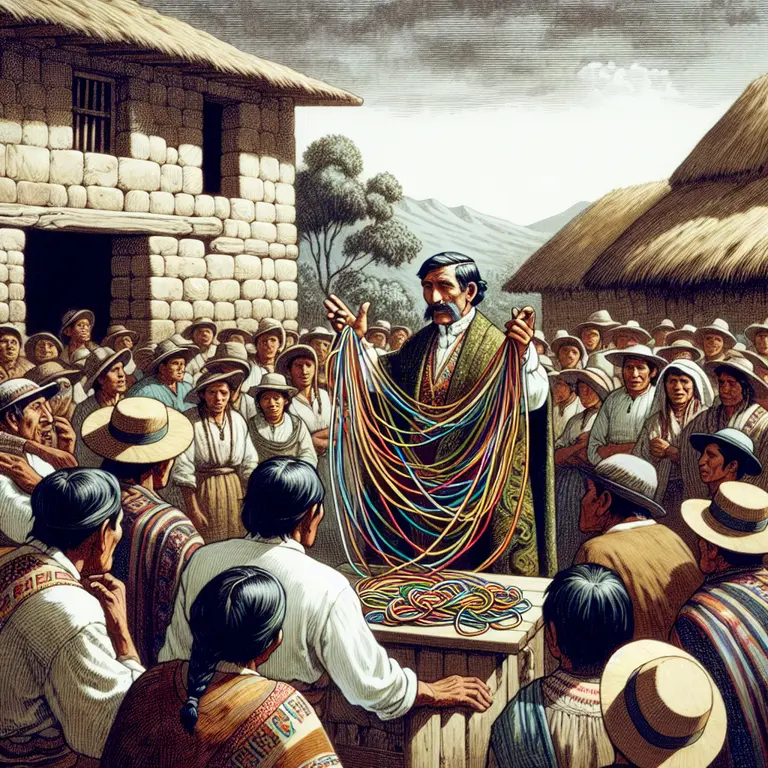
A quipu (also spelled khipu, from the Quechua word for “knot”) is a device made of a primary horizontal cord from which dozens — sometimes hundreds — of pendant strings hang. Each string is knotted in specific ways, at specific positions, using specific colors of fiber. Together, they encode numerical data in a base-10 positional system that, structurally, is not entirely different from how a modern spreadsheet organizes information.
The position of a knot along a string indicates its decimal place value. The type of knot indicates the digit itself. A cluster of strings could represent a village’s population, its tribute in llamas, its output in dried fish, or its military levy — organized hierarchically, like nested folders in a filing system made of wool. Some quipus contain subsidiary strings attached to pendant strings, which are in turn attached to other subsidiaries, creating a branching architecture of data that can represent relationships between categories of information rather than just isolated numbers.
The materials themselves were not incidental. Quipus were made from cotton or camelid fiber, both of which were economically and symbolically significant in Andean culture. The choice of material, the direction of the spin used to create the cord, and the specific dyes used to produce particular colors were all potentially meaningful variables. This was not a crude tally system scratched into stone. It was a carefully engineered, portable, and durable piece of information technology.
At its peak around 1500 CE, the Inca state employed a professional class of quipu-keepers called quipucamayocs — literally, “those who are in charge of the knots.” They were trained from youth, inherited their roles, and could read another keeper’s quipu the way an accountant reads a balance sheet. Spanish chroniclers described them as indispensable to provincial governance, summoned to court to recite census figures and tribute records from memory, with the quipu serving as both mnemonic aid and primary document. When a quipucamayoc died, the knowledge encoded in their strings risked dying with them unless successors had been properly trained — a fragility that the Inca administrative system appears to have taken seriously.
The Part That Gets Genuinely Strange
Here is where the story departs from the comfortable narrative of clever accounting and enters genuinely unsettled territory. Some quipus do not fit the accounting model at all.
Of the roughly 900 surviving quipus — most held in European museums, taken during or after the Spanish conquest — a significant subset contains structural patterns that do not correspond to any numerical logic researchers have been able to identify. The knot types, color sequences, and string arrangements in these objects appear to carry non-numerical information. The leading hypotheses suggest this information may be phonetic, narrative, or calendrical in nature, though no consensus decipherment has emerged.
In 2017, Harvard anthropologist Gary Urton proposed that quipus may encode a binary system of up to 1,536 distinct signs when you account for fiber direction, knot handedness, attachment method, and color. This level of combinatorial complexity would, in principle, be sufficient to record language itself — not just numbers, but words, names, stories, and speech. The implications of this are difficult to overstate. It would mean that the Inca possessed not an absence of writing but a form of writing so different from anything in the Old World that scholars spent centuries failing to recognize it as such.
Spanish colonial records from the 16th century actually describe quipus being used to preserve histories, poems, and ritual speeches. These records also describe those same quipus being burned by agents of the Inquisition, who suspected the objects of harboring idolatrous content. What was destroyed in those fires may have been an entire literary tradition — epics, genealogies, cosmological narratives — encoded in string and color rather than ink and parchment. The loss is comparable in scale, if not in kind, to the burning of the Library of Alexandria, and it is far less discussed.
A Cross-Disciplinary Collision
The study of quipus has increasingly drawn researchers from fields that would not normally concern themselves with pre-Columbian artifacts. This is where the story collides unexpectedly with computer science and information theory.
Researchers, including Urton and the late Marcia and Robert Ascher of MIT, have applied mathematical frameworks used to analyze digital data compression to the analysis of quipu structure. The central question they have been asking is essentially: what is the minimum structural complexity required for a system to encode language? This is not a humanistic question—it is an engineering question that can be answered with formal tools. Preliminary analyses suggest that some quipus clear that bar. They contain enough distinct, non-random structural variation to carry linguistic content, even if the specific mapping between structure and meaning remains unknown.
The challenge facing decipherment is partly a problem of sample size and partly a problem of context. With most ancient scripts, decipherment was made possible by bilingual inscriptions — texts that said the same thing in a known and an unknown language. The Rosetta Stone is the obvious example. For quipus, no such bilingual key has been found, and the oral traditions that would have accompanied the reading of a quipu were severed by conquest and forced conversion within a generation or two of Spanish arrival.
In 2022, however, a potentially significant discovery was announced. A research team examining a quipu recovered from the village of San Juan de Collata in Peru found what they believe may be the phonetic encoding of the community’s name within the knot patterns. If confirmed, this would represent the first successful decipherment of linguistic content in a quipu — a genuine Rosetta Stone moment for the field. The finding remains contested, and independent verification is ongoing, but the methodological approach it represents has energized the broader research community.
Why This Should Reframe Everything
The conventional markers of civilization as defined by 19th-century European scholars included agriculture, cities, monumental architecture, metallurgy, and writing. The Inca had all of these except the last — or rather, they had something that may have served the same function through an entirely different physical medium. This distinction matters more than it might initially appear.
We tend to define advanced civilization partly by the presence of writing, and we tend to define writing as marks made on a flat surface that represent language visually. The Inca case forces a genuine rethink of both assumptions. A fully functional imperial bureaucracy — arguably the largest and most complex in the pre-Columbian Americas — operated entirely through a tactile, portable, three-dimensional information technology. The quipu was a database you could carry on your belt, read in the dark, and pass between administrators across thousands of kilometers of mountain terrain.
There is also something worth sitting with in the fact that we have had 900 of these objects in our possession for centuries and still cannot read most of them. The quipus are not lost. They are in museums in Berlin, Madrid, and New York. They have been photographed, measured, and catalogued. And yet the information they contain remains, for the most part, inaccessible — not because it was destroyed, but because the interpretive tradition that made them legible was interrupted before it could be recorded.
The knots are still there. We just do not yet know what they are saying. And that gap — between physical survival and meaningful comprehension — is one of the most quietly haunting problems in the history of human knowledge.