
The Medieval 'Cadaver Synods': When Corpses Stood Trial
In the 9th century, a pope exhumed his predecessor's corpse to put it on trial for alleged crimes
 Watch on YouTube
 Watch on Rumble
The Grotesque Spectacle of the Cadaver Synod
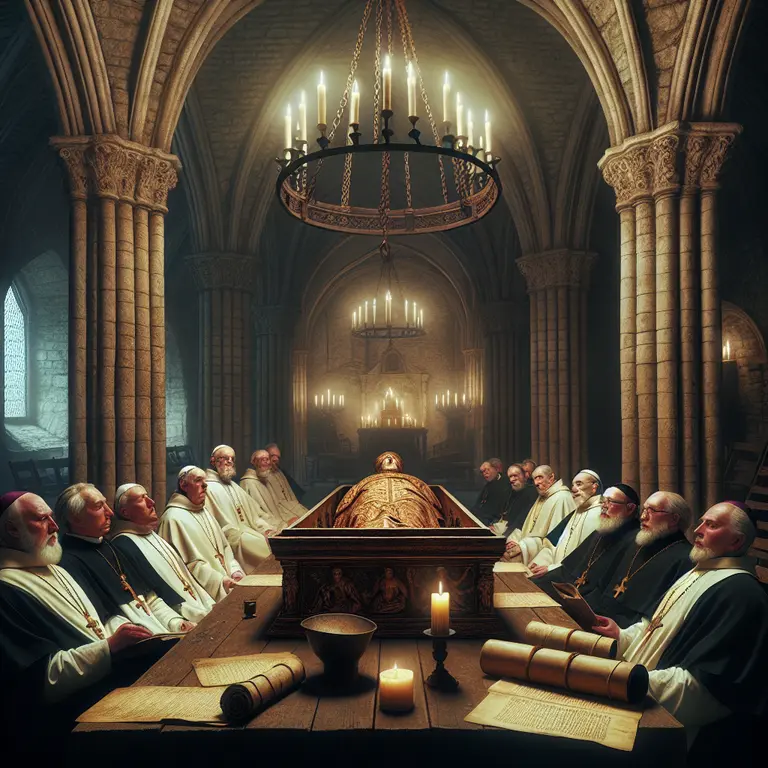
In one of history’s most bizarre legal proceedings, Pope Stephen VI (VII) ordered the exhumation of Pope Formosus’s corpse, nine months dead, in 897 CE to stand trial in what became known as the Cadaver Synod (Latin: Synodus Horrenda). The decomposing body, dressed in papal vestments, was propped up on a throne in the Basilica of St. John Lateran in Rome and assigned a trembling deacon to speak for it.
The charges? Perjury, coveting the papacy, and violating church canons by serving as the Bishop of Rome when he had previously been the Bishop of Porto (a violation of rules against transferring bishoprics). The rotting corpse was found guilty on all counts.
As punishment, the three fingers used to give papal blessings were cut off the corpse’s right hand, all ordinations performed by Formosus were declared invalid, and his papal vestments were torn away. The body was initially buried in a pauper’s grave before being exhumed again and thrown into the Tiber River.
This macabre episode occurred during a particularly turbulent period in papal history known as the Saeculum Obscurum (Dark Age), when the papacy was caught in violent power struggles between rival aristocratic factions in Rome. The trial wasn’t merely a bizarre aberration but rather a calculated political maneuver by Stephen VI to delegitimize his predecessor’s appointments and allies, particularly those who had supported the Carolingian faction in Italian politics over the local Roman nobility.
A Pattern of Posthumous Justice
What makes this even more surprising is that this wasn’t a one-time medieval oddity. Posthumous trials were an established legal concept across medieval Europe and beyond. The Byzantines regularly conducted trials of deceased emperors to justify policy reversals, a practice known as damnatio memoriae—the condemnation of memory.
In 1329, the corpse of Antipope Nicholas V was tried and convicted, and in 1559, Pope Paul IV’s corpse was dragged through the streets of Rome and thrown into the Tiber after his death. The latter case was particularly noteworthy as it represented popular anger against Paul IV’s harsh policies, including his expansion of the Roman Inquisition and establishment of the Jewish ghetto in Rome.
The English Parliament posthumously attainted and symbolically executed Oliver Cromwell in 1661, three years after his death. His corpse was exhumed, hanged in chains at Tyburn, and then beheaded. The head was displayed on a pole outside Westminster Hall until 1685—nearly 30 years after Cromwell’s actual death.
Even outside Europe, posthumous justice had precedent. In ancient China, the practice of “posthumous degradation” (夷三族) could condemn not only the deceased but also punish three generations of their family. The Aztec civilization had rituals for posthumously disgracing nobles who had fallen from favor, including symbolic destruction of their remains and possessions.
Theological and Practical Foundations
The practice of trying the dead connects to both theological and practical concerns that reveal much about medieval worldviews. Theologically, it reflected beliefs about the connection between the body and the soul, even after death. In medieval Christian thought, the body remained, in some sense, connected to a person’s identity and would eventually be reunited with the soul at the Last Judgment. This created a theological framework where the corpse retained a vestige of personhood that could be subject to earthly justice.
The medieval concept of “the King’s two bodies”—the mortal body and the immortal office—further complicated matters for rulers and popes. By trying Formosus’s corpse, Stephen VI was attacking the legitimacy of Formosus’s papal acts rather than simply the man himself.
Practically, posthumous trials served as powerful political tools for delegitimizing predecessors and their policies without the messy business of executing a living person. They allowed new regimes to establish clear breaks with previous administrations while maintaining the appearance of legal continuity. This was particularly important in the papal context, where the doctrine of apostolic succession required an unbroken chain of legitimate authority.
These trials also served a public relations function. By publicly desecrating the remains of a former authority figure, rulers could demonstrate their complete dominance and the totality of their predecessor’s fall from grace. The theatrical elements—dressing corpses in official regalia before stripping them, public display of remains, and ritual destruction—were calculated to impress upon witnesses the consequences of opposing the current regime.
Modern Echoes and Philosophical Questions
This medieval legal oddity has surprising connections to modern forensic science, where exhumations are sometimes ordered to gather evidence in criminal cases. The 1991 exhumation of President Zachary Taylor to test for arsenic poisoning and the multiple exhumations of Salvador Dalí for paternity testing demonstrate that the dead’s remains still participate in our justice systems, albeit in a more scientific context.
Posthumous legal proceedings continue in modified forms. Posthumous pardons have been granted to figures like Alan Turing in 2013 and thousands of people executed for witchcraft across Europe. Russia posthumously tried Sergei Magnitsky in 2013 in what Amnesty International called “a sinister attempt to deflect attention from those who committed the crimes he exposed.” These cases raise philosophical questions about whether justice can be meaningfully served after death.
The most counterintuitive aspect? Despite seeming barbaric to modern sensibilities, these trials followed formal legal procedures with defense representatives and evidence presentation—they weren’t just symbolic mob actions but were conducted with procedural seriousness. The Cadaver Synod assigned a deacon to speak for Formosus, called witnesses, and cited canonical law. This reveals how radically different medieval concepts of personhood, death, and justice were from our own.
The Aftermath and Historical Legacy
The aftermath of the Cadaver Synod was equally dramatic and illustrates the volatile nature of papal politics during this period. Pope Stephen VI, who had orchestrated the grim spectacle, was imprisoned and strangled shortly afterward in a popular uprising partly triggered by public disgust at the trial and an earthquake that damaged the Lateran Basilica—interpreted by many as divine disapproval.
His successor, Pope Romanus, held office for only four months before being deposed and forced into a monastery. The next pope, Theodore II, reigned for a mere twenty days but used that brief time to rehabilitate Formosus’s memory. He had Formosus’s body recovered from the Tiber, reclothed in papal vestments, and reburied with honor in St. Peter’s Basilica.
Pope John IX subsequently convened synods that annulled the Cadaver Synod, prohibited future trials of dead persons, and ordered all records of the trial burned. However, the political wounds remained unhealed. In 904, Pope Sergius III (a former supporter of Stephen VI) reversed these decisions and reaffirmed the validity of the Cadaver Synod.
This bizarre episode and its chaotic aftermath have become emblematic of the corruption and political intrigue that plagued the papacy during the 9th and 10th centuries. It has been cited by historians as evidence of how far the papal office had fallen from its spiritual mission, becoming instead a prize fought over by Roman noble families who used it to advance their worldly interests.
The Cadaver Synod stands as a reminder of how profoundly different past societies’ conceptions of justice, death, and political legitimacy could be from our own—and perhaps serves as a warning about the extremes to which political vendettas can be taken when power becomes divorced from ethical constraints.