
The Immortal Goats of the Galápagos: a Hunting Paradox
How a misguided eradication effort led to the evolution of super-goats that were nearly impossible to eliminate
 Watch on YouTube
 Watch on Rumble
Evolution in the Fast Lane
Imagine a conservation effort so spectacularly backfired that it created the very problem it sought to solve—but worse. This is exactly what happened on Pinta Island in the Galápagos archipelago, where a well-intentioned attempt to eliminate invasive goats inadvertently created what ecologists now call the “Judas goat paradox.”
In the 1950s, feral goats were devastating the unique ecosystem of the Galápagos Islands, threatening native species, including the iconic Galápagos tortoise. The goats, originally introduced by sailors as a food source, had no natural predators and multiplied rapidly, devouring vegetation that native species depended on.
In the 1970s, conservationists launched an eradication program with a seemingly clever strategy. They would capture female goats, sterilize them, inject them with hormones to keep them perpetually in estrus (heat), and release them back into the wild wearing radio collars. These “Judas goats” would attract males, who could then be located and eliminated by hunters.
But here’s where evolution threw a fascinating wrench into the plan: the constant hunting pressure created a powerful selection mechanism. Goats that were naturally shy, had exceptional hearing, possessed acute smell, or displayed unusual wariness around humans were the ones that survived. With each generation, these traits became more concentrated.
The Rise of the Super-Goat
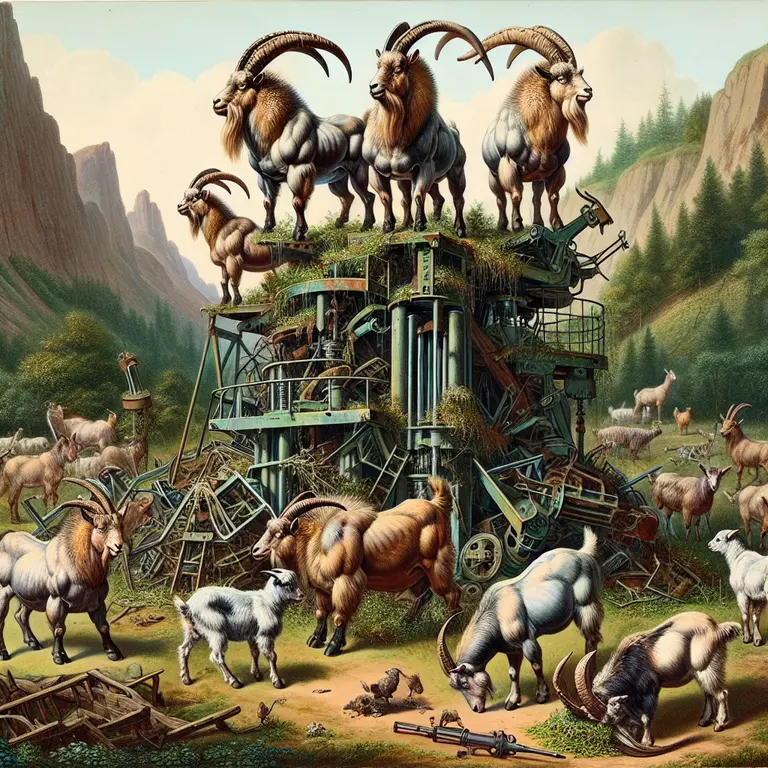
By the 1990s, the remaining goat population had evolved into what one researcher described as “super-goats”—animals with remarkable adaptations that defied conventional eradication methods. These weren’t the same docile creatures that had first arrived on the islands. Through intense selection pressure, they had transformed into something far more elusive.
The super-goats could detect human presence from over a mile away, utilizing their enhanced senses in ways their ancestors never needed to. Their hearing became so acute that they could distinguish between natural sounds and the subtle noises made by approaching hunters. Their olfactory capabilities evolved to detect human scent particles carried on the wind, even in minuscule concentrations.
Perhaps most remarkable was their behavioral adaptation. These goats had learned to remain completely motionless when hunters were nearby—a stark contrast to their species' typical flight response. They shifted their feeding patterns to primarily nocturnal activity, minimizing exposure during daylight hours when hunting teams were active. They developed preferences for hiding in the most inaccessible terrain—steep volcanic slopes, dense thickets, and narrow ravines that humans could barely navigate.
Dr. Elena Vásquez, who studied the Pinta Island goat population in the late 1990s, documented how the animals had even altered their vocalization patterns. “Traditional goats are quite vocal,” she noted in her research. “But these animals had become nearly silent, communicating through subtle body language rather than bleats that might give away their position. It was as if they had developed their own covert communication system.”
Outsmarting the Judas Strategy
The most sophisticated adaptation observed was how some goats appeared to recognize and avoid the Judas goats altogether. This represented a remarkable cognitive leap—the ability to identify something “off” about the behavior of these hormone-manipulated females and subsequently avoid them.
Wildlife biologist Carlos Mendoza, who participated in the later stages of the eradication program, described the phenomenon: “We would track our Judas goats expecting to find them surrounded by males, but instead they would be completely isolated. Somehow, the remaining population had learned to recognize that these females were associated with danger.”
Some researchers hypothesize that the avoidance behavior may have been triggered by subtle differences in the Judas goats’ movement patterns or social behaviors resulting from their hormone treatments. Others suggest that surviving goats may have witnessed the hunting of companions who approached Judas goats and subsequently formed an association between these particular females and danger.
This level of behavioral plasticity was unprecedented and represents a textbook case of human-induced evolution at an accelerated pace—what would normally take thousands of years occurred in mere decades under intense selection pressure.
The Technological Arms Race
The eradication program entered what ecologists now call an “evolutionary arms race,” with humans developing increasingly sophisticated hunting methods while the goats continued to adapt. By the late 1990s, traditional ground-based hunting had become almost entirely ineffective against the super-goats.
The program eventually succeeded only through the use of aerial hunting techniques and advanced technology—methods that hadn’t even been developed when the program began. Teams employed helicopter-based hunting units equipped with thermal imaging to detect goats hiding in vegetation. GPS-coordinated systematic sweeps ensured no areas were missed. Some operations even utilized specialized trained dogs that could track goats across difficult terrain.
The program's financial cost ballooned far beyond initial projections. What was intended as a straightforward eradication became a multi-million dollar, multi-decade endeavor requiring international cooperation and cutting-edge technology. The last goats were finally removed from Pinta Island in 2003, but not before teaching biologists a humbling lesson about evolutionary adaptation.
Broader Implications for Conservation Science
The Pinta Island goat saga has profound implications for invasive species management worldwide. It demonstrates how human interventions can trigger unexpected evolutionary responses—a phenomenon increasingly observed across ecological systems, from antibiotic-resistant bacteria to pesticide-resistant insects.
Dr. Jonathan Rivera, a conservation biologist at Universidad San Francisco de Quito, explains: “The Judas goat paradox has become a cautionary tale in conservation circles. It teaches us that we must anticipate evolutionary responses when designing eradication programs. What works initially may become ineffective as the target population adapts.”
The experience has transformed how modern eradication programs are designed. Current approaches emphasize overwhelming force applied in coordinated, rapid campaigns rather than sustained pressure that allows time for adaptation. The concept of “adaptive management”—continuously monitoring results and adjusting strategies accordingly—has become standard practice largely because of lessons learned from cases like the Galápagos goats.
Perhaps most importantly, the case highlights the remarkable adaptive potential of species when faced with existential threats. Evolution isn’t just something that happens over geological timescales—it can occur with surprising speed when selection pressures are strong enough. The super-goats of Pinta Island stand as living proof that nature’s capacity for adaptation should never be underestimated.
As ecosystems worldwide face unprecedented pressures from human activities, understanding these rapid evolutionary dynamics becomes increasingly crucial for effective conservation. The legacy of the Galápagos super-goats continues to influence how scientists approach the complex challenge of managing invasive species in fragile ecosystems.