
Frozen Alligators: Evolutionary Brumation Revealed
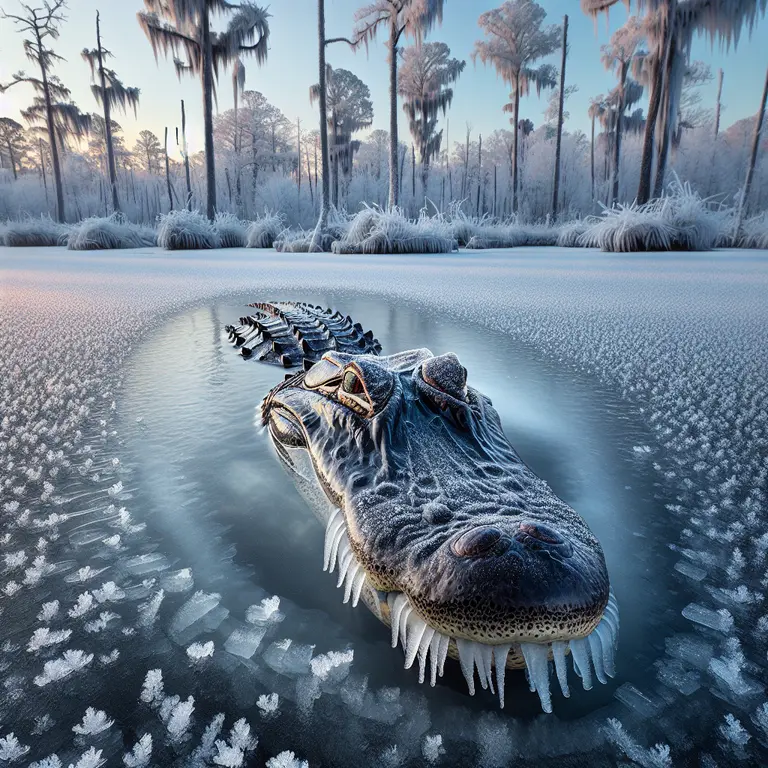
American alligators can survive being frozen in ice by entering a state of brumation with their snouts sticking out.
 Watch on YouTube
 Watch on Rumble
The Frozen Alligators of North Carolina
An Ancient Adaptation Revealed
In January 2018, visitors to the Shallotte River Swamp Park in North Carolina witnessed what appeared to be a scene from prehistoric times frozen in a moment: alligators seemingly trapped in ice, with only their snouts protruding above the frozen surface. Far from being a tragedy, this was actually a remarkable survival strategy that challenges our fundamental understanding of reptilian physiology.
Alligators, typically associated with warm, swampy environments, have evolved an extraordinary adaptation called “brumation” – a hibernation-like state that allows them to survive in freezing conditions that would kill most reptiles. When water bodies freeze over, these cold-blooded creatures slow their metabolism to an absolute minimum, positioning themselves with just their nostrils above the ice line.
What makes this particularly surprising is that alligators, unlike mammals with antifreeze proteins in their blood, can have parts of their bodies encased in ice without suffering cellular damage. They essentially become living popsicles, with their vital organs functioning at minimal levels while their extremities can endure partial freezing.
The Evolutionary Marvel of Brumation
The American alligator (Alligator mississippiensis) has inhabited North America for approximately 37 million years, surviving numerous ice ages and climate fluctuations that drove many other species to extinction. This remarkable longevity is largely due to their sophisticated brumation process, which differs significantly from mammalian hibernation.
During brumation, alligators experience a dramatic 80-90% reduction in their metabolic rate. Their heart rate drops from 30-40 beats per minute to just 2-3 beats per minute, and they can go without food for months. Unlike hibernation, brumation doesn’t involve deep sleep; instead, alligators enter a state of profound torpor while maintaining minimal awareness of their surroundings. This allows them to respond to threats or environmental changes if necessary, even in their slowed state.
The timing of brumation is triggered by both temperature and photoperiod (day length), demonstrating a sophisticated internal clock mechanism. Typically, full brumation begins when temperatures consistently drop below 70°F (21°C); it occurs when temperatures fall below 55°F (13°C). This precise temperature sensitivity helps explain why alligators have been able to expand their range northward into regions like North Carolina, where winter freezes were once thought to create impenetrable barriers to reptilian colonization.
Perhaps most remarkable is the alligator’s ability to regulate ice formation in its tissues. While mammals prevent freezing through various mechanisms, including specialized proteins, alligators appear to allow controlled ice formation in peripheral tissues while protecting vital organs. This controlled freezing state represents a fundamentally different approach to cold survival than seen in most vertebrates.
Beyond North Carolina: Geographic Range and Climate Adaptation
The 2018 North Carolina freezing event captured public imagination, but similar phenomena have been documented throughout the northern edges of alligator territory. American alligators now range as far north as coastal North Carolina and parts of Oklahoma, regions that regularly experience freezing temperatures.
Historical evidence suggests their range once extended even further north before human hunting and habitat destruction pushed populations southward. Fossil records indicate alligators or their close relatives once inhabited areas as far north as present-day New Jersey and Nebraska during warmer climatic periods. As global temperatures continue to rise due to climate change, biologists are tracking a gradual northward expansion of alligator populations, with occasional sightings now reported in southern Virginia.
This geographic flexibility contradicts the common portrayal of alligators as creatures exclusively adapted to tropical and subtropical environments. Instead, they demonstrate remarkable climatic versatility, with populations successfully adapting to seasonal temperature variations ranging from freezing conditions to sweltering summer heat exceeding 100°F (38°C).
Research from the Savannah River Ecology Laboratory has documented that alligators in their northern range grow more slowly but reach larger maximum sizes than their southern counterparts, suggesting complex physiological adaptations to different thermal regimes. These northern populations also show behavioral differences, including modified nesting behaviors and different seasonal activity patterns compared to Florida alligators.
Biomimetic Potential: From Swamp Survival to Medical Breakthroughs
The alligator’s freeze tolerance has attracted significant interest from biomedical researchers working on organ preservation techniques. Current methods for preserving human organs for transplantation are limited, with most organs remaining viable for only 4-36 hours, depending on the tissue type. This narrow window creates logistical challenges and contributes to organ shortages worldwide.
Researchers at the University of Louisiana and the Medical University of South Carolina have identified unique compounds in alligator blood that may contribute to their freeze tolerance. These include novel antioxidants and specialized proteins that help prevent cellular damage during temperature extremes. Initial studies suggest these compounds might be adaptable for use in human organ preservation solutions.
Beyond organ preservation, the study of alligator brumation has implications for treating ischemic injuries in humans. When alligators emerge from brumation, their bodies must handle a rapid increase in oxygen after months of reduced circulation – a situation similar to reperfusion after stroke or heart attack in humans. Understanding how alligator cells prevent damage during this transition could inform new treatments for these common and often devastating conditions.
Additionally, the alligator’s ability to survive with minimal brain activity during brumation, followed by full cognitive recovery, has attracted attention from neuroscientists studying brain protection during trauma and surgery. The protective mechanisms that preserve alligator neural tissue during prolonged oxygen and glucose restriction might translate to neuroprotective strategies for human patients.
A Testament to Evolutionary Resilience
The image of alligator snouts protruding from ice represents far more than a curious winter phenomenon. It stands as a testament to the remarkable evolutionary resilience of a species that has survived multiple extinction events that eliminated countless contemporaries, including the non-avian dinosaurs.
These prehistoric-looking creatures, often portrayed as evolutionary relics, demonstrate remarkable behavioral plasticity. They’re making complex decisions about when to enter brumation, how to position themselves, and when to emerge – all based on environmental cues that require sophisticated sensory integration.
The frozen alligators of North Carolina remind us that evolution often produces solutions more elegant and effective than our technology can currently achieve. As climate patterns continue to shift globally, the alligator’s time-tested adaptability may prove increasingly valuable as a model for biological resilience in the face of environmental change.
Next time you think of alligators as simple, primitive creatures suited only for warm climates, remember their frozen snouts poking through ice – a testament to evolutionary ingenuity that has allowed them to outlast countless other species through dramatic climate changes across millions of years.