
Unveiling the Optical Illusion of Blue in Butterfly Wings
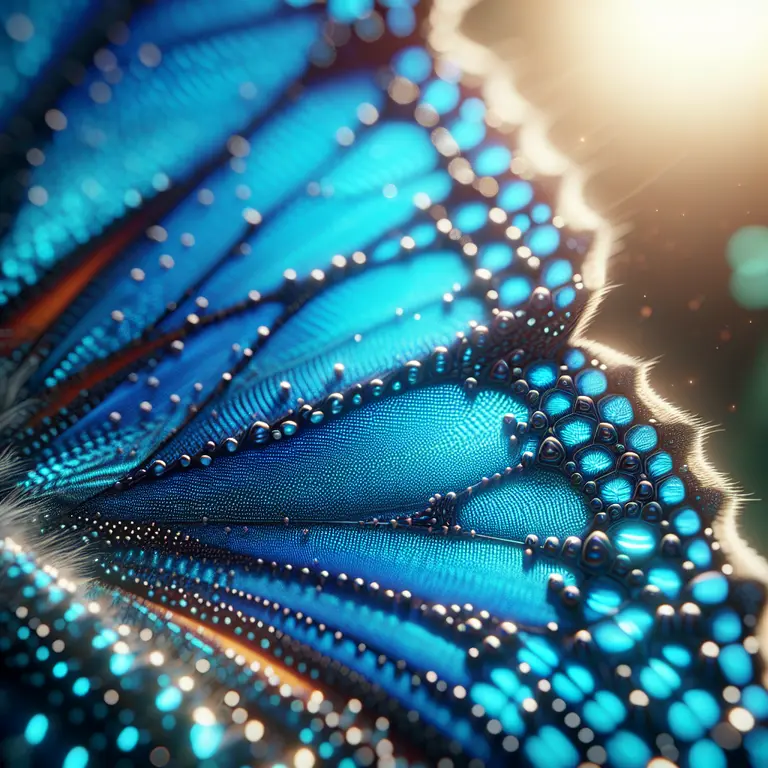
The brilliant blue color in butterfly wings isn't created by pigments but by complex nanostructures that manipulate light through structural coloration.
 Watch on YouTube
 Watch on Rumble
Nature’s Grand Optical Illusion
That dazzling blue morpho butterfly you have admired in nature documentaries is pulling off one of nature’s most sophisticated optical illusions. Despite what your eyes tell you, there is no blue pigment in those wings whatsoever. What appears to be a vibrant, almost electric blue is actually produced by an extraordinary phenomenon called structural coloration, in which nanoscale structures, rather than chemical pigments, produce color by manipulating light. The butterfly does not contain blue. It manufactures the appearance of blue from pure geometry and physics, and it does so with a precision that continues to humble the engineers and materials scientists who study it.
The Morpho genus, comprising approximately 30 species of neotropical butterflies found across Central and South America, has captivated human attention for centuries. Indigenous Amazonian cultures attributed spiritual significance to these brilliant creatures, weaving them into cosmological narratives and ceremonial life. European naturalists in the 18th century paid premium prices for preserved specimens, shipping them across oceans to fill the cabinets of collectors who could only marvel at the color without understanding its origin. Yet throughout this long history of fascination, the true nature of their color remained elusive until the development of electron microscopy in the mid-20th century revealed the astonishing truth: these creatures achieve their signature blue through physical architecture rather than pigmentation. What had seemed like a biological mystery turned out to be a masterclass in applied optics.
The Physics Behind the Deception
Morpho butterfly wings are covered with microscopic scales containing elaborate structures made of transparent chitin, the same tough polysaccharide material that forms insect exoskeletons and crustacean shells. These scales are not simply flat or smooth. They feature precisely arranged ridges with multiple layers separated by distances of around 200 nanometers, a measurement smaller than the wavelength of visible light. The structure is sometimes described as resembling a Christmas tree in cross-section, with branches extending outward from a central spine at carefully calibrated angles.
When light strikes these structures, something remarkable happens at the boundary between physics and biology. The ridges cause light waves to diffract, bending them around the microscopic obstacles. Some wavelengths then experience constructive interference, meaning the reflected waves align and amplify one another, while other wavelengths undergo destructive interference, effectively canceling each other out. Blue wavelengths, sitting near 450 nanometers in the visible spectrum, are the ones that reflect back toward the observer. All other wavelengths are either absorbed or scattered away from the viewer’s line of sight.
This phenomenon, known as thin-film interference, operates on the same principles that create the rainbow sheen on soap bubbles or the iridescent shimmer on the surface of an oil slick. However, the butterfly’s version is far more sophisticated than either of those familiar examples. Each wing scale contains multiple stacked layers of chitin arranged with mathematical precision that would challenge the most advanced nanofabrication techniques available today. The spacing between layers must be maintained within a few nanometers for the interference effect to work correctly. A deviation even slightly outside that range would shift the reflected wavelength toward green or violet, eliminating the characteristic blue entirely.
The complexity does not end at the individual scale. The scales themselves are arranged across the wing surface in overlapping patterns, creating a kind of redundancy that ensures the color effect persists even when some scales are damaged or missing. This evolutionary adaptation provides remarkable durability to the visual signal, which is critical for mate recognition and territorial displays in the dense, competitive environment of the tropical forest understory.
Why These Challenges Common Assumptions
Most people intuitively assume that colors in living organisms come from pigments, molecules that selectively absorb certain wavelengths while reflecting others back to the eye. We expect red flowers to contain red pigments, yellow bananas to have yellow pigments, and green leaves to be packed with green-reflecting compounds. The reality of leaves is actually more complicated than that, but the general expectation holds. Structural color reveals a completely different pathway to visual appearance, one that sits at the intersection of biology, physics, and materials science in ways that most introductory education never addresses.
What makes this particularly counterintuitive is that we tend to think of color as an intrinsic property of a material. A blue shirt is blue because the fabric contains blue dye, and that dye would remain blue whether the shirt was in sunlight, shade, or a darkened room, at least in principle. But with structural coloration, the material itself is completely colorless. The chitin that forms those elaborate nanostructures is transparent and would appear brownish-gray if compressed into a formless mass. The blue exists only in the interaction between light and structure, emerging from the geometry of the architecture rather than from any inherent chemical property of the substance.
This distinction forces a deeper reckoning with what color actually is. From a strict physics perspective, color is not an inherent property of objects at all. It is an emergent phenomenon arising from the interaction between electromagnetic radiation and matter, further filtered through the particular sensory architecture of the observer’s visual system. The morpho butterfly simply exploits this reality more explicitly and more visibly than pigment-based coloration systems do. In a sense, all color is an illusion. The butterfly just makes the illusion more obvious once you know what you are looking at.
Evolutionary Advantages of Structural Color
Why would butterflies evolve such an elaborate and demanding mechanism when pigments seem far simpler to produce? The answer lies in several distinct advantages that structural coloration offers over chemical pigmentation, advantages that would have been strongly favored by natural selection across millions of years of evolutionary history.
The most immediately apparent advantage is brilliance. Structural colors can achieve a saturation and intensity that no biological pigment can match. The intense, almost metallic blue of a morpho butterfly is visible from a considerable distance, even within the dappled, low-contrast lighting of a tropical forest canopy. This makes it an exceptionally effective long-distance visual signal for locating potential mates, a significant benefit in an environment where individuals may be spread across large territories and visual communication must compete with dense vegetation.
Durability represents a second major advantage. Chemical pigments are vulnerable to degradation over time. Ultraviolet radiation, oxidation, and simple chemical breakdown gradually bleach and alter pigment molecules, causing colors to fade. The chitin nanostructures of the morpho wing, by contrast, maintain their optical properties for the butterfly’s entire lifespan and well beyond. Museum specimens collected and preserved two or three centuries ago still display the same vivid blue that living individuals show today, a remarkable testament to the longevity of structural coloration as a strategy.
There is also a metabolic argument to be made. Synthesizing and maintaining complex pigment molecules requires ongoing biochemical investment. The chitin nanostructures, however, are formed once during the pupal stage of development and require no further energy input once the butterfly has emerged. From a biological economics perspective, this represents an efficient solution to the challenge of producing a conspicuous, reliable visual signal that may last only a few weeks throughout an adult life.
Finally, the angle-dependent properties of structural coloration add a dynamic quality that static pigments cannot replicate. As a morpho butterfly moves through its environment, the reflected blue shifts and flashes with changes in viewing angle, creating a flickering visual effect that may confuse predators attempting to track the insect while simultaneously providing conspecifics with a recognizable motion signature that aids in individual and species identification.
Cross-Disciplinary Connections and Biomimicry
The biological phenomenon of structural coloration has inspired a surprisingly wide range of innovations in fields far removed from entomology. Anti-counterfeiting technology now routinely incorporates structural color patterns into currency and secure documents, because the precise nanostructures required to produce these effects are extraordinarily difficult to replicate with conventional printing methods. The cosmetics industry has developed what it calls interference pigments, microscopic particles engineered to produce shimmer and iridescence through structural means rather than traditional dye chemistry. Textile researchers are working toward fabrics that display structural color, materials that would never fade, and would eliminate the need for chemical dye processes that currently generate significant industrial pollution.
The field of biomimicry has embraced the morpho butterfly as one of its most instructive model systems. Qualcomm’s Mirasol display technology, developed in the early 2000s, directly adapted the butterfly’s structural coloration principles to create low-power color screens that reflect ambient light rather than generating their own, dramatically reducing energy consumption compared to conventional display technologies. Architectural firms have explored building materials with structural color properties and facades that change their apparent color and luminosity throughout the day as the angle of sunlight shifts, without requiring paint, pigment, or ongoing chemical maintenance. Research into structural coloration for adaptive camouflage systems has attracted military interest, with the goal of developing materials that can shift their apparent color and pattern in response to environmental changes.
The Ultimate Irony
Perhaps the most striking demonstration of how thoroughly structural coloration defies ordinary intuition is this: if you were to grind a blue morpho butterfly wing into a fine powder, destroying those precise nanostructures in the process, the resulting powder would appear brown or gray. The brilliant blue would simply cease to exist, because it was never a property of the material in the first place. It was a property of the arrangement.
This single fact, that one of the most vivid blues in the natural world is produced by structures that are themselves colorless, carries implications that extend well beyond butterfly biology. It is a reminder that perception is not always a reliable guide to underlying reality, and that nature routinely achieves its most striking effects through physics rather than chemistry. The morpho butterfly stands as a living demonstration of the extraordinary complexity that can emerge from evolutionary processes operating over geological timescales, and as a continuing source of inspiration for scientists and engineers seeking solutions that are simultaneously elegant, efficient, and durable. What we see, it turns out, is often not what is there. It is what the architecture of the world allows us to see.