
The Blind Watchmaker: Termites as Master Architects
How termites build climate-controlled structures with sophisticated ventilation systems without any central planning or blueprint
 Watch on YouTube
 Watch on Rumble
Introduction
Imagine constructing a skyscraper without architects, engineers, or blueprints. Seems impossible, right? Yet termites routinely build structures that, scaled to human proportions, would dwarf many of our tallest buildings — all without any central planning mechanism. These remarkable insects, often dismissed as mere pests, have evolved construction capabilities that challenge our fundamental understanding of design, intelligence, and emergence. Their architectural prowess represents one of nature’s most extraordinary examples of complex systems arising from simple components — a living testament to the power of decentralized intelligence.
What makes this even more astonishing is the timeline involved. Termites have been constructing these structures for over 50 million years, long before the first hominid ever picked up a stone tool. The engineering principles embedded in their mounds are not accidents of nature but refined solutions to real physical problems, tested and optimized across geological timescales. That such sophistication could arise from creatures with brains smaller than a grain of rice forces us to confront some deeply uncomfortable questions about what intelligence actually is, and whether design requires a designer at all.
The Paradox of Emergent Architecture
What is truly mind-bending about termite mounds is not just their size, though that alone is impressive enough. Some species of the Macrotermes genus construct mounds reaching up to 30 feet in height, which, when adjusted for the body size of the builders, would be equivalent to humans erecting structures several miles tall. But scale is only the beginning. The more remarkable feature is the sophisticated internal climate control these structures maintain, despite extreme external fluctuations in the African savanna, where temperatures can swing from below 50 degrees Fahrenheit at night to over 100 degrees during the day.
No single termite knows the blueprint. No termite foreman directs construction. No termite architect designed the ventilation system. Each individual insect possesses a brain containing fewer than a million neurons, compared to our 86 billion, yet collectively they create architectural marvels that have survived in essentially unchanged form across tens of millions of years of evolutionary history.
The Macrotermes genus exemplifies this phenomenon most dramatically. Their mounds feature complex internal chambers, including royal chambers for the queen and king, fungus gardens where they cultivate their primary food source, nurseries for developing young, and an elaborate network of tunnels and ventilation shafts that would not look out of place in a mechanical engineering diagram. The queen herself undergoes a transformation that borders on the surreal. She grows to thousands of times her original size, becoming a largely immobile egg-laying machine capable of producing up to 30,000 eggs daily, while being continuously tended by specialized worker termites in a chamber specifically designed to accommodate her expanded form. The entire colony, which may number in the millions, is essentially organized around sustaining this single reproductive unit — a biological city-state with its own division of labor, infrastructure, and resource management.
Stigmergy: Building Through Trace Signals
Termites achieve this feat through a process called stigmergy, a form of indirect coordination in which the trace of one action stimulates the next, often by a different agent entirely. Each termite follows simple rules, responding to pheromone trails and environmental cues left by other termites. There is no conversation, no planning session, no shared vision of the finished product. There is only a response to what is immediately present in the local environment.
French biologist Pierre-Paul Grasse first identified and named this mechanism in the 1950s, observing that termites did not communicate construction plans directly but rather responded to the evolving structure itself. A termite carrying a soil pellet impregnated with pheromone will deposit it where the pheromone concentration is highest, which is precisely where other termites have already deposited their pellets. This self-reinforcing feedback loop creates increasingly complex patterns without requiring any individual termite to comprehend the overall design. The architecture, in a very real sense, builds itself.
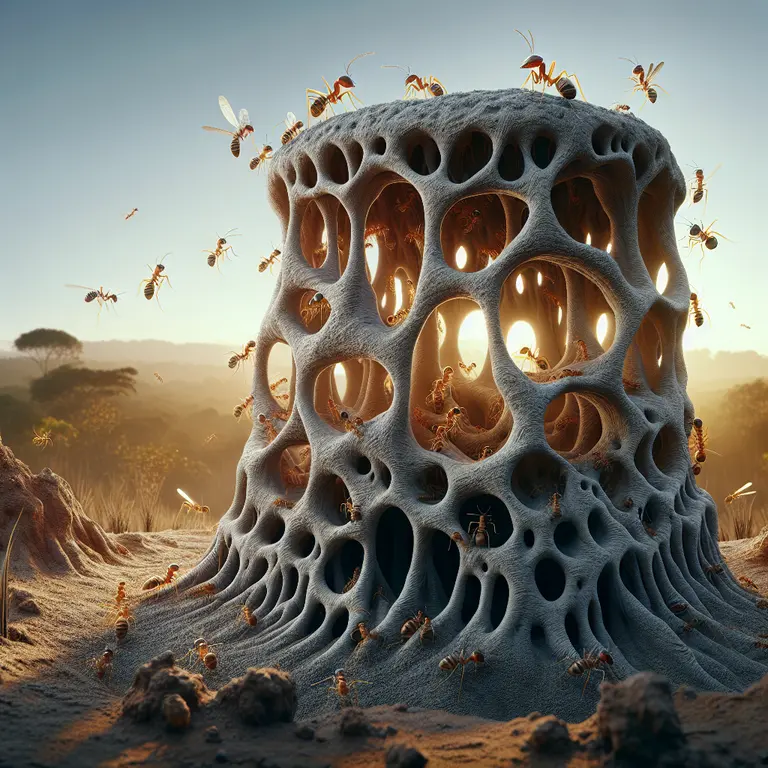
The mound’s ventilation system is the most celebrated product of this process. It operates through a combination of mechanisms working in passive concert. The central chimney creates convection currents as warm air rises from the colony below, drawing cooler air through peripheral channels. The mound’s thick walls create a thermal lag that drives rhythmic air circulation synchronized with the daily temperature cycle. Surface conduits harness external wind energy without requiring direct openings that would expose the colony to predators or weather. The resulting structure functions like a lung, breathing to regulate oxygen, carbon dioxide, and humidity levels without fans, pumps, or any moving parts other than the termites themselves. Research by Dr. J. Scott Turner of SUNY-ESF has revealed that this respiratory function is so efficient that it can completely exchange the air within a mound in approximately one hour, despite the absence of any direct openings to the outside environment. No human-designed passive ventilation system currently approaches this level of efficiency at a comparable scale.
The Material Science of Termite Engineering
Perhaps equally impressive is the material science behind termite construction, a dimension of their achievement that receives far less popular attention than the architectural drama of the mound’s exterior form. Worker termites create their building material by mixing soil particles with saliva and fecal matter to produce a composite substance that, when dried, exhibits properties that would be remarkable even in a laboratory setting. This termite concrete demonstrates compression strength approaching that of conventional manufactured concrete, with zero external energy input required for its production.
The material composition varies significantly by species and geographic location, reflecting a kind of localized material optimization that parallels the practices of traditional human builders who used whatever the landscape provided. Macrotermes bellicosus incorporates specific clay minerals that provide exceptional structural integrity under load. Desert-dwelling species incorporate silica particles to create glass-like strengthening elements within the matrix. These materials achieve extraordinary durability, surviving decades of torrential tropical rains, scorching heat, and even moderate seismic activity without catastrophic failure.
Recent X-ray tomographic analysis has revealed that termite mounds contain sophisticated microstructures optimized simultaneously for both strength and gas exchange, two properties that typically trade off in conventional materials. These microstructures feature variable porosity that balances structural integrity with permeability for gas diffusion, a design principle that materials scientists are now actively exploring for applications in energy-efficient building insulation and filtration membranes. The termite did not stumble upon this solution recently. It has been manufacturing this material for millions of years.
From Insect Colonies to Human Systems
This phenomenon has profound implications well beyond entomology. Computer scientists studying artificial intelligence and swarm robotics have drawn direct inspiration from termite construction behaviors, recognizing in stigmergy a model for solving coordination problems that have historically required centralized control. The principles of stigmergic coordination have begun influencing urban planning approaches that favor decentralized, adaptive development over rigid master plans. Software architects have explored how complex programs can self-organize through local rules rather than top-down design. Network theorists study termite colonies to improve resilience in electrical grids and communication infrastructure, seeking the same property that makes termite mounds so difficult to permanently damage: the absence of a single critical node whose failure collapses the whole.
The TERMES project at Harvard University demonstrated the practical potential of these ideas by creating small robots programmed with simple behavioral rules analogous to those guiding termites. These robots successfully constructed complex three-dimensional structures without any central coordination, direct communication between units, or access to a global plan. Each robot simply responded to the state of the structure it encountered, exactly as a termite does. The results were not perfect imitations of human construction, but they were coherent, functional, and achieved without any of the hierarchical management that human construction projects require.
In medicine, researchers are exploring how termite-inspired algorithms could help design drug-delivery systems that self-organize within the body, navigating complex biological environments without centralized direction. Even the architecture of certain cryptocurrency systems incorporates principles of decentralized consensus-building that parallel the construction methods of termites, achieving system-wide coherence through purely local interactions rather than a central authority.
The Philosophical Challenge
Perhaps most surprising is the philosophical challenge termites pose, one that extends far beyond their practical engineering applications. They create structures that appear intelligently designed without any central intelligence directing the process. The mound demonstrates how complex, seemingly purposeful systems can emerge from simple agents following basic rules, a natural example of what complexity theorists call emergence.
This challenges our intuitive understanding of design and purpose in ways that remain genuinely unsettling even after repeated exposure to the argument. When we observe something as intricate as a termite mound’s ventilation system, our minds naturally infer a designer who planned it. The inference feels almost involuntary. Yet termite mounds emerge through distributed processes with no central planner, no foresight, and no comprehension of the outcome. They are the product of evolution selecting for simple behavioral rules whose aggregate consequences happen to solve hard engineering problems.
Philosopher Daniel Dennett references termites in his discussions of intentionality and design, describing them as exemplars of competence without comprehension, achieving sophisticated outcomes without understanding what they are doing or why it works. Evolutionary biologist Richard Dawkins used the termite example in his book The Blind Watchmaker to illustrate how natural selection can produce designs that appear purposeful without requiring a purposeful designer.
Conclusion
Next time you see a skyscraper, consider what it actually represents: a solution to engineering problems that required centuries of accumulated human knowledge, written language to preserve that knowledge, mathematical tools to formalize it, and institutional structures to organize its application. Termites solved comparable problems without any of these things, using only the residue of pheromones and the evolving shape of the structure around them.
Millions of years before humans drew their first blueprint, tiny insects were building climate-controlled, structurally sophisticated, materially optimized structures through the power of emergent complexity. The termite stands as nature’s most persistent reminder that intelligence and design can manifest in forms radically different from our own, and that the boundary between simple and complex, between mindless and purposeful, may be far less fixed than we have always assumed.