
Victorian Mummy Unwrapping: Entertainment and Exploitation
How Victorian elites turned Egyptian mummy unwrappings into fashionable social events complete with souvenirs and refreshments
 Watch on YouTube
 Watch on Rumble
The Morbid Victorian Soirée You Weren’t Invited To
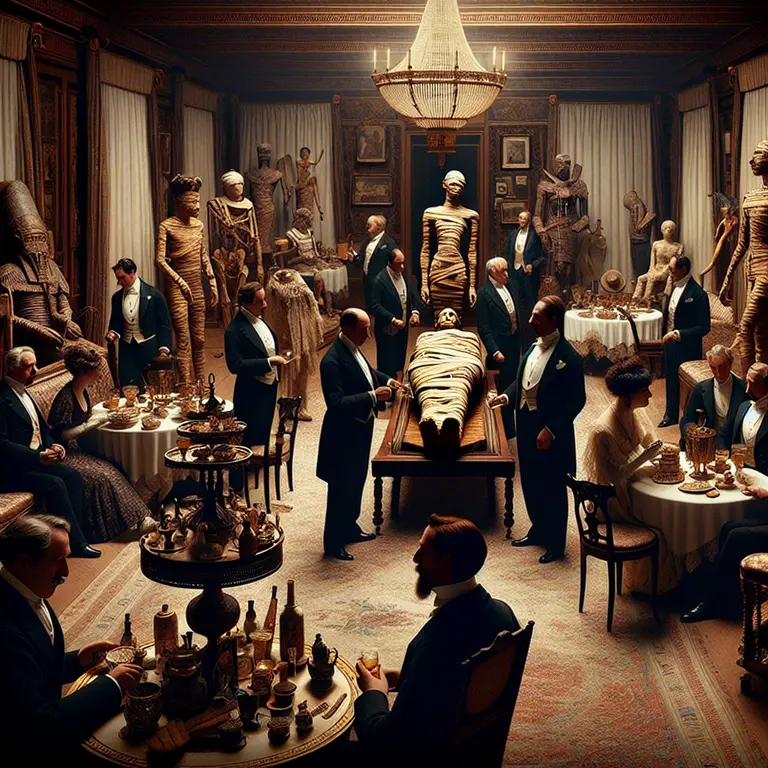
In the 1830s-1860s, wealthy Victorians hosted what might be the most macabre dinner parties in history: mummy unwrapping events where guests gathered to watch an ancient Egyptian corpse being methodically undressed layer by layer as entertainment.
These weren’t clandestine affairs but high-society gatherings where invitations were coveted social currency. The events typically began with lectures on Egyptian history before the main attraction: the systematic unwrapping of a 2,000+-year-old mummy, often accompanied by refreshments.
Victorian Egyptomania: Context and Origins
The British fascination with Egypt didn’t materialize from thin air. Napoleon’s Egyptian campaign (1798-1801) had unleashed a wave of “Egyptomania” across Europe. The discovery of the Rosetta Stone during this period and its subsequent decipherment by Jean-François Champollion in 1822 opened the floodgates to understanding hieroglyphics and ancient Egyptian culture. By the 1830s, Egyptian antiquities were streaming into European museums and private collections at an unprecedented rate.
Victorian England, at the height of its empire, developed a particular obsession with Egypt. The ancient civilization represented everything the industrializing British aspired to: monumental architecture, sophisticated culture, and most importantly, a preoccupation with death and the afterlife that resonated with Victorian sensibilities. In an era when Queen Victoria’s decades-long mourning for Prince Albert would set the tone for elaborate death rituals, the Egyptian approach to mortality held special fascination.
The unwrapping parties emerged at this intersection of scientific curiosity, imperial acquisition, and the Victorian death culture. These events satisfied both intellectual pretensions and morbid curiosity, wrapped in the respectable veneer of scientific inquiry. For the social climbers of Victorian England, hosting or attending such an event signaled one’s cultural sophistication and wealth – after all, not everyone could afford to purchase and destroy an ancient human corpse for an evening’s entertainment.
The Science-Entertainment Complex
Surgeon Thomas Pettigrew became the premier mummy unwrapper of the era, performing over 40 such public demonstrations. He charged admission, published findings, and developed techniques that ironically advanced archaeological methods while simultaneously destroying irreplaceable artifacts.
Pettigrew, nicknamed “Mummy Pettigrew,” brought theatrical flair to his unwrappings. He would begin with scholarly lectures on Egyptian burial practices before proceeding to the main event. His background as a surgeon gave his performances medical authority, as he would often comment on the physical characteristics and possible causes of death while methodically removing bandages. His 1834 book, “A History of Egyptian Mummies,” established him as the foremost authority on the subject and helped legitimize what might otherwise have been seen as mere spectacle.
The scientific community’s relationship with these events was complicated. On one hand, genuine discoveries were occasionally made during unwrappings. The identification of various preservation techniques, the documentation of amulets and their placement, and observations about Egyptian funerary practices did advance knowledge. Giovanni Belzoni, an Italian explorer and former circus strongman, conducted several public unwrappings that yielded important archaeological information about burial practices.
What’s particularly shocking by modern standards is the casual souvenir culture that surrounded these events. Attendees frequently received pieces of the mummy wrappings as keepsakes—sometimes containing actual human remains. Some hosts distributed mummy fragments in custom-made party favors. The novelist Louisa May Alcott, visiting Europe from America, described receiving “a bit of a bandage” at one such event, which she kept as a treasured memento.
The Economic Exploitation Chain
This Victorian fascination created a bizarre supply chain. In Egypt, local grave robbers intensified tomb raiding to meet European demand. Mummies became so commercially valuable that some were ground into powder and sold as “Mummia”—a supposed medicinal cure-all in Europe. The demand was so high that counterfeit mummies were manufactured using recently deceased bodies.
The economics of mummy acquisition revealed the darker aspects of colonial exploitation. By the 1830s, a thriving black market existed where Egyptian mummies could be purchased for transport to Europe. Prices varied wildly depending on the perceived quality and completeness of the specimen. A well-preserved mummy with intact wrappings and a decorative sarcophagus could command premium prices from wealthy collectors or institutions.
Local Egyptian workers, desperately poor under Ottoman rule, turned to tomb raiding as a lucrative profession. European buyers rarely questioned the provenance of their purchases, creating a system where ancient burial grounds were systematically looted. Some areas, like the necropolis at Thebes, were so thoroughly pillaged that archaeologists today still struggle to reconstruct the original contents of many tombs.
The mummy trade extended beyond unwrapping parties. “Mummia,” the powdered remains of mummies, had been used in European medicine since the 12th century, believed to cure everything from bruises to epilepsy. By the Victorian era, this practice had mostly fallen out of medical favor but continued as folk medicine. More disturbing was the industrial use of mummies – some were purchased in bulk by paper manufacturers who used the wrappings to make paper, while others were burned as locomotive fuel on Egyptian railways due to local wood scarcity.
Cultural Legacy and Ethical Reckonings
The phenomenon represents a strange intersection of early archaeology, colonialism, and entertainment. While today we recognize the profound ethical problems with treating human remains as curiosities, these events paradoxically contributed to the development of Egyptology as a discipline. Many observations made during these public spectacles were recorded and published, creating some of the first systematic studies of mummification techniques.
Perhaps most surprising is how this practice reflected class dynamics: what began as scientific inquiry became fashionable entertainment for the elite, then eventually trickled down to become public spectacles for the masses. By the 1890s, street vendors were unwrapping mummies for crowds, charging a few pennies per person.
The unwrapping craze began to wane toward the end of the 19th century as archaeological methods became more scientific and preservationist. Flinders Petrie, considered the father of modern scientific archaeology, strongly opposed destructive practices such as unwrapping. The establishment of formal archaeological societies and regulations in Egypt also curtailed the easy export of antiquities that had fueled the unwrapping parties.
This Victorian fascination with mummy unwrapping connects unexpectedly to modern medical imaging development—today’s non-invasive CT scanning of mummies evolved as a direct ethical response to the destructive practices of these unwrapping parties. Modern Egyptologists use advanced imaging techniques to “virtually unwrap” mummies, revealing their secrets without disturbing the remains.
Conclusion: Reflections on a Peculiar Practice
The mummy unwrapping parties of Victorian England stand as a testament to how cultural attitudes toward death, scientific inquiry, and the ethics of handling human remains have evolved. What was once considered sophisticated entertainment would today be viewed as desecration and cultural theft.
Yet these events also reveal the complex ways in which scientific advancement can occur even through ethically questionable practices. The detailed observations recorded at these events provided valuable information about ancient Egyptian burial practices that might otherwise have been lost. The subsequent ethical backlash against unwrapping helped establish principles of archaeological conservation that guide the field today.
As we look back on these macabre soirées, we’re reminded of how thin the line between scientific inquiry and exploitation can be, especially when viewed through the lens of imperial power dynamics. The mummies, once people with names and lives in ancient Egypt, became commodities in a colonial economy before finally regaining their dignity as subjects of respectful study in modern museums and research facilities.