
Orchids: Pioneers of Fungiculture Millions of Years Ago
A species of orchid cultivates its own fungal gardens in a sophisticated agricultural relationship that predates human farming by millions of years.
 Watch on YouTube
 Watch on Rumble
The World’s First Farmers Weren’t Human
When we think about the dawn of agriculture, we typically imagine early human settlements in the Fertile Crescent about 12,000 years ago. But it turns out humans were extremely late to the farming game. The Cypripedium californicum orchid—commonly known as the California lady’s slipper—has been practicing a sophisticated form of agriculture for millions of years. This remarkable orchid engages in a behavior called “fungiculture”—the deliberate cultivation of fungi. Unlike most plants that simply form symbiotic relationships with fungi, this orchid actively manages its fungal partners in a way that eerily resembles human agricultural practices. This discovery not only challenges our anthropocentric view of agriculture as a uniquely human innovation but also forces us to reconsider our understanding of plant intelligence and the very definition of agriculture itself.
How Orchid Agriculture Works
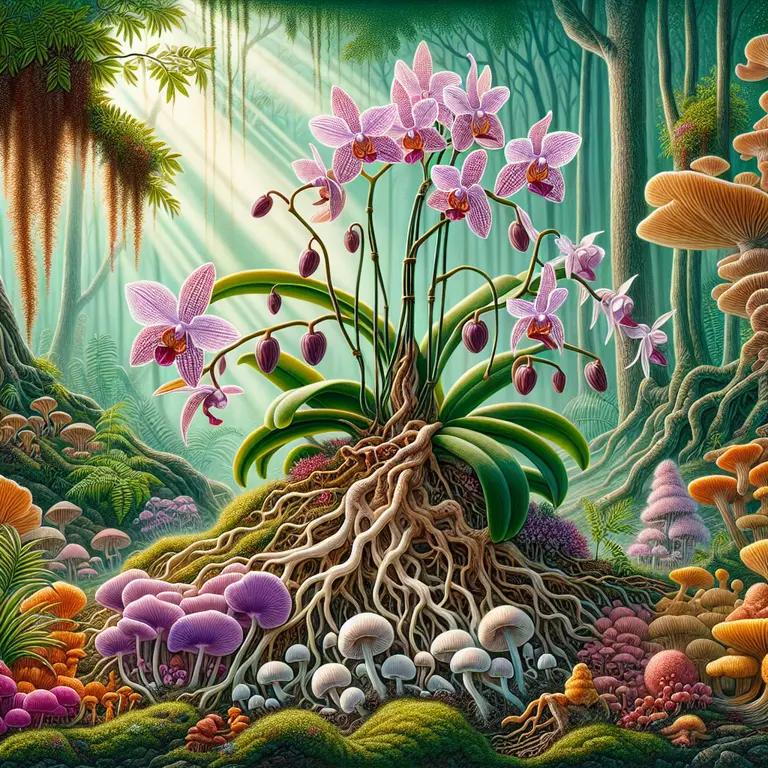
The California lady’s slipper creates specialized underground structures that serve as “fungal farms.” These structures are not merely passive habitats but carefully constructed environments in which the orchid exerts remarkable control over its fungal partners. Within these underground farms, the orchid selectively cultivates specific fungal strains, particularly those of the genus Rhizoctonia. This selectivity demonstrates a level of discrimination that goes beyond random symbiosis.
The orchid provides carbohydrates as “fertilizer” for the fungi, allocating photosynthetic products specifically for fungal consumption. This resource allocation represents an investment, as the plant dedicates energy to maintaining its fungal crops. In return, the orchid harvests nutrients, particularly phosphorus and nitrogen, that the fungi extract from the soil. These elements are often limiting factors in plant growth, and the fungi can access forms of these nutrients that would otherwise be unavailable to the plant.
Perhaps most impressive is how the orchid maintains optimal environmental conditions for fungal growth. It regulates moisture levels and chemical composition within its root structures, creating a microenvironment that promotes fungal proliferation. Additionally, the orchid employs chemical defenses to prevent pathogenic organisms from invading its fungal gardens, essentially implementing a form of pest management.
What makes this relationship truly agricultural rather than merely symbiotic is the orchid’s active management. It doesn’t just coexist with fungi—it deliberately cultivates them, controls their growth conditions, and harvests their products in a systematic way. The relationship has evolved far beyond mutual benefit into a specialized cultivation system that mirrors human agricultural practices in its fundamental structure.
The Evolutionary Twist
The agricultural relationship between the California lady’s slipper and its fungal partners represents a fascinating evolutionary reversal. Most orchids begin life as parasites on fungi, stealing nutrients until they develop photosynthetic capabilities. This initial parasitism, known as mycoheterotrophy, is common in the Orchidaceae, with young orchid seedlings depending entirely on fungi for carbon and other essential nutrients.
However, the California lady’s slipper evolved from these parasitic ancestors into something resembling a farmer—a transition that mirrors how human hunter-gatherers eventually became agricultural societies. This evolutionary trajectory suggests a shift from exploitation to cultivation, a pattern that has occurred independently in multiple lineages across the tree of life.
Molecular clock analyses suggest that this agricultural relationship began to develop between 20 and 40 million years ago, during the late Eocene or early Oligocene epochs. This places orchid agriculture roughly 2,000 times older than human agriculture, which emerged a mere 12,000 years ago. The longevity of this relationship has enabled sophisticated coevolutionary adaptations that fine-tune the agricultural system, including specialized signaling molecules that coordinate activities between the plant and fungus.
This evolutionary history challenges our understanding of agricultural innovation, suggesting that the fundamental concept of cultivation for resource production has been “discovered” multiple times, long before humans existed.
Agricultural Parallels Across Species
The discovery of fungiculture in orchids places them in an elite group of non-human agriculturalists. Agricultural behaviors have evolved independently in several biological lineages, creating fascinating parallels to human farming practices.
Leaf-cutter ants (Atta and Acromyrmex genera) maintain extensive underground fungal gardens, feeding them with harvested plant material and protecting them from pathogens with antibiotic secretions. Their agricultural system is so developed that different ant castes perform specialized roles in the farming process, much like human agricultural societies developed specialized labor.
In marine environments, damselfish farm algae patches on coral reefs, actively weeding out undesirable algal species and defending their plots against grazing by other fish. These underwater farmers have been observed to cultivate specific algal compositions that maximize nutritional returns, showing remarkable parallels to human crop selection.
Ambrosia beetles bore into trees and inoculate the tunnels with specific fungal spores they carry in specialized structures. They then tend these fungal gardens, which break down wood tissue into digestible nutrients. Some species have even evolved mechanisms to prevent contamination by competing fungi, effectively providing a form of crop protection.
But the orchid’s approach is particularly sophisticated, involving complex biochemical signaling and resource management that conceptually rivals human farming techniques, if not in scale. Unlike the insects mentioned above, orchids lack mobility and centralized nervous systems, making their agricultural adaptations all the more remarkable. They must accomplish all aspects of fungal cultivation through chemical signals and specialized tissue structures, demonstrating that agriculture doesn’t necessarily require physical manipulation or centralized decision-making.
Implications for Understanding Plant Intelligence
The agricultural behavior of the California lady’s slipper challenges conventional notions of plant intelligence and agency. While plants lack brains and nervous systems as we understand them, they’ve evolved complex biochemical and structural systems to manipulate other organisms—suggesting that agriculture doesn’t necessarily require consciousness or intentionality as we typically define them, but rather can emerge through evolutionary processes alone.
Plants employ sophisticated communication networks, using hormonal signals, volatile compounds, and even underground fungal networks (often called the “wood wide web”) to share information and resources. The orchid’s agricultural relationship represents an advanced application of these communication systems, where chemical signals coordinate a complex interspecies relationship.
Some researchers in the emerging field of plant neurobiology suggest we reconsider our definitions of intelligence to acknowledge plants' sophisticated problem-solving capabilities. While not conscious in the human sense, plants demonstrate adaptive behaviors, memory, learning, and complex responses to environmental challenges. The agricultural relationship between orchids and fungi exemplifies this sophisticated plant behavior, showing how selection pressures can produce systems that functionally resemble intentional cultivation without requiring human-like consciousness.
Conclusion
The agricultural relationship between the California lady’s slipper orchid and its fungal partners offers a profound shift in perspective on what we consider uniquely human innovations. Agriculture, it seems, is not a human invention but a strategy that has emerged multiple times throughout evolutionary history. This discovery invites us to reconsider our place in the natural world and to appreciate the sophisticated adaptations that surround us.
Perhaps most importantly, understanding non-human agriculture broadens our conception of intelligence and adaptation. Complex behaviors need not arise from brains or consciousness as we understand them—they can emerge through the elegant processes of natural selection acting over millions of years. The next time you walk past an unassuming orchid, remember you might be in the presence of a farming civilization millions of years older than our own, quietly cultivating its fungal partners through a sophisticated agricultural system that predates human existence by eons.