
Unraveling the Enigma of Mysterious Lunar Light Phenomena
For centuries, astronomers have documented strange, fleeting flashes and colorful glows on the Moon's surface that science still struggles to explain.
 Watch on YouTube
 Watch on Rumble
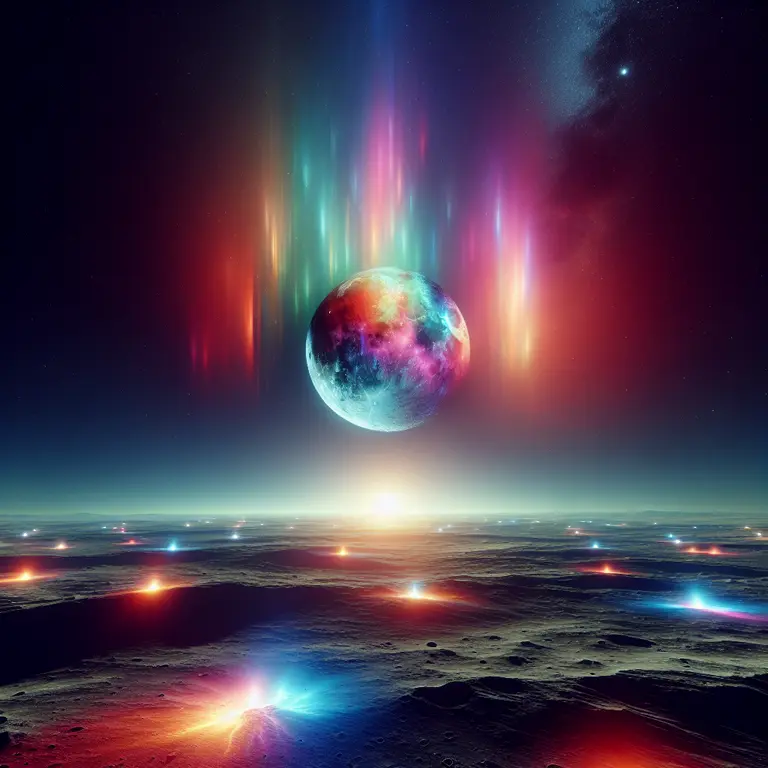
The Moon hangs in our night sky as a familiar companion, its cratered face essentially unchanged for billions of years. Yet beneath this apparent constancy lies an enigma that continues to baffle astronomers. Imagine staring at the Moon through a telescope when suddenly a bright red flash appears on its surface, glows for several minutes, then vanishes without a trace. You might assume you’ve witnessed a meteor impact or experienced an optical illusion. But you may have actually observed what astronomers call a “Transient Lunar Phenomenon” (TLP) – mysterious, short-lived changes in the Moon’s appearance that have baffled scientists for centuries.
These phenomena include temporary colorations (often reddish or bluish), unusual brightenings, haziness, and even geometric shapes that appear and disappear within hours or minutes. What makes TLPs so perplexing is that the Moon is supposed to be geologically dead – yet these events suggest something active is occurring on our seemingly dormant satellite.
A Long History of Lunar Mysteries
The first recorded TLP dates back to 1178 when five monks in Canterbury, England, reported seeing a “flaming torch” on the crescent Moon. Since then, over 2,600 TLP events have been documented by professional and amateur astronomers alike. The respected astronomer Sir William Herschel reported a “bright red spot” on the dark portion of the Moon in 1783. Even NASA’s Apollo missions encountered unexplained phenomena – during Apollo 11, astronauts reported unusual flashes in their vision while orbiting the Moon, potentially related to TLPs.
What’s particularly strange is that these events often cluster in specific regions of the lunar surface, especially around the Aristarchus crater, which accounts for about one-third of all reported TLPs. The Aristarchus plateau is already unusual for its high reflectivity and geological features that suggest past volcanic activity. Other hotspots include the craters Plato, Tycho, and Kepler, along with the Schröter Valley – a winding valley near Aristarchus.
During the Cold War, both American and Soviet lunar observers documented numerous TLPs. In October 1963, astronomers at the Lowell Observatory witnessed a reddish glow in the Aristarchus region that lasted for about an hour. The Soviet astronomer Nikolai Kozyrev even captured spectroscopic evidence of what appeared to be gas emissions from the crater Alphonsus in 1958, one of the few instances where instrumental data supported visual observations of a TLP.
The historical record of these events is complicated by changes in terminology over time. What we now call TLPs have historically been described as “lunar volcanoes,” “lunar meteors,” or simply “lunar anomalies.” This linguistic evolution reflects changing scientific understanding about what might be possible on the lunar surface.
The Scientific Puzzle
Despite centuries of observations, scientists still debate what causes these phenomena. The leading theories include:
Outgassing from the lunar interior – Pockets of gas occasionally escaping through lunar fissures, catching sunlight in ways that create colorful displays
Electrostatic levitation of lunar dust – The charged lunar surface might temporarily suspend dust particles, creating unusual optical effects
Impact events – Small meteorites striking the Moon’s surface
Solar wind interactions – Charged particles from the Sun interacting with the lunar surface in unexpected ways
Piezoelectric effects – Pressure changes in lunar rocks generating electrical discharges
What makes this mystery particularly compelling is its intersection with multiple scientific fields. Geologists are interested because TLPs might indicate the Moon isn’t as geologically inactive as previously thought. Plasma physicists study them to gain insights into the behavior of charged particles in vacuum environments. Even astrobiologists have taken an interest, as some theories suggest certain TLPs could involve volatile compounds – potentially relevant to questions about the Moon’s formation and composition.
The outgassing theory has gained particular traction following the discovery of trace amounts of water and hydroxyl molecules on the lunar surface by India’s Chandrayaan-1 mission in 2009. If subsurface water or other volatiles exist in greater quantities than previously thought, their occasional release could explain some TLP observations. NASA’s Lunar Reconnaissance Orbiter has identified over 150 sites showing evidence of relatively recent geological activity, lending credence to the idea that the Moon might not be entirely “dead.”
The Verification Challenge
Perhaps the most frustrating aspect of TLPs is their transient nature. By the time one astronomer alerts others to a sighting, the phenomenon has often disappeared. This has led many in the scientific community to question whether TLPs are real or merely optical illusions, equipment malfunctions, or atmospheric effects on Earth.
However, the consistency of reports across centuries, cultures, and observational technologies suggests something genuine is occurring. Modern automated lunar monitoring systems are now being deployed specifically to catch these elusive events in the act.
One such project is the Lunar Monitoring Program at Columbia University, which uses automated telescopes to observe the Moon’s surface continuously. The Association of Lunar and Planetary Observers (ALPO) maintains a dedicated TLP observing program that coordinates amateur observations worldwide. The European Space Agency has also expressed interest in establishing a network of robotic telescopes specifically designed to detect and analyze TLPs.
The verification challenge is compounded by the fact that different types of TLPs may have various causes. A reddish glow might result from radon gas emissions, while an electrostatic dust levitation event could cause a localized brightening. This multiplicity of potential mechanisms makes it particularly difficult to create a unified theory.
Modern Investigations and Future Prospects
Recent advancements in imaging technology have brought new tools to the study of TLPs. High-resolution cameras, spectroscopic analysis, and infrared observations enable more detailed documentation when events occur. Citizen science has also played an increasingly important role, with amateur astronomers around the world contributing valuable observations through coordinated networks.
In 2007, observers using the 10-inch Newtonian telescope at Aberystwyth University in Wales captured what appeared to be a TLP near the crater Aristarchus. The observation was particularly valuable because it was confirmed by multiple observers and recorded using modern imaging equipment. Spectral analysis suggested the presence of radon-222, a radioactive gas that could be released through subsurface fissures.
The LADEE (Lunar Atmosphere and Dust Environment Explorer) mission, which orbited the Moon from 2013 to 2014, provided valuable data on the Moon's thin exosphere and dust environment. While it didn’t directly observe TLPs, its findings on lunar dust behavior support theories that electrostatic levitation could explain some of the observed phenomena.
Looking ahead, NASA’s Artemis program and planned lunar bases could revolutionize our understanding of TLPs. Having human observers on the lunar surface would allow for immediate investigation of these phenomena as they occur. Instruments could be rapidly deployed to areas of recent activity, potentially solving a mystery that has persisted for centuries.
Conclusion
The Moon – our closest celestial neighbor, one we’ve literally walked upon – continues to exhibit behaviors we cannot fully explain, challenging our understanding of what should be one of our most thoroughly studied astronomical bodies. The persistence of Transient Lunar Phenomena reminds us that even the most familiar cosmic objects can harbor secrets.
As we prepare to return to the Moon in the coming decade, these mysterious light shows represent not just a puzzling astronomical curiosity but an opportunity to deepen our understanding of lunar geology, physics, and perhaps even the Moon’s evolutionary history. Whether TLPs are primarily caused by outgassing, dust movement, or some combination of factors not yet considered, solving this centuries-old mystery will likely yield insights that extend far beyond the phenomena themselves.
In an age when we routinely photograph distant galaxies and detect exoplanets around faraway stars, it’s humbling to acknowledge that our own Moon still manages to surprise us with its fleeting light shows – ephemeral reminders of how much we still have to learn about our cosmic neighborhood.