
Mind Control in Nature: The Parasitic Wasps of Ladybugs
A parasitic bacterium that transforms ladybugs into zombie bodyguards for its offspring
 Watch on YouTube
 Watch on Rumble
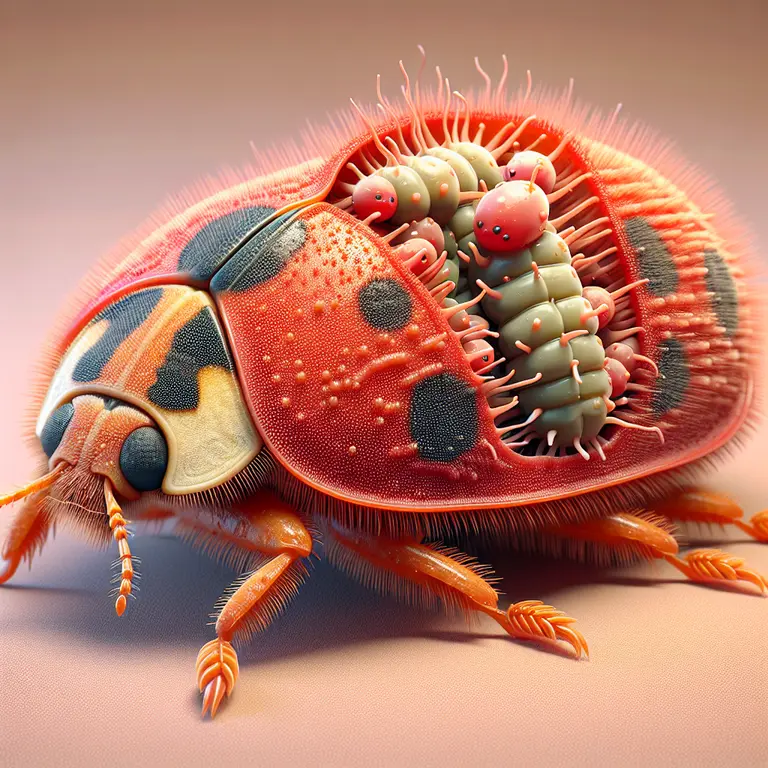
In the seemingly innocent world of garden ladybugs lurks a biological horror story that would make science fiction writers envious: a parasitic wasp called Dinocampus coccinellae that performs one of nature’s most sophisticated hijackings of another organism’s body. This remarkable example of parasitism showcases evolution’s capacity to produce relationships so intricate and disturbing that they challenge our understanding of biological autonomy. The ladybug—beloved by gardeners and symbol of good luck in many cultures—becomes an unwitting participant in a macabre puppet show, its body and behavior manipulated with precision by microscopic invaders.
The Invasion Begins: A Two-Pronged Attack
The parasitoid wasp’s strategy begins with a calculated assault. Female D. coccinellae wasps target adult ladybugs, particularly from the Coccinellidae family, approaching them with seeming innocence before launching a lightning-fast attack. Using a specialized ovipositor—a tube-like organ evolved specifically for egg-laying—the wasp pierces the ladybug’s exoskeleton and deposits a single egg into the host’s body cavity. But the egg doesn’t arrive alone.
Alongside this embryonic invader comes a biological weapon: a unique RNA virus known as Dinocampus coccinellae paralysis virus (DcPV). This viral accomplice represents one of the most sophisticated examples of symbiosis in the natural world. The wasp and the virus have evolved a mutualistic relationship in which both benefit at the ladybug’s expense. The virus doesn’t replicate within the wasp, only activating once inside the ladybug host—a remarkable example of evolutionary synchronization between two entirely different types of organisms.
Once deposited, the egg hatches into a larva that begins feeding on the ladybug’s internal tissues. Remarkably, the larva consumes non-vital tissues first, carefully avoiding organs essential for the host’s survival. This selective parasitism allows the ladybug to remain alive and mobile during the initial parasitic phase, continuing its regular feeding and movement while harboring its growing invader.
The Emergence and the Zombie Phase
After approximately 20 days of internal development, the parasitoid larva is ready for the next phase of its life cycle. Rather than killing its host outright—as many parasites would—it initiates a carefully choreographed exit strategy. The mature larva emerges from the ladybug’s abdomen, breaking through the exoskeleton in a process that would usually be fatal to an insect. Yet the ladybug survives.
This is where the true horror—and scientific wonder—of the relationship manifests. Following the larva’s emergence, the ladybug enters what researchers call a “zombie-like state.” The insect becomes paralyzed but remains alive, its legs splayed in an unnatural position. The DcPV virus, having multiplied within the host, concentrates in the ladybug’s brain and central nervous system, causing this selective paralysis.
The wasp larva, now external to its host, spins a cocoon between the ladybug’s legs. The positioning is not random—it places the cocoon directly under the ladybug’s body, using the host as a protective canopy. The immobilized beetle, though largely paralyzed, retains just enough motor function to exhibit occasional twitching movements. These movements aren’t random spasms but appear to serve a specific defensive purpose.
Research published in the journal Biology Letters revealed the evolutionary advantage of this arrangement: ladybug “bodyguards” increase larval survival by approximately 40% compared to wasp cocoons without such protection. The twitching movements specifically deter predators, such as ants and other small arthropods, that might otherwise consume the vulnerable developing wasp.
The Neurological Hijacking: Mechanisms of Control
What makes this system particularly fascinating to neurobiologists is the mechanism behind the mind control. Unlike some parasites that directly infiltrate and manipulate specific neural pathways, the D. coccinellae system employs a more sophisticated approach through its viral partner.
The DcPV virus acts as a biological neurotoxin with extraordinary specificity. It targets specific motor neurons while leaving others functional, resulting in paralysis that immobilizes the ladybug while preserving vital functions such as respiration. The virus accumulates in the ladybug’s brain, particularly in regions controlling locomotion, but deliberately avoids areas controlling basic life support systems.
Electron microscopy studies have revealed densely packed viral particles in the cerebral ganglia of parasitized ladybugs. This concentration correlates directly with behavioral changes, suggesting a dose-dependent relationship between viral load and the degree of behavioral manipulation. More remarkably, the virus appears to induce specific changes to neurotransmitter systems, particularly those involving dopamine and octopamine (an invertebrate analog of norepinephrine), which control movement and arousal.
This targeted approach represents an evolutionary refinement far more sophisticated than crude toxicity. The parasite benefits not from killing its host but from reprogramming it into a living shield with just enough functionality to perform its new protective role.
Recovery and Evolutionary Game Theory
Perhaps the most surprising aspect of this parasitic relationship, and one that puzzled entomologists for years, is that approximately 25% of “zombie” ladybugs actually recover after the wasp emerges from its cocoon. This recovery challenges conventional understanding of host-parasite relationships, which typically end in host death or permanent impairment.
This unexpected survival rate represents what evolutionary biologists call an evolutionary stable strategy (ESS)—a balance point where the parasite extracts maximum benefit while imposing just enough cost on the host population to avoid driving it to extinction. By allowing some hosts to recover, the parasite ensures the continued existence of its target species.
The recovery process itself remains incompletely understood but appears to involve the ladybug’s immune system gradually clearing viral particles from neural tissues. Recovered ladybugs show reduced fertility but can resume regular feeding and movement patterns. Some evidence suggests they may even develop partial immunity to subsequent parasitism attempts, though they remain vulnerable to other wasp attacks.
This relationship exemplifies concepts from game theory in biology—specifically, the idea that parasites evolve to optimize resource extraction rather than maximize host damage. The wasp-virus partnership has developed a strategy that represents a sophisticated trade-off between virulence and host preservation.
Conclusion: Beyond Entomology
The relationship between Dinocampus coccinellae and ladybugs transcends simple parasitism, offering insights across multiple scientific disciplines. For virologists, it demonstrates how viruses can function as biological tools wielded by other organisms. For neuroscientists, it reveals mechanisms for targeted behavioral manipulation through specific neural pathways. For evolutionary biologists, it exemplifies the intricate co-evolutionary arms races that drive biological complexity.
This relationship also raises profound philosophical questions about biological autonomy. When a ladybug’s behavior is controlled by another organism’s genetic programming, where does one organism end and another begin? The boundaries between individual organisms blur in such relationships, challenging our conceptual frameworks for understanding biological identity.
The next time you spot a ladybug in your garden, consider that it might not be fully in control of its own body—it could be an unwilling participant in one of nature’s most macabre puppet shows, forced to sacrifice its autonomy to protect the very organism that invaded it. In this microscopic drama playing out on leaves and stems worldwide, we glimpse the unsettling sophistication of nature’s evolutionary experiments, where mind control is not science fiction but biological reality.