
The Poisonous Book That Could Kill Anyone Who Touched It
In the 1800s, Victorian-era book manufacturers created arsenic-laden 'Scheele's Green' books that could poison readers through skin contact.
 Watch on YouTube
 Watch on Rumble
The Deadly Pages of Victorian Literature
Imagine picking up a beautiful emerald-green book from your shelf, only to discover that simply turning its pages could slowly poison you. This isn’t fiction—it’s a forgotten hazard of Victorian-era publishing that combined chemistry, fashion, and tragic ignorance. The intersection of industrial innovation and aesthetic desires created a silent killer that lurked in the most unexpected place: the literary treasures of the educated classes. These toxic tomes represent one of history’s most peculiar public health hazards—where knowledge itself became physically dangerous to acquire.
The Toxic Allure of Scheele’s Green
In the 1800s, a vibrant pigment called “Scheele’s Green” (copper arsenite) became wildly popular in Victorian manufacturing. This arsenic-based compound, discovered in 1775 by Swedish chemist Carl Wilhelm Scheele, produced a brilliant green hue that consumers adored. Before its development, truly vibrant greens were difficult and expensive to produce, making Scheele’s innovation revolutionary for decorative arts and manufacturing.
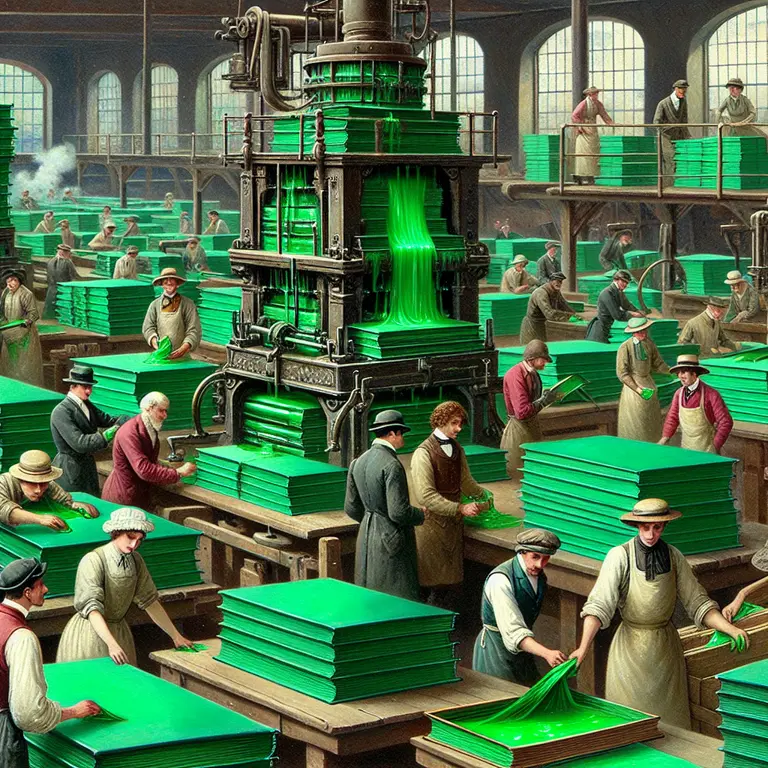
Book publishers, eager to create visually striking volumes in an increasingly competitive market, began using this pigment to color book covers, endpapers, and even to tint the edges of pages. The Victorian era coincided with significant developments in mass publishing, creating a perfect storm where aesthetic innovation outpaced safety considerations. Publishers like Routledge, Chapman & Hall, and even academic presses adopted these vibrant greens to make their editions stand out in bookshops and private libraries.
What readers didn’t know: these books were deadly. The arsenic compound would shed microscopic particles whenever the books were handled. These particles could be absorbed through the skin or inadvertently ingested when readers licked their fingers to turn pages—a common practice at the time. The arsenical dust would accumulate on readers’ hands, under fingernails, and could be transferred to food or directly into the body through mucous membranes. A particularly avid reader might unknowingly expose themselves to significant arsenic doses over years of literary pursuit.
The irony wasn’t lost on later historians: books, the very vessels of enlightenment and progress, had become vectors for poisoning. The most educated Victorians—those with extensive private libraries—were often the most at risk from this hidden danger.
Scientific Detection and Modern Discovery
In 2019, researchers at the University of Southern Denmark made a startling discovery while examining books from the 16th-19th centuries. Using X-ray fluorescence spectroscopy, they identified several books with dangerously high arsenic concentrations—high enough that handling them required protective gloves. The project, led by Professor Kaare Lund Rasmussen, began as a study of medieval manuscript pigments but expanded when researchers noticed unusual readings from certain Victorian volumes.
Three books in particular contained such toxic levels of arsenic that they were quarantined in special sealed containers. Scientists estimated that a child handling one of these books for less than an hour could receive a potentially lethal dose. The most contaminated volume, a collection of German poetry from 1853, had arsenic concentrations exceeding 400 mg/kg in its emerald-green covers.
The discovery process itself was fascinating. Initial scans showed anomalous readings, but researchers initially suspected contamination of their equipment. Only after repeated testing did they realize they were observing one of the most concentrated arsenic sources ever found in a consumer product. The books had effectively preserved their toxic content for over 150 years, waiting to be rediscovered by modern science.
This research has prompted major libraries worldwide, including the British Library and the Library of Congress, to review their collections for potentially toxic volumes. Many institutions have now implemented special handling protocols for books with characteristic bright green bindings or page edges from this period. Conservators have developed specialized methods to stabilize these books without destroying their historical integrity—a challenging balance between preservation and safety.
The Wider Poisonous Environment
The toxic book phenomenon connects to a broader Victorian arsenic crisis. The same Scheele’s Green was used in numerous everyday products, creating what environmental historians now call “the arsenic century.” This poisonous pigment appeared in:
Wallpaper, which could release arsenic-containing dust and, more dangerously, could convert to trimethylarsine gas in damp conditions through the action of certain molds. The famous case of Napoleon Bonaparte’s potential arsenic poisoning has been linked by some researchers to the green wallpaper in his exile residence on St. Helena.
Children’s toys and candies often contained arsenic-based colorants. Victorian children might play with toxic toy soldiers or consume sweets with arsenical dyes. Educational materials, including illustrated children’s books, sometimes contained these same dangerous pigments—creating the disturbing scenario where learning materials themselves posed physical dangers.
Clothing, particularly women’s dresses, frequently used arsenical dyes. A fashionable ball gown might contain up to 60 grams of arsenic. These dresses would release toxic dust as they moved, poisoning both the wearer and those nearby. Multiple documented cases exist of dancers and socialites who fell ill after wearing such garments in hot, crowded rooms.
Artificial flower decorations handled by factory workers created some of the most severe occupational arsenic exposures of the era. Young women working in artificial flower workshops often developed characteristic arsenic poisoning symptoms, including distinctive lesions on their hands, neck, and face, cruelly undermining their health while they created beauty for others.
This created a bizarre situation where a Victorian home’s entire aesthetic environment—from books to walls to clothing—formed an interconnected web of poison. A middle-class Victorian might unwittingly surround themselves with arsenic in virtually every aspect of their domestic life.
The Historical Blind Spot
What makes this particularly surprising is that, despite their scientific progress, the Victorians remained willfully ignorant of these dangers even as evidence mounted. Arsenic poisoning symptoms (including skin lesions, hair loss, and cognitive impairment) were often misdiagnosed as common illnesses or “women’s hysteria.”
Several prominent physicians did attempt to raise the alarm. In 1862, Dr. Arthur Hill Hassall published research demonstrating the dangers of arsenical wallpapers. Chemist Robert Kedzie even produced a book of arsenical wallpaper samples in 1874 titled “Shadows from the Walls of Death” to educate the public—ironically creating another potentially toxic book. Despite these warnings, manufacturers continued producing arsenical goods, often dismissing health concerns as unscientific or exaggerated.
The economic interests behind arsenic production were substantial. Mining operations in Cornwall, Devon, and elsewhere produced significant quantities of arsenic as a byproduct of tin and copper extraction. Finding commercial applications for this arsenic became a profitable venture, creating powerful industrial lobbies resistant to regulation.
The Legacy of Toxic Knowledge
The book poisonings represent an intersection of multiple fields: chemistry, public health, literary history, and industrial design. They remind us that everyday objects can harbor hidden dangers—and that the everyday items we use today might contain hazards future generations will find equally shocking.
Modern parallels exist in concerns over chemicals in consumer products, from BPA in plastics to flame retardants in furniture. The Victorian arsenic story serves as a cautionary tale about how innovations can outpace safety evaluations and how consumer demand for aesthetic qualities can override health considerations.
For book collectors and librarians, this history has practical implications. Institutions like the Winterthur Museum now offer guidelines for identifying potentially toxic historic books. The characteristic emerald green of arsenical pigments, often found on book edges or cover designs from 1820-1900, serves as a warning sign for cautious handling.
Next time you handle an antique book with vibrant green coloring from this era, you might want to wear gloves. That beautiful emerald hue could be hiding a deadly secret that’s been waiting on your shelf for over a century—a reminder that knowledge itself once came with physical risks that went far beyond the dangerous ideas contained within a book’s pages.