
The Sun's Rays Trap Earthly Hydrogen in a 'Geocorona'
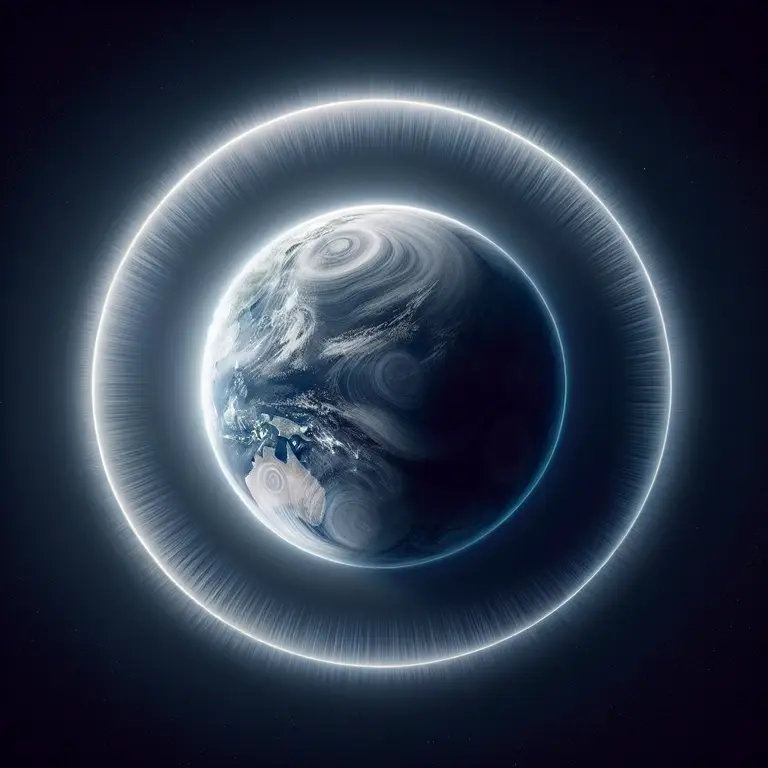
Earth has a hydrogen atmosphere extending 50,000 miles into space, visible only from the Moon.
 Watch on YouTube
 Watch on Rumble
Imagine standing on the Moon during the Apollo missions and looking back at Earth. If you had the right equipment, you would see something NASA astronauts glimpsed, but few people know about: our planet surrounded by an enormous glowing bubble extending nearly a quarter of the way to the Moon.
This isn’t science fiction—it’s a genuine but almost forgotten discovery about our own planet. While most of us think of Earth’s atmosphere as ending where the blue sky gives way to the blackness of space, our planet’s actual atmospheric boundary extends far beyond what conventional wisdom suggests. This hidden atmospheric layer represents one of Earth’s most overlooked features and challenges our understanding of where our planet truly ends.
The Hydrogen Envelope You Never Knew Existed
Earth is surrounded by an immense, skinny cloud of hydrogen atoms extending approximately 50,000 miles (80,000 kilometers) into space—that’s roughly 15-20 times the diameter of Earth itself. This bubble, called the “geocorona,” is essentially a second atmosphere made almost entirely of hydrogen that becomes increasingly diffuse the further it extends from Earth.
What makes this phenomenon particularly surprising is that hydrogen, being the lightest element, shouldn’t remain trapped by Earth’s gravity. The escape velocity for hydrogen at Earth’s surface temperature exceeds the average thermal velocity of hydrogen atoms. Yet there it is—a massive hydrogen envelope surrounding our planet.
The geocorona begins at the outer edge of what we traditionally consider our atmosphere, around 250 miles (400 kilometers) above Earth’s surface. At this altitude, the atmosphere is already fragile, but the hydrogen geocorona continues outward, becoming progressively more rarefied. Despite its vast extent, the total mass of the geocorona is estimated to be only a few tons spread across a volume larger than the Moon’s orbit—making it one of the most tenuous structures in our solar system.
The hydrogen atoms in the geocorona primarily come from water vapor in the lower atmosphere. Solar radiation breaks water molecules apart in a process called photodissociation, releasing hydrogen atoms that slowly drift upward. Once these atoms reach sufficient altitude, they form this vast extended structure that silently accompanies Earth through space.
Why Don’t We Know About This?
The geocorona remains unknown mainly because it exists beyond our direct sensory experience. It’s completely invisible to the human eye from Earth’s surface, exceedingly thin (about 70 atoms per cubic centimeter at its densest point). It can only be observed in far ultraviolet light, which our atmosphere blocks.
The first clear images of this phenomenon came from NASA’s Apollo 16 mission in 1972, which carried the first astronomical observatory to the Moon. Later, ESA’s SOHO observatory confirmed its existence and mapped its extent in 1996-1997. More recently, in 2019, researchers analyzing archived data from the SOHO mission discovered that the geocorona extends even further than previously thought—reaching up to 390,000 miles (630,000 kilometers) from Earth.
This knowledge gap also persists because the geocorona falls into a scientific gray area between atmospheric science and space physics. Atmospheric scientists typically focus on the denser regions closer to Earth’s surface, while space physicists concentrate on phenomena like the magnetosphere and solar wind. The geocorona, existing at the boundary between these domains, often receives less attention from both fields.
Additionally, studying the geocorona requires specialized instruments that can detect far-ultraviolet radiation—technology that has only become sufficiently sophisticated for detailed observations in recent decades. Even today, comprehensive studies of the geocorona require satellites positioned at specific vantage points outside Earth’s main atmosphere.
The Physics Behind the Impossible
Here’s where it gets fascinating: the geocorona exists because of a continuous cycle of creation and destruction. Hydrogen atoms in the upper atmosphere would usually escape Earth’s gravity, but solar ultraviolet radiation ionizes them. Once ionized, these hydrogen atoms become trapped in Earth’s magnetic field. Later, they recombine with electrons, forming neutral hydrogen again—and in this process, they emit the ultraviolet light that makes the geocorona visible to specialized instruments.
This process establishes a dynamic equilibrium in which hydrogen is continually lost and replenished, resulting in a stable hydrogen cloud that defies our intuitive understanding of atmospheric retention.
The geocorona also interacts with solar radiation in complex ways. When hydrogen atoms absorb specific wavelengths of solar ultraviolet light, particularly at 121.6 nanometers (Lyman-alpha radiation), they enter an excited state. When these atoms return to their ground state, they re-emit this radiation in all directions, creating a subtle glow that surrounds Earth like a luminous halo—invisible to human eyes but detectable with the right instruments.
The density and extent of the geocorona aren’t constant—they fluctuate with solar activity. During periods of intense solar radiation, the geocorona becomes more compressed on Earth’s dayside. It extends further on the nightside, creating an asymmetrical shape somewhat like a comet’s tail pointing away from the Sun.
Cross-Disciplinary Implications
The existence of the geocorona has surprising implications across multiple fields of science and exploration.
In astronomy, all our observations of distant cosmic objects pass through this hydrogen veil, potentially affecting spectroscopic measurements. Astronomers must account for the geocorona’s absorption and emission when studying hydrogen signatures from distant celestial bodies. This is particularly important for studies of the early universe, where hydrogen emission lines provide crucial information about the formation of cosmic structure.
For space exploration, spacecraft in low Earth orbit are actually traveling through the innermost region of this second atmosphere. The presence of hydrogen atoms, though extremely diffuse, creates a small but measurable drag on satellites, affecting their orbital calculations and lifespan predictions. Engineers designing long-duration missions must account for these effects.
In astrobiology, similar hydrogen envelopes around exoplanets could be detectable and might indicate the presence of water and potential habitability. The geocorona serves as a model for understanding how hydrogen behaves in the outer atmospheres of other worlds. Some scientists propose that detecting extended hydrogen atmospheres around exoplanets could indicate the presence of water oceans on their surfaces, as water vapor photodissociation is a primary source of atmospheric hydrogen.
Perhaps most surprisingly, this means that technically, the Moon orbits within Earth’s atmosphere—challenging our conventional definition of where Earth’s atmosphere truly ends. This realization forces us to reconsider fundamental questions about planetary boundaries and influences how we conceptualize Earth’s interaction with its near-space environment.
Redefining Our Planetary Identity
The discovery and ongoing study of the geocorona remind us that even our home planet continues to surprise us. This vast hydrogen envelope represents a physical connection between Earth and space—a gradual transition rather than a sharp boundary.
Understanding the geocorona helps us recognize that Earth’s influence extends far beyond its solid surface. Our planet doesn’t simply end where the visible atmosphere fades to black; it projects its presence tens of thousands of miles into space through this delicate hydrogen veil. This perspective encourages us to think of Earth as a complex system with layers of influence that extend far beyond what we can see or directly experience.
As our instruments and understanding continue to improve, we may discover even more surprising aspects of this hidden atmospheric layer. The geocorona stands as a reminder that even in an age of remarkable scientific advancement, our own cosmic neighborhood still holds secrets waiting to be fully revealed.
Next time you look up at the night sky, remember that our planet is wrapped in a vast, invisible veil of the universe’s most abundant element—hiding in plain sight, visible only from the Moon, yet influencing our understanding of Earth’s place in the cosmos.