
The Accidental Invention of Bubble Wrap as Wallpaper
How a failed attempt at creating textured wallpaper led to one of the world's most ubiquitous packing materials
 Watch on YouTube
 Watch on Rumble
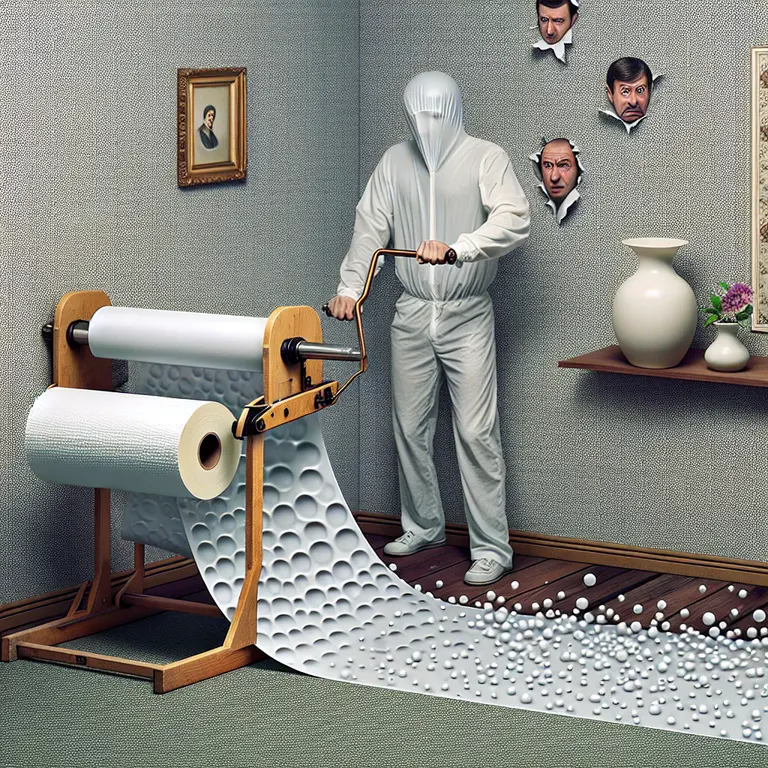
In the pantheon of serendipitous inventions that have shaped our modern world, few stories illustrate the unpredictable nature of innovation better than Bubble Wrap. That satisfying plastic material you love to pop between your fingers was never intended to protect your packages. In 1957, engineers Alfred Fielding and Marc Chavannes were actually attempting to create a new type of textured wallpaper.
Working in a garage in Hawthorne, New Jersey, the two inventors sealed two shower curtains together, creating a pattern of air bubbles. Their vision? A modern, easy-to-install wallpaper with a three-dimensional texture that would appeal to the space-age aesthetic of the late 1950s. The product was a complete market failure—consumers showed virtually no interest in bubble-textured wall coverings.
Rather than abandoning their creation, Fielding and Chavannes pivoted dramatically. They rebranded their invention as “Sealed Air,” marketing it first as greenhouse insulation (another failure) before discovering its perfect application: as a protective packaging material.
The Post-War Innovation Context
The late 1950s represented a unique period in American consumer culture. The post-World War II economic boom created unprecedented prosperity and, with it, a hunger for products that embodied modernity and futurism. This was the era that gave birth to Formica countertops, vinyl furniture, and a fascination with synthetic materials that promised to revolutionize everyday living.
Fielding and Chavannes were products of this zeitgeist. Both had engineering backgrounds—Fielding was a chemical engineer who worked for the U.S. government during wartime production, while Chavannes had experience in plastic manufacturing. Their partnership reflected a broader trend of technically skilled professionals turning their talents toward consumer applications in the booming peacetime economy.
The initial concept for bubble-textured wallpaper wasn’t as outlandish as it might seem today. Three-dimensional wall coverings were gaining popularity, with embossed patterns and textured surfaces seen as sophisticated alternatives to flat paint or traditional wallpaper. The inventors believed their air-pocket design would not only provide visual interest but also offer practical benefits such as insulation and sound damping—qualities that would appeal to the increasingly suburban American homeowner.
From Failure to Pivot: The Business Evolution
The initial market rejection of bubble wallpaper represented more than just a product failure—it threatened the very existence of the fledgling company the inventors had established. Sealed Air Corporation, founded in 1960, faced an existential crisis before it had even properly launched.
The pivot to greenhouse insulation made logical sense. The trapped air pockets provided thermal insulation, and the material's transparency allowed light to pass. However, this application also failed to gain traction, primarily due to cost factors and competition from more established insulation products.
What’s particularly instructive about the Bubble Wrap story is how the inventors demonstrated remarkable perseverance and flexibility. Market research eventually revealed that IBM had begun shipping its new 1401 variable-word-length computer in 1959 and needed a secure packaging solution to protect these delicate, expensive machines during transport. This presented the perfect opportunity for Sealed Air’s product.
By 1960, Bubble Wrap had found its niche in protective packaging, and the company began to flourish. The inventors’ willingness to completely reimagine their product’s purpose represents a textbook case of what business theorists now call “pivoting”—adapting quickly to market feedback rather than stubbornly adhering to an original vision.
The Technical Innovation Behind the Bubbles
The seemingly simple structure of Bubble Wrap belies the technical challenges Fielding and Chavannes had to overcome. Creating consistent, sealed air pockets between two layers of plastic required precise control of materials and manufacturing processes that were quite sophisticated for the era.
The original production method involved feeding two plastic sheets through rollers with a precise gap between them, while simultaneously introducing air at a specific pressure. The heat-sealing process had to create strong bonds between the sheets while maintaining the integrity of each bubble. This required careful calibration of temperature, pressure, and timing.
Over the decades, the manufacturing process has evolved substantially. Modern Bubble Wrap production uses extrusion methods, in which molten plastic is forced through dies to create the bubble pattern, rather than sealing two separate sheets. This innovation dramatically increased production efficiency and reduced costs, helping to cement Bubble Wrap’s market dominance.
The material itself has also evolved. While the original Bubble Wrap used polyethylene—chosen for its combination of flexibility, durability, and relatively low cost—contemporary versions include specialized formulations with antistatic properties for electronics, biodegradable variants for environmentally conscious applications, and even metallized versions for thermal insulation.
The Psychological Connection and Cultural Impact
Perhaps most fascinating is the unexpected psychological component. The very same tactile experience that consumers rejected on their walls became irresistibly satisfying in packaging. Studies in haptic psychology have shown that popping Bubble Wrap can actually reduce stress and anxiety—the repetitive tactile action releases small amounts of dopamine in the brain. This has made it one of the few packaging materials that consumers actively enjoy interacting with rather than immediately discarding.
In 2015, researchers at the Materials Research Centre in Manchester even attempted to create “unpoppable” Bubble Wrap (with air channels between bubbles). Still, consumer backlash was so intense that the design was abandoned mainly for consumer applications.
The cultural footprint of Bubble Wrap extends far beyond its utilitarian purpose. It has inspired art installations, fashion designs, and even musical performances. The Sealed Air Corporation officially trademarked “Bubble Wrap Appreciation Day” (celebrated on the last Monday in January), and virtual bubble-popping apps have been downloaded millions of times, suggesting our fascination transcends the physical material itself.
The Legacy of Accidental Innovation
The Bubble Wrap story perfectly illustrates how innovation often emerges not from flawless execution of an original vision, but from the willingness to completely reimagine a product’s purpose when confronted with market reality.
Today, Sealed Air Corporation employs over 16,000 people worldwide and generates approximately $5 billion in annual revenue. The company has diversified into numerous packaging solutions, but Bubble Wrap remains its iconic product and origin story. In 2016, the company introduced a new version, iBubble Wrap, that ships flat and allows users to inflate it on-site, dramatically reducing shipping costs for the packaging material.
What began as a failed wallpaper experiment in a New Jersey garage transformed into an indispensable global product. Fielding and Chavannes could never have predicted that their invention would protect billions of shipments annually, become a stress-relief phenomenon, and enter the cultural lexicon as a symbol of both protection and satisfaction. Their story reminds us that innovation is rarely linear, and that some of our most valuable creations emerge from our greatest disappointments—if we remain flexible enough to recognize their true potential.