
Microbial Gold Mining: Bacteria That Extract Precious Metals
How specialized extremophile bacteria are revolutionizing gold extraction while reducing environmental impact
 Watch on YouTube
 Watch on Rumble
Microbial Gold Mining: Bacteria That Extract Precious Metals
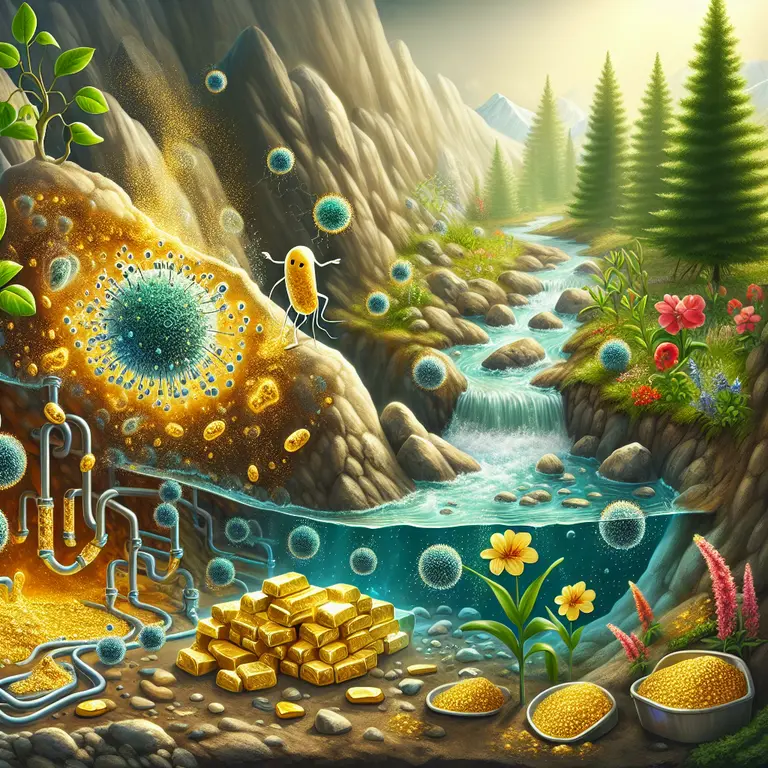
In the harsh, acidic environments of mining sites around the world, an unexpected workforce is transforming how we extract precious metals from ore. These laborers require no wages, protective equipment, or rest breaks—because they’re microorganisms. This revolutionary approach to mining represents not only a technological breakthrough but also a potential paradigm shift in how humanity accesses the Earth’s mineral wealth, offering solutions to environmental challenges while unlocking resources previously deemed economically unviable.
Nature’s Metallurgists
The process, known as biomining or bioleaching, employs specialized bacteria such as Acidithiobacillus ferrooxidans and Leptospirillum ferrooxidans to extract metals from low-grade ores that would otherwise be economically unfeasible to process using conventional methods. These remarkable microorganisms have evolved sophisticated biochemical pathways that allow them to derive energy from inorganic compounds—a metabolic strategy that predates photosynthesis by billions of years.
“These microorganisms have evolved over billions of years to extract energy from minerals through oxidation reactions,” explains Dr. Elena Rodríguez, a geomicrobiologist at the Chilean Center for Mining Biotechnology. “They essentially ‘breathe’ metals instead of oxygen.”
What makes these bacterial species particularly valuable for mining applications is their extraordinary tolerance for conditions that would be lethal to most life forms. They thrive in environments with pH levels as low as 1.0—comparable to battery acid—and can withstand high concentrations of toxic heavy metals that would poison conventional cellular machinery. Some species even prefer temperatures above 45°C, conditions found naturally in certain mineral deposits or that develop during the exothermic oxidation reactions they catalyze.
The biochemical mechanisms underlying their metal-extraction capabilities involve a complex series of enzymatic reactions. The bacteria attach to mineral surfaces and secrete proteins that facilitate electron transfer from the mineral to their cellular respiration systems. As they metabolize, they produce sulfuric acid and ferric iron compounds that further accelerate the dissolution of minerals, creating a self-reinforcing cycle that progressively liberates metals from their ore matrices.
The Gold Revolution in Kazakhstan
While biomining has been used for copper and uranium extraction since the 1950s, recent advancements have made it viable for gold recovery. In Kazakhstan’s Akmola Region, the Altyntau Kokshetau gold mine has implemented one of the world’s most significant commercial biomining operations for gold extraction.
The mine, which previously relied on cyanide leaching—a process notorious for its environmental hazards—now employs specialized bacterial consortia to oxidize the sulfide minerals that trap microscopic gold particles. This pre-treatment makes the gold accessible for subsequent extraction with significantly reduced cyanide consumption.
“We’ve seen a 30% reduction in cyanide usage since implementing the bacterial pre-treatment,” notes Serik Baimanov, chief metallurgist at the facility. “The environmental benefits are substantial, but equally important is that we can now profitably process ore with gold concentrations as low as 0.8 grams per ton.”
The Kazakh operation represents a significant scaling of biomining technology. Their bioreactors process thousands of tons of ore daily using carefully maintained bacterial cultures. The facility maintains a sophisticated biomonitoring system that continuously adjusts temperature, acidity, and nutrient levels to optimize bacterial activity. Most impressively, they’ve developed a proprietary bacterial consortium that combines multiple species, each specialized for different aspects of the extraction process, and that works in a synergistic relationship, outperforming single-species approaches.
The economic impact has been profound. The mine has extended its operational lifespan by an estimated 15 years by making previously uneconomic ore bodies viable for processing. Additionally, the reduced chemical usage has lowered both environmental remediation costs and regulatory compliance expenses.
From Extremophiles to Economic Models
What makes this development particularly fascinating is the intersection of extremophile microbiology and economic viability. The bacteria thrive in conditions that would kill most organisms—highly acidic environments (pH 1-2), temperatures between 40-50°C, and high concentrations of heavy metals.
Dr. Jian Chen of the Beijing Institute of Mineral Resources Engineering has developed economic models suggesting that biomining could make previously abandoned mining sites economically viable again. “Our calculations indicate that approximately 15% of abandoned gold mining sites worldwide contain sufficient residual gold that could be extracted using these biological methods,” Dr. Chen stated in a recent paper published in Resources Policy.
These economic models incorporate factors beyond simple extraction efficiency. They account for reduced energy requirements compared to conventional smelting or pressure oxidation methods, lower chemical input costs, diminished environmental remediation expenses, and the potential for carbon credit generation due to the significantly smaller carbon footprint of biomining operations.
Perhaps most significantly, Chen’s research suggests that biomining could fundamentally alter the economics of the mining industry by shifting the cutoff grade—the minimum metal concentration that makes extraction profitable—to levels previously considered waste. This could effectively transform billions of tons of what is currently classified as waste rock into viable ore, potentially extending global metal reserves by decades.
Archaeological Connections and Ancient Precedents
Intriguingly, there’s evidence suggesting that ancient civilizations may have unknowingly used rudimentary forms of biomining. Archaeological studies at Roman mining sites in the Iberian Peninsula have discovered proof of engineered pools where ore was left to weather for months before processing.
“The Romans couldn’t have known about the microorganisms, but they observed that certain ores became more amenable to gold extraction after prolonged exposure to the elements,” explains Dr. Margarita Sánchez, an archaeometallurgist at the University of Seville. “They were inadvertently creating perfect conditions for naturally occurring metal-oxidizing bacteria.”
Recent archaeological investigations have revealed similar practices in pre-Columbian Andean mining operations, where Incan metallurgists constructed elaborate terraced leaching beds to process silver ores. Residue analysis of these ancient structures has identified biofilms containing bacteria remarkably similar to modern metal-oxidizing species, suggesting that indigenous knowledge systems had empirically optimized conditions for microbial extraction centuries before the scientific understanding of microorganisms.
These historical connections highlight how contemporary biomining represents not so much a novel technology as a scientifically informed optimization of natural processes that have been occurring since life first evolved on Earth—and that human civilizations have been inadvertently harnessing for millennia.
Future Applications Beyond Earth
The implications extend beyond our planet. NASA and the European Space Agency are investigating biomining as a potential technology for resource extraction during future Mars missions or asteroid mining operations.
“The ability to deploy microorganisms that can extract metals in extreme conditions with minimal equipment and energy requirements makes them ideal candidates for off-world mining,” says Dr. Natalie Johnson of NASA’s Ames Research Center. “We’re essentially looking at bacteria as biological factories that could support human expansion into space.”
Experimental payloads testing biomining capabilities have already been deployed to the International Space Station, where researchers are studying how microgravity affects bacterial mineral processing. Initial results suggest that certain bacterial strains exhibit enhanced metal extraction efficiency under space conditions, possibly due to changes in biofilm formation on mineral surfaces in microgravity.
The European Space Agency’s BioRock experiment has demonstrated the successful extraction of rare-earth elements by microbes under simulated Martian conditions. This breakthrough could be critical for establishing a sustainable human presence beyond Earth, as these elements are essential components in technologies ranging from batteries to electronics—resources that would be prohibitively expensive to transport from Earth.
Challenges and Limitations
Despite its promise, biomining faces challenges. The process is slower than conventional methods, typically requiring days or weeks rather than hours. Additionally, the bacterial communities must be carefully maintained at optimal conditions.
Researchers at South Africa’s Stellenbosch University are addressing these limitations by exploring genetic engineering approaches to enhance bacterial metal extraction rates and tolerance to extreme conditions.
“We’ve identified key genes that regulate metal oxidation pathways,” explains Dr. Thabo Mokoena, lead researcher on the project. “By optimizing these pathways, we believe we can reduce processing times by up to 40%.”
Another significant challenge involves scaling the technology to handle the massive throughput required by commercial mining operations. While bioreactors work effectively at laboratory and pilot scales, engineering systems capable of processing thousands of tons daily require significant innovation in bioreactor design, fluid dynamics, and process control systems.
There are also regulatory hurdles to overcome, particularly regarding the potential use of genetically modified organisms in open environmental applications. Current commercial operations rely exclusively on naturally occurring bacterial strains, but the most promising efficiency improvements may come from engineered variants that would require new regulatory frameworks.
As global demand for precious metals continues to rise while accessible deposits diminish, these microscopic miners may represent not just an environmental improvement but an economic necessity for the future of resource extraction—proving once again that in the most extreme environments, life not only finds a way but might also show us a better one.