
Termite Gut Microbes: Climate Change's Unexpected Heroes
How specialized bacteria in termite digestive systems could help mitigate methane emissions and provide new biofuel technologies.
 Watch on YouTube
 Watch on Rumble
In the battle against climate change, scientists are finding allies in surprising places—including the digestive tracts of termites, those tiny insects often maligned for their wood-destroying habits. These diminutive creatures, numbering over 3,000 species worldwide, may hold biological secrets that could help address some of our most pressing environmental challenges. Their remarkable digestive systems—evolutionary marvels refined over millions of years—are inspiring technologies ranging from renewable fuels to agricultural methane-reduction strategies.
The Remarkable Termite Microbiome
Termites possess one of the most efficient lignocellulose-degrading systems on Earth, allowing them to convert wood—one of the planet’s most abundant but recalcitrant carbon sources—into usable energy. This remarkable ability isn’t actually the termite’s own, but rather that of their gut microbiota: a complex community of bacteria, archaea, and protists that has co-evolved with termites for over 100 million years.
What makes this system particularly fascinating is its methane paradox. Lower termites (more primitive species) produce significant methane—a greenhouse gas 28 times more potent than CO₂—through their digestive processes. However, higher termites (more evolved species) produce remarkably little methane despite digesting similar materials.
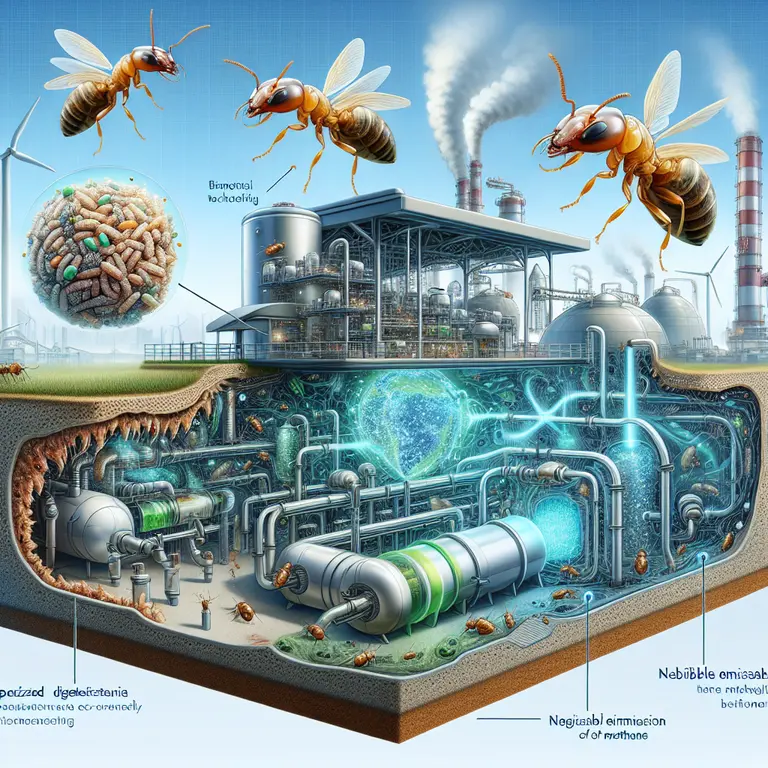
The termite gut represents one of nature’s most sophisticated microbial ecosystems, containing hundreds to thousands of microbial species working in precise coordination. This digestive tract can be considered a series of specialized bioreactors, with different sections maintaining distinct pH levels, oxygen gradients, and microbial populations. In some termite species, the hindgut alone contains over 200 bacterial phylotypes, creating a metabolic network of extraordinary complexity.
Most remarkably, these microorganisms can convert up to 95% of the cellulose they consume into accessible nutrients—an efficiency unmatched by any human-engineered system. The termite gut achieves in hours what industrial processes require days to accomplish, and does so without the high temperatures, pressures, or caustic chemicals typically employed in biofuel production.
The Breakthrough Discovery
Researchers at Australia’s CSIRO and Brazil’s Federal University of Rio de Janeiro recently identified specific bacterial consortia in higher termites that effectively capture methane before it can be released. These bacteria—primarily from the Actinomycota and Bacillota phyla—utilize methane as a carbon source through a metabolic pathway previously unknown in insect symbionts.
“These microbes essentially perform a biological version of carbon capture,” explains Dr. Fernanda Oliveira, lead microbiologist on the study. “They intercept methane molecules and convert them into compounds the termite can use for energy, creating a nearly closed-loop system.”
The research team employed metagenomics, metatranscriptomics, and stable isotope probing to track the fate of carbon atoms through the termite digestive system. Their findings revealed that certain Actinomycota bacteria possess modified forms of methane monooxygenase enzymes that function in the oxygen-limited environment of the termite hindgut—something previously thought impossible. These specialized enzymes enable bacteria to oxidize methane up to 300 times faster than their free-living relatives in soil environments.
Further investigation showed these bacteria form intricate physical associations with methanogenic archaea, creating microscopic metabolic islands where methane is produced and immediately consumed before it can escape as gas. This arrangement represents a previously undocumented form of syntrophy—a mutually beneficial metabolic relationship between different microbial species.
Agricultural Applications
The implications extend beyond termite nests. Agricultural scientists are now exploring how these microbial communities might be adapted for use in livestock, particularly cattle, which account for approximately 14.5% of global greenhouse gas emissions through enteric fermentation.
Preliminary trials in Brazil have shown that certain termite-derived bacterial strains can survive in the bovine rumen, potentially reducing methane emissions by 8-12% when introduced as feed supplements. While still in early stages, these findings suggest a biological approach to reducing agricultural methane that doesn’t require changing livestock diets or breeding practices.
The challenge lies in adapting organisms from the termite hindgut—an environment evolved over millions of years—to function effectively in the biochemically distinct rumen of cattle. Researchers are using genetic engineering to enhance the oxygen tolerance of these bacterial strains while preserving their methane-consuming abilities. A collaborative project between Australian and Brazilian research institutions has already filed patents on modified bacterial consortia explicitly designed for livestock application.
Unlike previous methane-reduction approaches that relied on chemical additives or antibiotics, this biome-supplementation strategy aims to establish self-sustaining microbial communities that integrate with existing rumen flora. This could potentially offer a one-time treatment rather than continuous supplementation, dramatically improving the economic feasibility of methane reduction in global cattle production.
Biofuel Innovation
Perhaps even more promising is the application in biofuel production. The enzymatic systems these microbes use to break down lignocellulose are remarkably efficient, operating at ambient temperatures and neutral pH conditions, far gentler than those of current industrial processes.
“Current cellulosic ethanol production requires harsh pretreatments and expensive enzymes,” notes Dr. Hiroshi Tanaka at Japan’s RIKEN Institute, who wasn’t involved in the original research but is developing applications. “These termite-derived microbial consortia can potentially break down agricultural waste and forestry residues with minimal pretreatment, dramatically reducing production costs.”
A pilot facility in Queensland, Australia, is already testing this approach, using termite-inspired bioreactors to convert sugarcane bagasse into ethanol with 30% greater efficiency than conventional methods.
The Queensland facility uses a multi-stage fermentation system modeled after the termite digestive tract, with sequential chambers that maintain specific conditions to optimize the breakdown of biomass at different stages. The system employs not only bacterial enzymes but also mimics the mechanical grinding performed by termite mandibles, using specially designed milling equipment that reduces particle size while preserving the structural characteristics that microbial enzymes have evolved to target.
Initial economic analyses suggest that at scale, this process could produce cellulosic ethanol at approximately $1.80 per gallon—approaching cost parity with conventional gasoline without subsidies. Perhaps more significantly, the method generates minimal waste streams and requires approximately 60% less water than traditional bioethanol production.
Interdisciplinary Implications
This research sits at the intersection of entomology, microbiology, and climate science, demonstrating how solutions to global challenges might be found in unexpected ecological niches.
Interestingly, architectural engineers have already been studying termite mound ventilation systems for decades to inspire energy-efficient building designs. Now, the internal biology of these insects may prove just as valuable as their external constructions.
Termite research has catalyzed new collaborative frameworks among traditionally separate scientific disciplines. Entomologists now regularly partner with bioprocess engineers, while microbiologists increasingly consult on agricultural policy. This cross-pollination of expertise has accelerated discovery and application in ways that siloed research approaches could not achieve.
The termite gut has also become an important model system for studying microbial ecology principles that apply far beyond these insects. The spatial organization, metabolic handoffs, and community resilience observed in termite microbiomes are informing research on human gut health, soil remediation strategies, and even the design of synthetic microbial communities for specialized industrial applications.
Looking Forward
As climate change accelerates and the need for carbon-neutral fuels grows more urgent, these humble insects and their microbial partners offer a powerful reminder: solutions to our most pressing problems may already exist in nature’s vast laboratory, refined by millions of years of evolution.
While termite-inspired technologies won’t single-handedly solve climate change, they represent the kind of cross-disciplinary innovation essential to addressing complex environmental challenges. From pest to potential climate hero—the termite’s reputation may be due for a significant upgrade.
The next research frontier involves understanding how termite colonies regulate their internal microbiomes across different castes and developmental stages. Preliminary evidence suggests that termites actively cultivate specific microbial communities through selective feeding, grooming behaviors, and chemical signaling—essentially practicing a sophisticated form of microbial agriculture within their colonies. Decoding these regulatory mechanisms could provide new tools for manipulating complex microbial communities in industrial and agricultural settings.
As we face unprecedented environmental challenges, the humble termite reminds us that sometimes the most potent solutions come in the smallest packages, hidden within biological systems we’ve long overlooked or misunderstood.
The research is currently undergoing peer review for publication in Nature Microbiology, with preliminary findings presented at the International Symposium on Microbial Ecology in Adelaide last month.