
Evolutionary Arms Race: How Snakes Reshape Bird Brains
Recent research reveals that the threat of snake predation has driven unexpected neurological adaptations in birds, with implications for understanding human cognition.
 Watch on YouTube
 Watch on Rumble
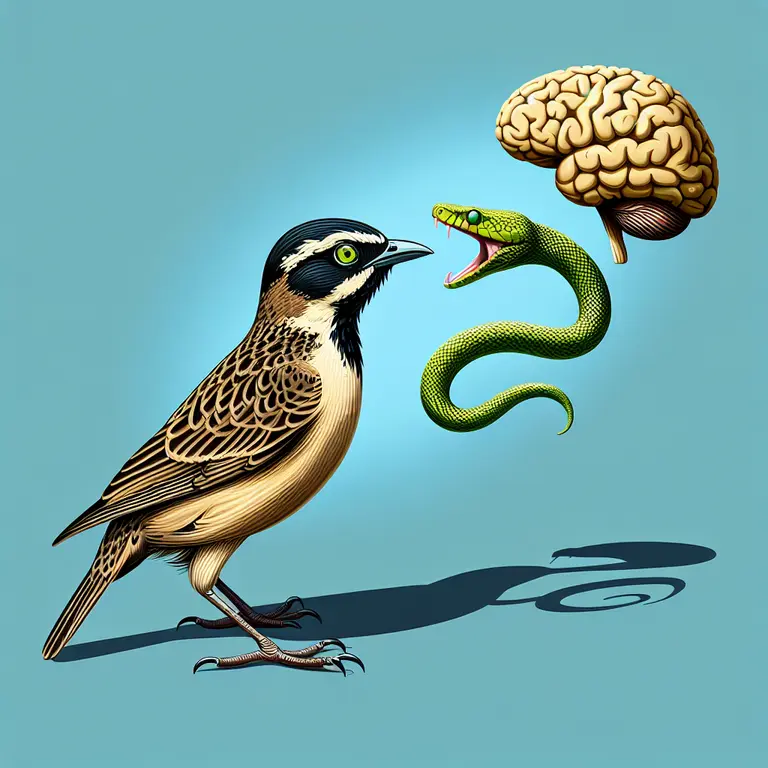
In the dense forests of New Caledonia, a remote island in the South Pacific, scientists have uncovered compelling evidence of how predator-prey relationships can literally reshape brains across generations. Recent findings published in the Journal of Comparative Neurology reveal that birds living in environments with high snake densities develop significantly enlarged hippocampal formations—brain regions crucial for spatial memory and threat detection. This discovery opens a fascinating window into the dynamic forces of natural selection and how environmental pressures can sculpt neural architecture with remarkable precision, offering insights that extend far beyond avian neurology to our understanding of brain evolution across the animal kingdom.
The Neurological Impact of Predation
Researchers from the Max Planck Institute for Evolutionary Anthropology and the University of Queensland collaborated on a comparative study of avian brain structures across 32 bird species from environments with and without snakes. Their findings challenge conventional understanding of evolutionary neurobiology.
“We expected to see some differences, but the magnitude was surprising,” explains Dr. Eloise Whitmore, the study’s lead author. “Birds from snake-dense regions showed hippocampal formations up to 38% larger relative to their body size compared to their counterparts in snake-free habitats.”
This neurological adaptation isn’t merely about size. The affected brain regions show increased neural density and more complex connectivity patterns, particularly in pathways associated with visual processing and spatial memory—precisely the cognitive tools needed to detect and remember dangerous predators.
The research team employed advanced neuroimaging techniques, including high-resolution magnetic resonance imaging (MRI) and tract-tracing methodologies, to map these differences in unprecedented detail. They discovered that particular avian species, particularly those nesting on the ground or in low vegetation where snake encounters are more frequent, exhibited the most pronounced neural adaptations.
Interestingly, these changes appear to develop through both evolutionary adaptation across generations and experience-dependent plasticity within individual lifetimes. Young birds raised in controlled environments still showed some innate differences in brain structure, but these became significantly more pronounced after exposure to snake stimuli during development. This suggests a fascinating interplay between genetic predisposition and environmental influence in shaping these neural adaptations.
From Birds to Primates: The Snake Detection Theory
These findings provide substantial support for the controversial “Snake Detection Theory,” proposed by anthropologist Lynne Isbell in 2006. This theory suggests that snakes played a crucial role in primate evolution, particularly in the development of the visual systems of primates.
Isbell hypothesized that the need to quickly identify snakes drove the evolution of enhanced visual processing in primates. The new avian research demonstrates this phenomenon occurs across taxonomic groups, suggesting a universal evolutionary response to snake predation.
“What’s fascinating is that we’re seeing parallel evolutionary pathways across vastly different species,” notes Dr. Takashi Nomura, a neurobiologist not involved in the study. “The selective pressure of avoiding snake predation appears to drive similar neurological adaptations whether you’re a bird or a primate.”
The theory gains further credence from comparative studies of mammals with varying historical exposure to snake predators. Old World monkeys and apes, which evolved in Africa with a high prevalence of snakes, demonstrate superior visual detection of snake-like patterns compared to New World monkeys, whose evolutionary history included fewer venomous snake species. Similarly, the research team found that bird species with longer evolutionary histories alongside snakes showed more pronounced neural adaptations than those with more recent snake exposure.
This convergent evolution across widely divergent taxonomic groups suggests that snakes represent a compelling selective force. Their combination of deadly venom, camouflage abilities, and distinctive morphology may have created an evolutionary pressure cooker that reshaped visual processing systems across multiple animal lineages over millions of years.
Cognitive Trade-offs and Human Implications
Perhaps most intriguing are the cognitive trade-offs observed in the study. Birds with enlarged snake-detection neural networks showed reduced capacity in other cognitive domains, particularly those associated with problem-solving flexibility.
This suggests a neurological zero-sum game: brain power allocated to predator detection comes at the cost of other cognitive functions. The researchers found that birds from snake-free islands demonstrated superior performance in novel food acquisition tasks, despite having smaller hippocampal formations.
“There’s a clear evolutionary trade-off,” explains cognitive ecologist Dr. Marta Soler. “Enhanced predator detection appears to come at the cost of cognitive flexibility in other domains.”
This finding has provocative implications for human psychology. Some researchers now suggest that our own cognitive biases—particularly our tendency to rapidly detect threat patterns, sometimes erroneously—may be evolutionary holdovers from our ancestors’ need to identify dangerous predators, such as snakes, quickly.
The human amygdala, a brain structure involved in fear processing, responds more rapidly to images of snakes than to other threatening stimuli, even in individuals with no direct experience with snakes. This “prepared learning” phenomenon may explain why snake phobias are among the most common specific fears across human cultures, despite most modern humans rarely encountering venomous snakes.
Furthermore, this research may help explain certain features of human attention and perception. Our visual system’s tendency to prioritize specific shapes, movements, and patterns over others can be partly explained by ancient selection pressures from predators, such as snakes. The “false positive” tendency in human threat detection—our propensity to see threats where none exist—might represent an evolutionary calculation where the cost of missing a genuine threat (death) far outweighs the cost of occasional false alarms.
Conservation Implications
The research also raises essential conservation questions. As invasive species alter ecological relationships on islands worldwide, the neurological development of native species may be affected in ways we’re only beginning to understand.
New Caledonia, where much of the research was conducted, has experienced several introductions of snakes over the past century. Birds there exhibit neurological adaptations that are developing in real-time—a rare opportunity to observe evolution in action.
“We’re essentially watching brains evolve before our eyes,” says Whitmore. “It demonstrates how quickly neurological adaptations can occur when selection pressure is strong enough.”
The introduction of the brown tree snake to Guam provides a sobering case study. Since its accidental introduction in the 1940s, this predator has decimated native bird populations. The few remaining bird species show dramatic changes in behavior, nesting patterns, and potentially brain structure as they adapt to this novel predator. Conservation biologists are now considering how these neurological insights might inform protection strategies for vulnerable bird populations facing new predatory threats.
Conversely, the removal of predators from ecosystems may have unintended consequences for the cognitive development of prey species. Birds on predator-free islands often exhibit what biologists call “ecological naiveté”—a reduced ability to recognize and respond to predatory threats. This phenomenon has neurological underpinnings that may limit these species’ adaptability should predators be reintroduced or invade.
Conclusion
As this research continues to develop, it may reshape our understanding of how environmental threats sculpt not just bodies, but brains—including our own. The ancient evolutionary arms race between predator and prey continues to echo in the neural architecture of species worldwide, a testament to the powerful forces that have shaped cognition throughout evolutionary history.
The findings highlight the remarkable plasticity of the brain in response to environmental challenges, challenging simplistic notions of brain evolution as a linear progression toward greater complexity. Instead, we see a dynamic process of adaptation, with neural resources allocated according to the most pressing survival needs of each species in its particular ecological context.
For human neuroscience, these discoveries provide a valuable evolutionary lens through which to understand our own cognitive peculiarities and biases. As we continue to unravel the neurological legacies of our evolutionary past, we gain deeper insight into the ancient forces that helped shape the most complex object in the known universe—the human brain—and its remarkable capacity for both pattern detection and creative problem-solving.