
Whale Dialects Reveal Unexpected Oceanic Migration Patterns
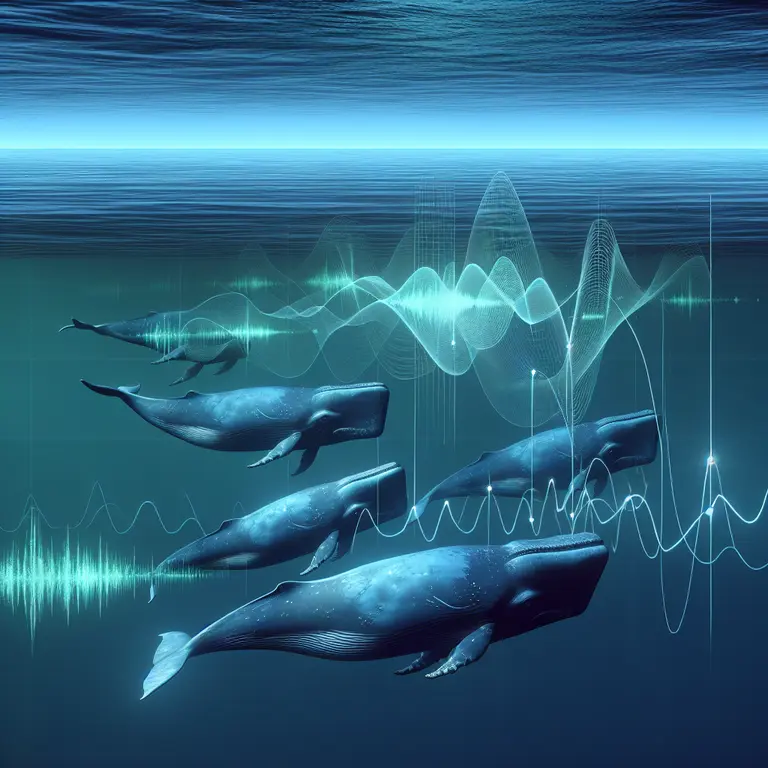
Recent bioacoustic research on sperm whale vocalizations suggests cultural learning and adaptations that challenge our understanding of cetacean migration.
 Watch on YouTube
 Watch on Rumble
In the depths of the South Pacific, an unexpected linguistic revolution is taking place—one that’s rewriting our understanding of both animal communication and oceanic migration patterns. Recent research from the Dominica Sperm Whale Project has revealed that sperm whale populations possess distinct “dialects” that function much like human language families, with implications that extend far beyond marine biology into cultural anthropology and even climate science.
The Clan-Based Communication System
For decades, scientists knew that sperm whales communicate through sequences of clicks called “codas.” What researchers didn’t realize until recently was the sophisticated social structure these codas represent. Dr. Shane Gero’s team has documented at least five distinct vocal clans across the Pacific, each with its own specific dialect that remains stable across generations and vast geographic distances.
“What we’re witnessing isn’t just communication, but cultural transmission,” explains Dr. Gero. “Young whales aren’t born knowing these specific patterns—they learn them from their social units, much like human children learn language.”
The most surprising discovery came when acoustic recordings revealed that some whale groups maintain their distinct dialects even when migrating thousands of kilometers from their traditional territories—a phenomenon previously thought impossible given the mixing of populations in the open ocean.
These dialect distinctions are exact. The “Regular Clan” of the eastern tropical Pacific, for instance, uses a distinctive 5R pattern of evenly spaced clicks, while the “Plus-One Clan” adds a sixth click after a short pause. Such subtle variations might seem insignificant to human ears, but they serve as powerful identity markers within whale society. Researchers have documented instances where whale groups from different clans encountered each other at feeding grounds yet maintained social separation despite sharing the same physical space—a clear indication that these vocal differences represent meaningful social boundaries.
The stability of these dialects across time is equally remarkable. Recordings from the 1980s, when compared with contemporary samples, show that clan-specific patterns have remained consistent for at least four decades, suggesting a robust cultural transmission system that preserves linguistic traditions despite environmental changes and population movements.
Climate Disruption and Dialect Adaptation
The research took an unexpected turn when bioacousticians noticed subtle changes in dialect patterns correlating with shifting ocean temperatures. As warming waters in the equatorial Pacific have altered the distribution of squid (the sperm whale’s primary food source), certain whale clans have begun incorporating vocalizations from neighboring clans—essentially developing linguistic adaptations to changing environmental conditions.
“It’s the cetacean equivalent of linguistic borrowing,” notes Dr. Maurício Cantor, a biologist specializing in whale communication. “We’re observing cultural evolution happening in real time.”
This discovery challenges the traditional view that animal adaptations to climate change occur primarily through genetic selection over multiple generations. Instead, these whales appear to be using cultural mechanisms to respond to environmental shifts within a single generation.
The process appears most pronounced in boundary regions where traditionally separate feeding grounds have shifted due to changing ocean temperatures. The “Short Clan,” known for its abbreviated codas in the western Pacific, has been documented incorporating elements of the “Four-Plus Clan” dialect in regions where warming has pushed both groups into shared hunting territories. What makes this particularly fascinating is the selective nature of this borrowing—whales appear to adopt specific vocalization elements related to feeding coordination while maintaining their distinctive identity markers in social contexts.
Marine ecologists are now investigating whether these dialect adaptations correlate with hunting success in changing environments. Preliminary data suggest that clans demonstrating greater vocal flexibility show more stable feeding patterns despite environmental disruption, raising intriguing questions about the relationship between cultural adaptation and ecological resilience.
Archaeological Connections
In a fascinating cross-disciplinary development, linguistic anthropologists have begun comparing the structure of whale clan dialects to ancient human language families. Dr. Helena Mirzakhani of the Max Planck Institute for Evolutionary Anthropology has identified structural similarities between sperm whale clan vocalizations and the way early human nomadic groups maintained cultural identity through language despite geographic dispersal.
“The parallels are striking,” says Mirzakhani. “Both systems use distinctive vocal markers that signal group membership while allowing for adaptation to new circumstances. It suggests convergent evolution of communication strategies between entirely different species facing similar social challenges.”
This convergence becomes even more compelling when examining historical patterns of human migration. Just as certain Pacific Islander groups maintained distinct linguistic traditions despite extensive maritime travel across thousands of kilometers, whale clans preserve their vocal identities despite oceanic wanderings. The mechanisms appear remarkably similar—both rely on strong matrilineal teaching structures where specific vocal patterns are transmitted primarily through female lineages.
Some anthropologists have even suggested that studying whale clan dynamics might provide insights into prehistoric human migration patterns that left few archaeological traces. The way whale clans maintain coherent cultural identities while following shifting food resources across vast distances may mirror how early human groups navigated changing environments during periods of climate instability.
Technological Breakthroughs
These discoveries wouldn’t have been possible without recent advances in deep-ocean acoustic monitoring. New autonomous recording devices can now capture whale vocalizations at depths exceeding 2,000 meters for extended periods, providing unprecedented datasets that enable pattern recognition across vast oceanic regions.
Engineers from the Woods Hole Oceanographic Institution have adapted machine learning algorithms developed initially for human speech recognition to analyze these massive acoustic datasets. This technological crossover has accelerated research progress by years.
The latest generation of these devices, known as Deep Acoustic Monitoring Systems (DAMS), can distinguish between individual whales within a clan, allowing researchers to track specific family units over thousands of kilometers. This technological leap has revealed previously undetected migration corridors between feeding grounds in the North Pacific and calving areas near equatorial islands—routes that follow ancient submarine mountain ranges and underwater thermal boundaries invisible to surface observation.
Perhaps most remarkably, these acoustic monitoring networks have begun detecting what researchers tentatively identify as “teaching sessions”—extended periods where adult female whales repeatedly demonstrate specific coda patterns. At the same time, juveniles practice imperfect versions, gradually refining their technique over weeks or months. These sessions typically occur in sheltered deep-water canyons with favorable acoustic properties, suggesting that whales actively seek out specific environments for cultural transmission activities.
Conservation Implications
Beyond their scientific significance, these findings have immediate conservation implications. If whale clans represent distinct cultural units with specific ecological knowledge encoded in their communication systems, then protecting biodiversity requires preserving these cultural groups, not just maintaining raw population numbers.
“We need to rethink marine conservation entirely,” argues marine policy expert Dr. Aisha Okafor. “It’s not enough to count whales—we need to ensure the survival of these knowledge systems that have evolved over thousands of years.”
As shipping noise, plastic pollution, and climate change continue to threaten oceanic ecosystems, understanding the cultural dimensions of whale communication has become urgent. Several Pacific island nations are now considering the establishment of expanded marine protected areas, specifically designed to encompass the territories of distinct whale clans.
This cultural approach to conservation represents a paradigm shift in marine protection strategies. Traditional approaches focused primarily on preserving habitat or maintaining minimum viable populations. Still, the clan dialect research suggests that losing even a small number of key individuals—particularly elder females who appear to serve as primary repositories of knowledge—could irreparably damage the cultural continuity of an entire clan.
The implications also extend to international maritime law. Conservation advocates are pushing for recognition of “cultural heritage zones” in international waters, where acoustic disturbance would be strictly limited during critical periods of teaching and socialization. Such proposals face significant challenges from shipping and naval interests, but they represent an emerging recognition that biodiversity encompasses both cultural and genetic dimensions.
This unexpected convergence of linguistics, marine biology, anthropology, and conservation policy demonstrates how cross-disciplinary research continues to reveal the ocean’s deepest secrets—and how much we still have to learn from our planet’s oldest and most enigmatic cultures, hidden beneath the waves.