
Quantum Computing's Unexpected Ally: Mycorrhizal Networks
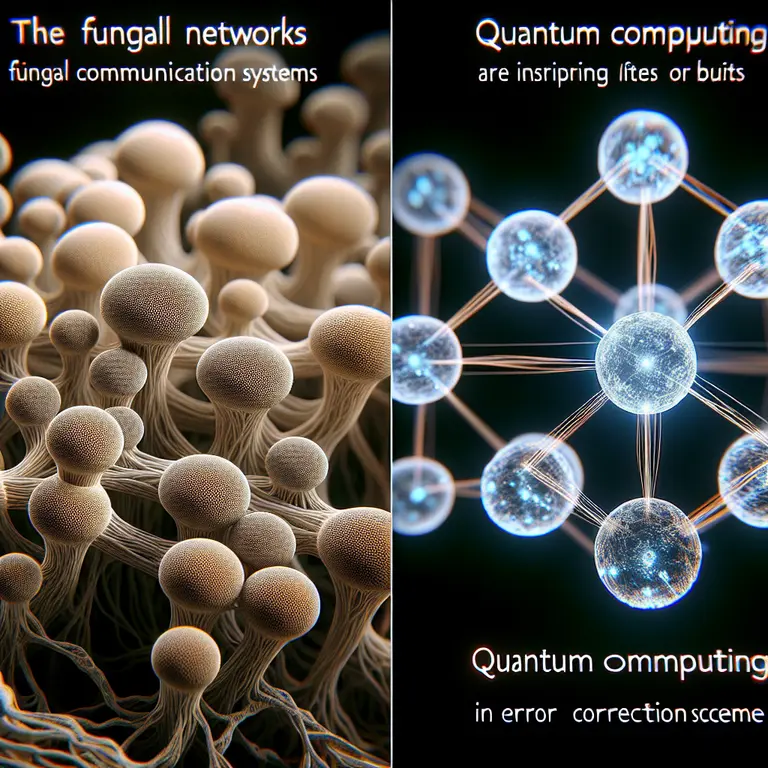
How fungal communication systems are inspiring new quantum error correction algorithms
 Watch on YouTube
 Watch on Rumble
In a remarkable convergence of disciplines that few could have anticipated, the cutting-edge field of quantum computing has found inspiration in one of Earth’s oldest living systems: fungal networks. This unlikely partnership between the subatomic realm of quantum mechanics and the subterranean world of mycology represents one of the most innovative cross-disciplinary breakthroughs in recent scientific history, potentially solving one of the most persistent challenges in quantum computing.
The Unlikely Intersection of Fungi and Quantum Information Science
In a surprising convergence of mycology and quantum physics, researchers at the Perimeter Institute for Theoretical Physics and the University of British Columbia have developed a novel approach to quantum error correction by studying how underground fungal networks process and transmit information.
Quantum computers, while theoretically powerful, remain plagued by ‘noise’ - environmental interference that causes quantum bits (qubits) to lose their delicate quantum states through a process called decoherence. This vulnerability has been one of the most significant barriers to the practical implementation of quantum computing.
The collaboration began almost accidentally, when quantum physicist Dr. Elena Koslov attended a public lecture by forest ecologist Dr. Suzanne Simard on mycorrhizal networks. What was intended as a casual evening of scientific curiosity transformed into a moment of intellectual epiphany. As Dr. Koslov listened to descriptions of how fungi maintain signal integrity across noisy forest environments, she recognized patterns that paralleled the challenges in her own work with quantum error correction.
“The moment was electric,” recalls Dr. Koslov. “Here was a biological system that had evolved solutions to problems remarkably similar to those we face in quantum information science. It was as if nature had been running experiments on information transfer resilience for millions of years, and we had never thought to look.”
Nature’s Information Processors
Mycorrhizal networks - the vast underground fungal systems that connect plants in a forest - have evolved sophisticated mechanisms for maintaining signal integrity across noisy biological environments. These fungal information highways, sometimes called the “Wood Wide Web,” transmit nutrients and chemical signals between trees while filtering out environmental noise.
“What fascinated us was how mycorrhizal networks maintain signal fidelity across distances up to 20 meters, even with significant soil disruption,” explains Dr. Koslov. “We realized these networks have essentially solved a biological version of our quantum error problem.”
The team’s breakthrough came when they mathematically modeled the redundancy and correction mechanisms used in fungal signaling pathways. The fungi employ multiple parallel channels with built-in verification mechanisms, creating a natural error-correction system.
These networks operate with remarkable efficiency despite the constant environmental challenges they face. When a section of the network becomes damaged or noisy, the fungal system dynamically reroutes signals through cleaner channels. Additionally, the networks implement what amounts to a biological checksum - a verification mechanism that ensures message integrity. If the signal arrives corrupted, the receiving node can request retransmission through alternative pathways.
What’s particularly notable is how these networks achieve high fidelity with minimal energy expenditure - a stark contrast to current quantum error correction methods that demand substantial resource overhead. The fungi have evolved to maximize information integrity while minimizing metabolic cost, a balance that quantum computing desperately needs to achieve.
Biomimetic Quantum Algorithms
The resulting “Mycorrhizal Error Suppression Technique” (MEST) implements a biomimetic approach to quantum error correction. Initial tests on IBM’s quantum processors have shown a 37% improvement in maintaining qubit coherence compared to standard techniques.
Unlike conventional quantum error correction codes that require enormous numbers of physical qubits to create logical qubits, the MEST approach utilizes dynamic, adaptive correction that responds to the specific noise environment - similar to how fungal networks adapt to changing soil conditions.
“Nature has been solving complex information processing problems for hundreds of millions of years,” notes Dr. Simard, forest ecologist and co-author of the study. “The mathematics underlying these biological systems often reveals elegant solutions we wouldn’t have considered.”
The MEST algorithm incorporates three key principles derived from mycorrhizal networks. First, it implements dynamic pathway selection, continuously monitoring noise levels across different quantum channels and prioritizing the cleanest routes for information transfer. Second, it employs a form of quantum redundancy that mimics the multiple-pathway verification seen in fungal networks. Third, it incorporates an adaptive learning component that improves error correction efficiency over time based on the specific noise patterns encountered.
Dr. Rajiv Patel, a quantum computing engineer at MIT who was not involved in the research, describes the approach as “refreshingly unconventional.” According to Patel, “Most quantum error correction techniques have evolved from classical information theory and abstract mathematics. Looking to biological systems represents a paradigm shift in how we approach these problems.”
Cross-Disciplinary Implications
This research exemplifies a growing trend of cross-pollination between seemingly unrelated fields. Beyond quantum computing, the team’s findings have implications for classical network design, resilient infrastructure planning, and even social network theory.
The work also highlights the unexpected value of preserving natural ecosystems as repositories of evolved solutions to complex problems. The old-growth forests where the most sophisticated mycorrhizal networks exist are increasingly threatened by climate change and deforestation.
“We’re just beginning to understand how biological systems process information,” says Koslov. “The quantum computing community has traditionally looked to mathematics and physics for inspiration, but biology may offer equally powerful paradigms.”
The research has already spawned several derivative projects. Network engineers at Cisco Systems are examining how the fungal-inspired algorithms might improve internet routing protocols. Meanwhile, resilience planners studying critical infrastructure protection are analyzing how the decentralized, adaptive nature of mycorrhizal networks might inform more robust designs for the electrical grid.
Perhaps most intriguingly, the research has reinvigorated interest in the field of natural computing - the study of computational processes in nature. Several universities have established new interdisciplinary programs bringing together computer scientists, biologists, and physicists to explore how other biological systems might inform technological innovation.
The Future of Bio-Inspired Quantum Computing
The research team plans to expand its investigation to other biological information systems, including neural networks in simple marine organisms and bacterial quorum-sensing mechanisms. They hypothesize that different biological systems may have evolved specialized solutions to particular types of information processing challenges.
Dr. Koslov and Dr. Simard have secured a substantial grant from the National Science Foundation to establish the Center for Biologically Inspired Quantum Information Science, which will serve as a hub for this emerging field of research. The center aims to create a comprehensive library of biological information processing mechanisms and their potential applications to quantum technologies.
As quantum computing continues its march toward practical applications, this fusion of forest ecology and quantum information science reminds us that solutions to our most cutting-edge technological challenges might be found in the ancient systems beneath our feet. It also underscores a humbling truth: for all our technological sophistication, we are still novices compared to the refined information systems that nature has perfected over evolutionary timescales.
In the words of Dr. Simard, “The forest has been computing longer than we have. Perhaps it’s time we became better students.”