
Christmas Truce 1914: Humanity Shines Amidst Ww1's Darkness
How spontaneous Christmas celebrations briefly halted World War I and created an extraordinary moment of humanity amid unprecedented carnage.
 Watch on YouTube
 Watch on Rumble
In the bitter cold of December 1914, as the first Christmas of World War I approached, soldiers huddled in muddy trenches along the Western Front faced a reality far removed from the patriotic fervor that had launched them into battle just months earlier. The promised quick victory had dissolved into a bloody stalemate. Yet amid this bleakness, an extraordinary moment of humanity would briefly illuminate the darkness of war—a moment that would later be known as the Christmas Truce of 1914.
The Spontaneous Ceasefire
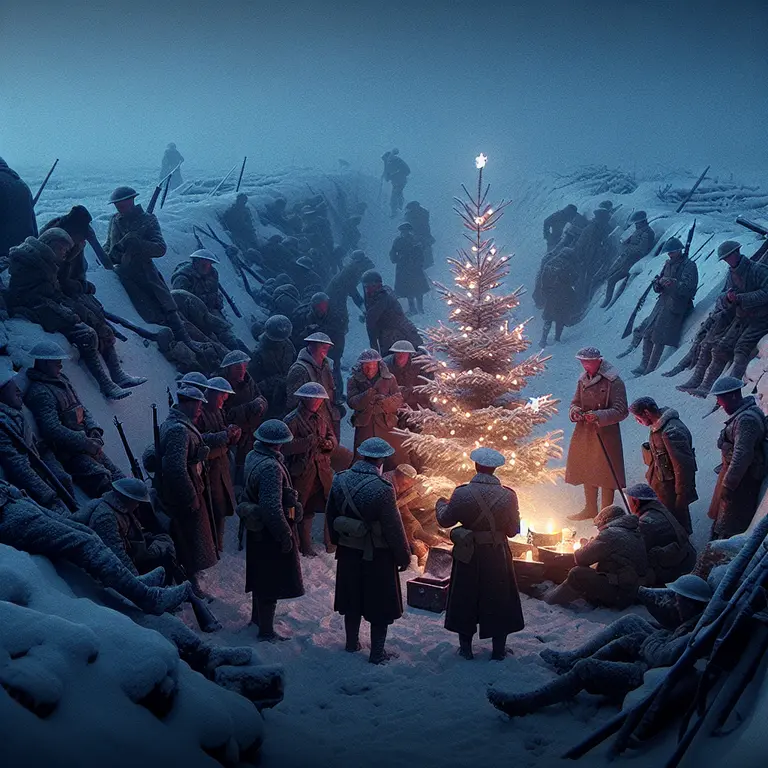
On Christmas Eve 1914, along the Western Front of World War I, an extraordinary phenomenon occurred that military historians still study with fascination. After months of brutal trench warfare that had already claimed hundreds of thousands of lives, British soldiers noticed something unusual: German troops were placing small Christmas trees with candles along their trench parapets. Then, across the frozen wasteland of No Man’s Land, came the sound of German soldiers singing “Stille Nacht” (Silent Night).
What followed was not documented in official military strategy or planned by high command. British soldiers responded by singing English carols, and soon both sides were exchanging songs across the battlefield. The impromptu concert evolved into something even more remarkable - a genuine, if unauthorized, ceasefire.
What’s particularly notable is that this truce wasn’t isolated to a single location. Similar scenarios unfolded across approximately two-thirds of the British-German sector, spanning about 100,000 troops. The French and Belgian sectors saw fewer instances of fraternization, but even there, small pockets of peace emerged.
The genesis of the truce varied by location. In some sectors, it began with simple calls of “Merry Christmas” across No Man’s Land. In others, it started with the practical need to recover the dead. Private Frank Sumpter of the London Rifle Brigade recalled: “We heard the Germans singing ‘Silent Night, Holy Night.’ When they finished, we clapped them, and then we sang ‘The First Noel,’ and when we finished, they clapped us.”
By Christmas morning, the unthinkable happened. In many areas, soldiers tentatively emerged from their trenches, meeting in No Man’s Land—the contested ground between opposing forces that had previously meant certain death for anyone who ventured there. German Lieutenant Johannes Niemann of the 133rd Saxon Regiment described the scene: “Suddenly, a Scotsman climbed out of his trench and came toward us. One of our men went out to meet him. They shook hands, and then everybody seemed to come out at once.”
Football in No Man’s Land: Myth and Reality
Perhaps the most famous tale from the Christmas Truce is the football (soccer) match allegedly played between opposing forces. While popular imagination has crystallized around a single organized match, the historical record reveals a more nuanced picture. Multiple small-scale kickabouts took place, rather than a single definitive game.
According to Lieutenant Kurt Zehmisch of Germany’s 134th Saxon Regiment, “The English brought a soccer ball from their trenches, and pretty soon a lively game ensued. How marvelously wonderful, yet how strange it was.” In the sector held by the 133rd Saxon Regiment, a German lieutenant recorded that the score of their match was 3-2 in favor of the Germans.
What’s less known is that these football interactions were primarily documented in the British-German sectors. The French and Belgian troops, who had witnessed the German invasion of their homeland firsthand, generally maintained a greater distance during the informal truces.
The impromptu football matches represent more than just a curious historical footnote—they embody a profound human connection forged amid industrialized slaughter. Captain Edward Hulse of the Scots Guards wrote to his mother about the strange scene: “Officers and men shook hands and exchanged cigarettes and cigars, and one of our men gave a German a haircut.” The surreal quality of these interactions underscores how the artificial constructs of national enmity briefly dissolved in the face of shared humanity.
The Aftermath and Military Consequences
While the Christmas Truce has been romanticized in popular culture, its aftermath reveals the harsh realities of war. Military authorities on both sides were deeply troubled by the fraternization. High Command worried that humanizing the enemy would undermine fighting spirit. General Sir Horace Smith-Dorrien, commander of the British II Corps, issued orders explicitly forbidding friendly communication with the opposing forces.
A lesser-known fact is that some officers who participated in the truce faced disciplinary action. Future British Prime Minister Winston Churchill, then First Lord of the Admiralty, expressed concern about the ceasefire, while German Crown Prince Wilhelm considered it “absolutely deplorable.”
The most sobering aspect of the aftermath was how thoroughly the military establishment worked to prevent any recurrence of such events. Artillery bombardments were scheduled explicitly for Christmas Eve and Christmas Day in 1915 to avoid a similar outbreak of peace. Gas attacks were deliberately planned for the holiday period in subsequent years. The Christmas Truce of 1914 would remain a singular event.
The military leadership’s reaction reflected a more profound anxiety—that soldiers might question the very premise of the conflict. As Adolf Hitler, then an Austrian corporal in the German Army, reportedly remarked: “Such a thing should not happen in wartime. Have you no German sense of honor?” The fraternization threatened the narrative that the enemy was inhuman and deserving of destruction, a narrative essential to sustaining the war effort.
The Truce’s Forgotten Practical Purpose
Beyond the singing and games, the Christmas Truce served a grimly practical purpose often overlooked in sentimental retellings. After months of fighting, No Man’s Land was littered with decomposing corpses that neither side could safely retrieve. The temporary ceasefire allowed for the recovery and burial of the dead—a rare moment of dignity amid the industrial-scale slaughter.
Captain Sir Edward Hulse of the Scots Guards wrote in a letter home: “I went out and found a Saxon officer, who agreed to a local armistice for the day… From 10 a.m. to 4 p.m., neither side would fire.” This arrangement allowed burial parties to recover remains that had been lying exposed for weeks or months.
Perhaps most poignant were the joint burial services, where chaplains from both sides conducted ceremonies together. In some sectors, German and British soldiers worked side by side to dig graves and construct makeshift crosses. At least 100 joint services were conducted during the truce, with prayers often said in both languages—a somber counterpoint to the more celebrated aspects of the Christmas ceasefire.
The practicality extended beyond burials. The ceasefire provided a rare opportunity to repair trenches, a task normally impossible under enemy fire. Some soldiers used the time to retrieve personal items they had abandoned during previous attacks. In the words of one British soldier: “Our trenches were in a terrible state… During the truce, we were able to bring up timber and repair the breastworks and dugouts.”
Legacy and Historical Significance
The Christmas Truce of 1914 occupies a unique position in military history—a spontaneous, bottom-up rejection of warfare by the very men tasked with waging it. Its significance extends beyond the momentary peace it brought to the Western Front.
Historian Stanley Weintraub, who chronicled the truce in his book “Silent Night,” observed that it represented “a moment of sanity in a world gone mad.” The fact that ordinary soldiers could recognize their shared humanity across enemy lines while political and military leaders remained committed to mutual destruction highlights the disconnect between those who declare wars and those who fight them.
The truce also stands as a testament to the resilience of human compassion. Despite months of propaganda depicting the enemy as monstrous, despite witnessing comrades killed, and despite orders to hate, soldiers found themselves unable to maintain artificial enmity during the sacred holiday.
As the war progressed toward its eventual toll of over 16 million dead, the Christmas Truce faded into memory, seemingly refuted by the escalating brutality that followed. Yet its legacy endures precisely because it demonstrated an alternative possibility—that even in the darkest circumstances, humans can choose connection over conflict, even if only briefly.
The Christmas Truce stands as a potent reminder that even in humanity’s darkest hours, our capacity for compassion can momentarily transcend the machinery of war. Though sadly, as the increasingly mechanized and dehumanized conflict continued for nearly four more years, such moments became impossible to replicate.