
Lisbon Earthquake of 1755: Catalyst for Enlightenment Change
How a massive natural disaster reshaped European philosophy, religion, and the science of seismology.
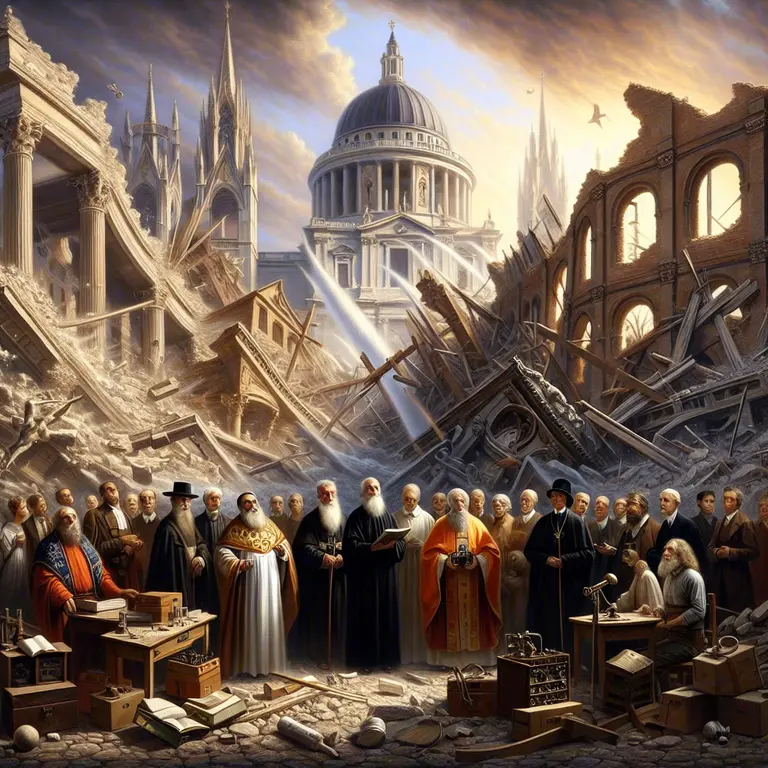
 Watch on YouTube
 Watch on Rumble
The Catastrophe That Shook More Than Earth
On the morning of November 1, 1755—All Saints’ Day—one of history’s most consequential natural disasters struck the Portuguese capital of Lisbon. At approximately 9:40 AM, as churches filled with worshippers, the earth began to tremble. What followed was not merely a seismic event but a cascading catastrophe of unprecedented proportions that would transform European thought.
The initial tremors, estimated at a magnitude of 8.5-9.0, lasted nearly six minutes—an eternity for an earthquake. Survivors reported that fissures up to 15 feet wide opened in the city center. Within minutes, the sea withdrew from the harbor, exposing the seafloor littered with lost cargo and shipwrecks, only to return as three massive tsunami waves reaching heights of 40 feet. The rushing waters penetrated nearly half a mile inland.
As if this weren’t enough, the earthquake toppled countless candles and cooking fires, igniting a firestorm that raged for five days. Between 30,000 and 50,000 people—nearly 20% of Lisbon’s population—perished. The city’s architectural treasures, including 85% of its structures, were destroyed. The earthquake demolished the Royal Palace, the Opera House, and countless churches filled with priceless art. The recently completed Ribeira Palace library, which contained 70,000 volumes and hundreds of works of art, including Titian paintings, was destroyed by fire.
The Philosophical Earthquake
Perhaps no natural disaster has ever had such profound intellectual consequences. The Lisbon earthquake occurred during the height of the Enlightenment, when European thinkers were confidently asserting the rationality of humans and the benevolence of the divine. The catastrophe struck at the heart of these optimistic assumptions.
Voltaire, already skeptical of religious explanations, seized upon the disaster in his satirical masterpiece “Candide.” He mercilessly attacked Leibnizian optimism—the philosophical position that we live in “the best of all possible worlds”—by having his characters experience the earthquake firsthand. How could a benevolent deity allow devout worshippers to be crushed in churches on a holy day?
The earthquake particularly troubled philosophers because it defied simple moral explanations. Unlike wars or plagues, which could be attributed to human failings, the randomness of who lived and died seemed to mock divine justice. Priests who claimed the earthquake was divine punishment for sin had to explain why Lisbon’s red-light district, Alfama, remained largely intact while nearly all the city’s churches were destroyed.
Jean-Jacques Rousseau entered the philosophical fray with a response to Voltaire that introduced early concepts of human-environment interaction. In his letter on Providence, Rousseau argued that the disaster’s severity was amplified by human choices—specifically, urban density and building practices. “Nature did not construct twenty thousand houses of six to seven stories there,” he wrote, suggesting that human vulnerability was largely self-created. This exchange between Voltaire and Rousseau represents one of the Enlightenment’s most significant debates on natural evil, human responsibility, and divine providence.
Immanuel Kant, then a young scholar, wrote three separate scientific treatises on the earthquake, marking some of his earliest published works. These papers helped establish the modern science of seismology, as Kant attempted to understand natural disasters through reason rather than theology. Kant’s approach was revolutionary—he sought to identify patterns in earthquake reports from across Europe to develop a comprehensive theory of seismic activity, even hypothesizing about subterranean caves filled with combustible materials that might explain the transmission of seismic waves.
The Birth of Modern Disaster Response
From the rubble of Lisbon emerged the first modern, state-led disaster response. Portugal’s Prime Minister, Sebastião José de Carvalho e Melo (later the Marquis of Pombal), reportedly responded to the crisis with the pragmatic order: “Bury the dead and feed the living.”
Pombal implemented extraordinary measures that would become the template for disaster management centuries later. He dispatched troops to prevent looting and distribute food. Price controls were established to prevent profiteering. He ordered an empire-wide survey—essentially the first scientific assessment of earthquake damage—asking priests throughout Portugal to report when they felt tremors, what damage occurred, and whether they observed unusual natural phenomena.
The questionnaire Pombal distributed contained 13 detailed inquiries that would not seem out of place in modern seismological research. It inquired about the duration of shaking, the direction of movement, observable effects on water bodies, and patterns of structural damage. The responses he received created an unprecedented dataset that allowed for the first empirical mapping of an earthquake’s effects across a wide geographic area.
Perhaps most remarkably, Pombal oversaw what may have been history’s first engineered earthquake-resistant reconstruction. Engineers developed the “Pombaline cage,” an ingenious wooden lattice structure built into the walls of new buildings that could flex during earthquakes without collapsing. This system was a precursor to modern seismic design principles and was so effective that many structures built with this technique still stand in Lisbon today.
The reconstruction of Lisbon also introduced modern urban planning concepts. Pombal’s chief engineer, Manuel da Maia, designed wide streets in a grid pattern, standardized building heights, and implemented the first building codes that required the use of fire-resistant materials. When aristocratic landowners protested the reconfiguration of property lines, Pombal famously responded, “The dead are buried; now we must care for the living.” This prioritization of public safety over property rights marked a significant shift in the philosophy of governance.
The Seismic Shift in Risk Management
The Lisbon earthquake also transformed how societies handle risk. The disaster bankrupted many of Europe’s earliest insurance ventures, which had no mathematical framework for assessing catastrophic risk. In response, new probabilistic approaches to risk assessment emerged.
The Lisbon catastrophe notably transformed the nascent insurance industry in London. Lloyd’s of London, which had begun as a coffee house where shipping merchants exchanged information, evolved more rapidly toward formal underwriting practices after the earthquake demonstrated the need for financial mechanisms to manage catastrophic risk. The disaster catalyzed the development of actuarial science as mathematicians sought ways to quantify and price the risk of rare but devastating events.
The earthquake also accelerated the development of what is now known as seismology. Before Lisbon, earthquakes were primarily explained through religious or mystical frameworks. Afterward, natural philosophers began to observe and classify seismic phenomena systematically. John Michell, a British geologist, published a groundbreaking paper in 1760 that proposed earthquakes traveled as waves through the earth—an astonishing insight that preceded modern wave theory by decades. He based his conclusions partly on reports from the Lisbon earthquake.
Perhaps most significantly, the disaster shifted European governance toward secularism. When religious authorities in Portugal suggested the appropriate response was prayer and penitence, Pombal famously retorted, “And build some houses.” His pragmatic, state-led response strengthened secular authority at the expense of the Church. Pombal went further, using the crisis to diminish the Jesuits’ influence and eventually expelling the order from Portugal entirely—a policy later adopted by other European powers.
Legacy and Modern Parallels
The intellectual and political aftershocks of the Lisbon earthquake continue to resonate in modern approaches to disaster management. The tension between theological and scientific explanations for catastrophe persists in contemporary discourse. When disasters strike today, religious interpretations still emerge alongside scientific analyses, echoing the philosophical debates of the 18th century.
Pombal’s innovative disaster response strategies—centralized coordination, evidence-based assessment, forward-looking reconstruction—remain core principles of modern emergency management. His recognition that disasters create opportunities for social reform anticipated by centuries what disaster scholars now call “build back better”—the concept that post-disaster reconstruction should not merely replace what was lost but improve upon it.
The Lisbon earthquake forced European thinkers to confront the limits of human understanding and the unpredictability of nature. It helped shift intellectual discourse from theological explanations toward scientific inquiry and from divine providence toward human responsibility. In this sense, the tremors that began on that November morning in 1755 continue to reverberate through our modern conception of disaster, risk, and resilience.