
Freeze Survival: North American Frogs' Cryogenic Adaptation
How certain frog species survive being completely frozen during winter months through remarkable biochemical adaptations.
 Watch on YouTube
 Watch on Rumble
Introduction
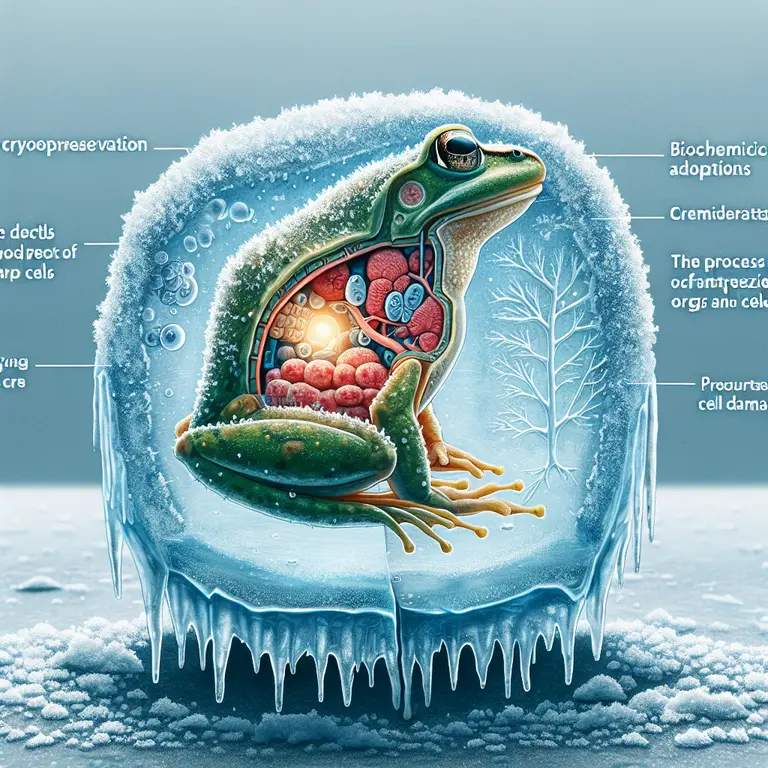
In the coldest regions of North America, several species of frogs perform what appears to be a biological miracle each winter. The wood frog (Lithobates sylvaticus), spring peeper (Pseudacris crucifer), and gray treefrog (Hyla versicolor) possess the remarkable ability to survive being frozen solid for weeks or even months. As temperatures drop below freezing, up to 65% of the water in their bodies turns to ice. Their hearts stop beating, blood flow ceases, and all visible signs of life disappear. Yet when spring arrives, and temperatures rise, these amphibians thaw and resume normal activities as if nothing extraordinary happened.
This phenomenon, known as freeze tolerance, represents one of the most extreme physiological adaptations in the vertebrate world. While many organisms can survive cold temperatures through various mechanisms, these frogs endure the formation of ice crystals throughout their tissues and organs—a condition that would be fatal to most animals, including humans. This natural cryopreservation strategy has evolved over millennia as a survival mechanism, allowing these species to thrive in environments where other amphibians cannot survive, and offering potential insights for human medical applications.
The Biochemistry of Freezing Alive
The secret to freeze tolerance lies in a sophisticated biochemical preparation that begins in autumn as temperatures drop. When wood frogs sense the approaching freeze, their livers start producing massive amounts of glucose—up to 250 times normal levels. This glucose, along with urea and other cryoprotectants, floods their cells and acts as a natural antifreeze.
Unlike typical antifreeze that prevents freezing altogether, these compounds allow ice to form in safe spaces between cells while protecting the cellular structures themselves. The high concentration of glucose prevents excessive dehydration of cells as water is drawn out to form ice in extracellular spaces. This prevents the lethal cell shrinkage and membrane damage that would typically occur during freezing.
The freezing process itself follows a precise sequence. Ice formation typically begins in the frog’s extremities and gradually moves inward. As ice forms in the abdomen and eventually throughout the body, the heart rate slows dramatically before stopping completely. Breathing ceases, and neural activity becomes undetectable. By conventional definitions, the frog appears dead. Yet at the cellular level, vital processes continue at a nearly imperceptible pace, maintained by the glucose that saturates the tissues.
Perhaps most remarkably, these frogs can endure multiple freeze-thaw cycles within a single winter. Research has shown that wood frogs can survive being frozen solid at temperatures as low as -4°C (25°F) for more than two weeks, with their internal organs protected by glucose concentrations that would cause diabetes in humans. During thawing, the heart is typically the first organ to resume function, beginning to beat even while ice remains in other parts of the body. Within hours of complete thawing, the frogs regain their mobility and return to their usual behavior patterns.
Evolutionary Puzzles and Geographic Distribution
The evolution of freeze tolerance presents intriguing questions. This adaptation appears to have evolved independently in several amphibian lineages, suggesting intense selective pressure in specific environments. The wood frog displays the most extreme freeze tolerance and has the northernmost range of any North American amphibian, extending into the Arctic Circle in Alaska and Canada.
Interestingly, freeze tolerance varies geographically even within a single species. Wood frogs from Alaska can survive longer freezes and lower temperatures than their counterparts from Ohio or Pennsylvania. Alaskan wood frogs produce more glucose and other cryoprotectants, allowing them to survive temperatures below -18°C (0°F) and remain frozen for over seven months—essentially spending more time frozen than thawed each year.
This geographic variation suggests rapid evolutionary adaptation to local conditions, as populations that colonized colder regions after the last ice age developed enhanced freeze tolerance mechanisms. The genetic basis for these differences is still being investigated, but research suggests that both genetic adaptations and epigenetic changes play roles in the enhanced cold hardiness of northern populations.
Freeze tolerance is also linked to drought tolerance in some species, as both conditions require cells to withstand significant dehydration stress. This connection may explain why particular species of frogs possess these abilities while closely related species do not. The ecological advantages are clear: freeze-tolerant species can exploit habitats and hibernation sites that are unavailable to other amphibians, thereby reducing competition and predation risk during the vulnerable winter months.
Cellular Mechanisms and Physiological Adaptations
The cellular mechanisms underlying freeze tolerance extend far beyond the simple production of glucose. When freezing begins, wood frogs activate specific genes that produce antifreeze proteins and ice-nucleating proteins. The latter actually promotes controlled ice formation in safe locations, preventing the damaging spread of ice crystals that would otherwise rupture cell membranes.
These frogs also undergo extensive preparation of their cell membranes before freezing. The composition of membrane lipids changes to maintain fluidity at low temperatures, and membrane proteins are modified to continue functioning in high-glucose environments. Mitochondria, the cellular powerhouses, undergo structural changes that enable them to resume energy production rapidly upon thawing.
Another crucial adaptation involves managing oxidative stress. When oxygen flow resumes after thawing, it creates potentially damaging free radicals in tissues. Freeze-tolerant frogs produce elevated levels of antioxidant enzymes that neutralize these harmful molecules, preventing the reperfusion injury that often occurs in oxygen-deprived tissues. This aspect of freeze tolerance has particular relevance to human medicine, where reperfusion injury remains a significant challenge in treating stroke, heart attack, and trauma.
The frogs also exhibit remarkable brain adaptations. Neural tissue is typically susceptible to oxygen deprivation and physical damage from ice crystals. Yet, freeze-tolerant frogs have evolved mechanisms to protect their brain cells during freezing, including specialized neuron membranes and an enhanced production of protective proteins that prevent programmed cell death under stress conditions.
Medical Implications and Biomimicry
The exceptional cryoprotective abilities of freeze-tolerant frogs have attracted significant attention from medical researchers. Understanding how these amphibians protect their cells and tissues during freezing could revolutionize organ preservation for transplantation. Currently, human organs remain viable for transplantation for only hours outside the body, severely limiting the geographic range for organ sharing.
Researchers at the University of Minnesota and other institutions are studying wood frog cryoprotectants to develop better preservation solutions for human tissues. The mechanisms that protect frog hearts during freezing may be particularly valuable, as heart tissue is susceptible to oxygen deprivation.
Beyond organ preservation, these adaptations could inform cryonic preservation technologies or treatments for conditions involving ischemia (restricted blood flow). Some scientists speculate that understanding how frogs prevent cell death during freezing might eventually contribute to suspended animation techniques for long-duration space travel.
The pharmaceutical industry has also taken an interest in these frogs’ natural compounds. Several research teams are investigating whether synthetic versions of the frogs’ cryoprotectant molecules could be developed as therapeutic agents for preventing tissue damage during cardiac surgery, stroke treatment, or organ transplantation.
Conclusion
The freeze tolerance of North American frogs represents one of nature’s most extraordinary adaptations—a testament to the remarkable plasticity of life in the face of extreme environmental challenges. These amphibians have essentially solved problems that continue to baffle human medical science: how to preserve complex tissues during freezing, how to prevent damage during oxygen deprivation, and how to successfully revive an organism after extended metabolic arrest.
As climate change alters winter conditions across North America, researchers are now monitoring how these freeze-tolerant species adapt to increasingly variable freeze-thaw cycles and unpredictable winter temperatures. Their ability to adjust their cryoprotective mechanisms may determine whether they can continue to thrive in rapidly changing environments.
While human applications remain largely theoretical, the humble wood frog continues to demonstrate that sometimes the most revolutionary biological innovations aren’t found in exotic tropical species, but in common creatures that have evolved extraordinary solutions to survive in extreme environments right beneath our feet. By studying these remarkable amphibians, we gain not only scientific knowledge but also a deeper appreciation for the ingenious adaptations that enable life to persist in seemingly impossible conditions.