
Victorian Post-Mortem Photography: Mourning Through Images
How 19th century families preserved the memory of deceased loved ones through an unsettling photographic practice that reflected period attitudes toward death.
 Watch on YouTube
 Watch on Rumble
The Birth of a Macabre Tradition
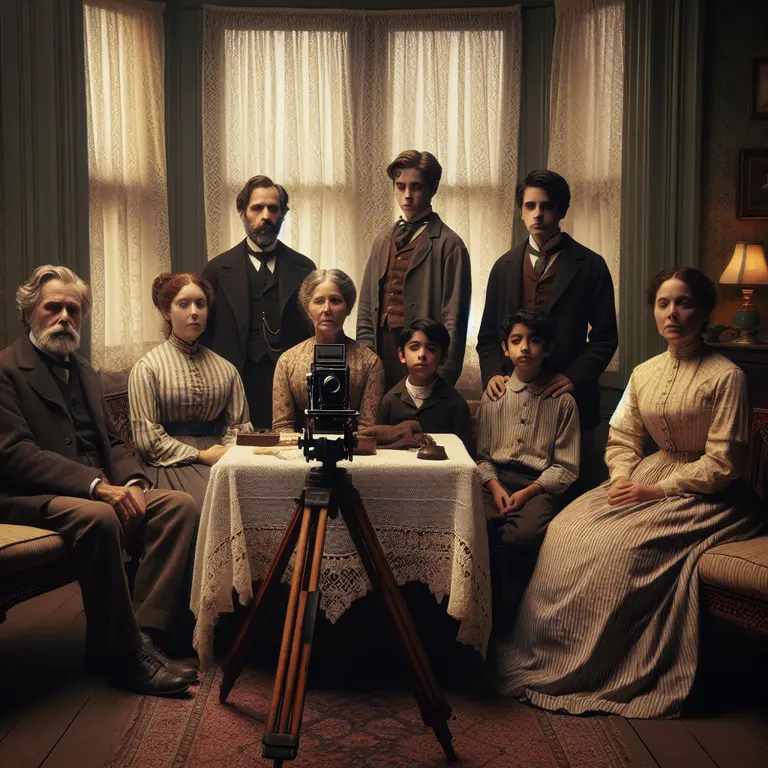
In the mid-19th century, as photography became commercially viable but remained expensive, a peculiar practice emerged that modern sensibilities might find disturbing. Post-mortem photography—the photographing of recently deceased individuals, often posed as if still alive—became a significant mourning ritual throughout Victorian-era Europe and America. The practice emerged from the intersection of new technology, high mortality rates (especially among children), and the Victorian cultural obsession with memorializing the dead.
The daguerreotype process, introduced commercially in 1839, required subjects to remain completely still for up to 15 minutes during early iterations—the deceased, in their eternal stillness, made for ideal subjects in this technical regard. For many families, especially those of modest means, a post-mortem photograph might represent the only visual record they would ever possess of a loved one, particularly of children who died before having their portrait taken while alive.
The Victorian era witnessed infant mortality rates as high as 40% in some urban areas, with diseases like diphtheria, scarlet fever, and cholera claiming countless young lives. This grim reality shaped a culture that developed elaborate mourning rituals and a complex relationship with death. Queen Victoria herself, following Prince Albert’s death in 1861, entered a state of perpetual mourning that normalized and even glorified the public expression of grief. In this context, post-mortem photography served not merely as documentation but as an essential component of the grieving process—a tangible connection to the departed that could be revisited and cherished.
Photographers who specialized in this delicate art often advertised discreetly in newspapers and trade directories, offering to visit homes “at any hour of day or night” to capture the likeness of the recently deceased before decomposition altered their appearance. Speed was essential, and many photographers kept special equipment ready for these somber assignments, which could constitute a significant portion of their business in an era when death was a frequent visitor to even the wealthiest households.
Techniques and Aesthetics of Memorializing the Dead
Post-mortem photographers employed various techniques to create the illusion of life or to frame death in aesthetically acceptable ways. In the earliest examples, photographers often positioned bodies in beds or coffins, acknowledging the reality of death. As the practice evolved, however, photographers began staging more elaborate scenes.
One common approach was the “last sleep” pose, where the deceased would be arranged on a bed or couch as if merely sleeping. More unsettling to modern viewers were attempts to create an illusion of life, with bodies propped up in chairs, eyes painted onto closed eyelids in post-production, or special stands and braces used to position the body upright. In family portraits, deceased children may be held by their parents or positioned among their living siblings.
Some photographers specialized in this morbid art form. The most skilled practitioners could manipulate the facial features of the deceased to approximate a peaceful expression or even a slight smile. They might add color to cheeks and lips during the developing process, creating a more lifelike appearance in the final image.
The technical challenges were considerable. Rigor mortis, which begins 2-6 hours after death, required photographers to either work quickly or manipulate stiffened limbs. Some practitioners developed specialized tools—including hidden stands, posing blocks, and adjustable chairs—that could support a body in various positions while remaining invisible in the final image. Wire frameworks hidden beneath clothing could maintain a natural-looking posture, while glass eyes might occasionally be inserted to replace the sunken appearance that occurs shortly after death.
The aesthetics of these images evolved with photographic technology. Early daguerreotypes, with their silvery, mirror-like surfaces, created an ethereal quality that seemed particularly appropriate for memorializing the dead. Later processes, such as ambrotypes (on glass) and tintypes (on metal), democratized the practice, making post-mortem portraits more affordable for working-class families. By the 1880s, cabinet cards and cartes de visite—paper photographs mounted on cardboard—enabled multiple copies to be shared among extended family members, creating distributed networks of remembrance.
Hidden Codes and Visual Symbolism
Post-mortem photographs incorporated subtle visual cues and symbols that contemporaries would recognize as signifiers of death. These elements created a visual language that acknowledged death while softening its harsh reality.
Flowers, particularly lilies, symbolized the restored innocence of the soul after death. Wreaths represented eternal life. Posed hands often held religious items such as Bibles or rosaries. Children might be photographed with their favorite toys or symbolic items, such as doves (representing the soul’s ascent to heaven).
More subtle indicators included certain poses that would have been impossible for the living to maintain. In group photographs, the deceased might be slightly out of focus compared to living subjects, as photographers sometimes used shorter exposure times for the dead who could not move or blur the image.
Perhaps most intriguing was the practice of positioning the deceased in ways that created visual ambiguity—the viewer might initially perceive the subject as alive, only to notice subtle indicators of death upon closer inspection. This reflected the Victorian concept of death as merely a transition rather than an end.
The visual language extended beyond the photograph itself. Many post-mortem images were displayed in specialized mourning frames of black lacquer or were kept in lockets and mourning jewelry worn close to the heart. Some were incorporated into elaborate memory tableaux alongside locks of hair, pressed flowers from the funeral, or handwritten memorial verses. These composite objects transformed the photograph from mere representation into a form of reliquary—a sacred object that contained both the image and symbolic fragments of the deceased.
Certain cultural and religious traditions developed their own distinct approaches. In the American South, African American communities incorporated elements of their spiritual traditions, while Catholic regions often emphasized religious iconography. In parts of Eastern Europe, particularly Romania and Hungary, post-mortem photography developed unique regional styles that sometimes included multiple village members posing with the deceased as a form of community acknowledgment and respect.
The Decline and Contemporary Rediscovery
As photography became more affordable and common in the early 20th century, the practice of post-mortem photography gradually declined. Improving mortality rates meant fewer childhood deaths, and changing attitudes toward death—increasingly viewed as something to be managed by professionals rather than experienced within the home—made the practice seem morbid rather than comforting.
By the 1930s, post-mortem photography had largely disappeared from mainstream culture, though it persisted in some rural communities and certain cultural traditions. The thousands of images that survived, however, remained tucked away in family albums and archives, considered too disturbing or private for public display.
The medicalization of death fundamentally altered Western relationships with mortality. As hospitals replaced homes as the primary site of dying, and funeral homes took over the preparation of bodies from family members, death became increasingly invisible in everyday life. Photography, meanwhile, shifted its focus toward capturing life’s happy moments rather than its inevitable conclusion. The few post-mortem photographs still taken became clinical rather than sentimental, produced for medical or forensic purposes rather than familial remembrance.
In recent decades, collectors, historians, and cultural anthropologists have rediscovered these images, recognizing their significance as artifacts of changing attitudes toward death, grief, and remembrance. Significant collections now exist in museums and private archives, with exhibitions occasionally showcasing these haunting images to modern audiences.
Contemporary scholarship has reframed these photographs not as macabre curiosities but as profound expressions of love and loss—tangible evidence of how previous generations confronted mortality and preserved memory in an era before death became institutionalized and hidden away from everyday life. Digital archives, such as the Thanatos Archive, have preserved thousands of these images. At the same time, books and exhibitions have brought them to wider public attention, sparking renewed conversations about how modern society might develop healthier relationships with mortality by understanding historical approaches to grief and remembrance.
Conclusion
Victorian post-mortem photography represents a lost visual language of mourning—one that speaks to fundamentally different understandings of death, memory, and representation. These images, initially jarring to contemporary sensibilities, reveal a society that integrated death into the fabric of everyday life rather than sequestering it behind institutional walls. The careful positioning, symbolic elements, and technical innovations employed by post-mortem photographers demonstrate not a morbid fascination with death but rather a profoundly human desire to preserve connection with loved ones beyond the threshold of mortality.
As modern society continues to grapple with increasingly mediated relationships to death and dying, these photographs offer a window into alternative approaches to grief—approaches that acknowledge death’s reality while creating tangible artifacts of remembrance. The Victorian camera, in capturing the dead, paradoxically gave them a form of immortality, preserving not just their image but the love of those who commissioned these final portraits. In this way, post-mortem photography served its ultimate purpose: transforming absence into presence, if only through the alchemy of silver and light.