
Peshtigo Firestorm: America's Deadliest Forgotten Wildfire
An exploration of the deadliest wildfire in American history that occurred simultaneously with the Great Chicago Fire but claimed far more lives.
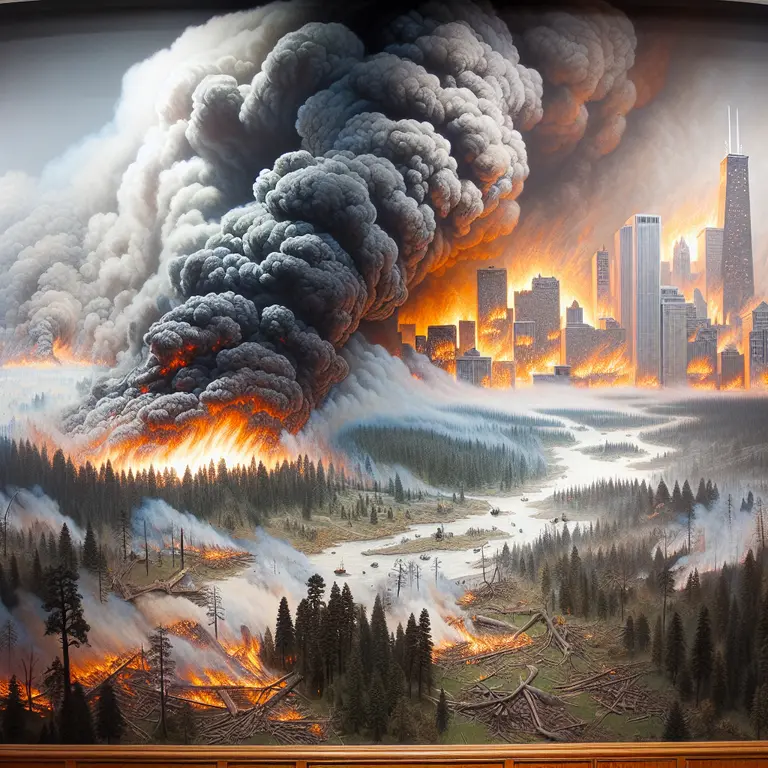
 Watch on YouTube
 Watch on Rumble
In the annals of American disasters, inevitable catastrophes become defining moments in our collective memory, while others fade into obscurity despite their magnitude. The Great Chicago Fire of 1871 has been immortalized in history books, commemorated in museums, and embedded in our national consciousness. Yet on that same fateful day of October 8, 1871, a far deadlier conflagration was consuming lives and land to the north. This disaster would claim more American lives than any wildfire before or since, but remain largely forgotten by history.
The Shadow of Chicago
On October 8, 1871, while the Great Chicago Fire was beginning its destructive path through the Windy City, another far more deadly conflagration was erupting 250 miles to the north. The Peshtigo Fire, which swept through northeastern Wisconsin and parts of Michigan’s Upper Peninsula, remains the deadliest wildfire in American history, claiming between 1,500 and 2,500 lives—yet it has been largely forgotten in the national consciousness.
While Chicago’s tragedy dominated national headlines and subsequently became legendary, the Peshtigo disaster occurred in a remote region with limited communication infrastructure. The fire itself had destroyed telegraph lines that might have carried news of the catastrophe. The result was a historical anomaly: a disaster of unprecedented proportions that became a mere footnote in American history.
The disparity in attention between these simultaneous disasters reflects the socioeconomic realities of 19th-century America. Chicago represented the nation’s burgeoning industrial might and commercial aspirations—a symbol of American progress. Peshtigo, by contrast, was a small lumber town on the frontier, primarily populated by immigrant workers and their families. When both burned on the same night, the nation’s eyes turned toward the destruction of capital and commerce rather than the greater loss of human life on the frontier.
Even the timing of news dissemination played a crucial role in this historical oversight. Reports of Chicago’s burning reached New York and other eastern cities within hours, while comprehensive accounts of Peshtigo’s destruction took days or even weeks to emerge. By then, the news cycle had solidified around the Chicago narrative, leaving little room for the Wisconsin tragedy.
A Perfect Firestorm
The conditions preceding the Peshtigo Fire created what modern fire scientists would call the perfect environment for a firestorm. The region had experienced an arid summer and early fall in 1871. The area around Peshtigo was heavily forested and had been subjected to significant logging operations, leaving behind enormous amounts of slash—discarded tops and branches—that essentially created a tinderbox across the landscape.
Compounding these factors was the common practice of “land clearing” by settlers and railroad companies, who regularly set small fires to clear brush. On October 8, a cold front moved through the region, bringing strong winds that fanned numerous small fires into a single, massive conflagration.
The resulting fire was so intense that it created its own weather system—a phenomenon now known as a firestorm. Temperatures reached an estimated 2,000 degrees Fahrenheit, hot enough to melt sand into glass and turn the Peshtigo River into the townspeople’s only refuge. Survivors reported seeing “fire tornados” and balls of fire seemingly falling from the sky. The conflagration moved so rapidly that many victims had only minutes to react before being overtaken.
Modern meteorologists and fire scientists have retrospectively studied the Peshtigo event as a case of what’s now termed a “plume-dominated fire.” As the intense heat created a massive convection column that rose miles into the atmosphere, it generated its own wind patterns, drawing in more oxygen from surrounding areas and creating a self-perpetuating cycle of intensification. The fire front reportedly moved at speeds exceeding 100 miles per hour at specific points—faster than any human could flee on foot.
The fire’s behavior exhibited phenomena rarely seen in nature. Witnesses described “fire whirls” (sometimes called fire tornadoes) that could uproot trees and hurl burning debris hundreds of feet into the air. These vortices of flame could generate localized wind speeds approaching those of an F3 tornado. The extreme heat caused pyrolysis—the chemical decomposition of organic materials—even before flames arrived, effectively turning the forest itself into a volatile gas ready to ignite.
Survival Against Impossible Odds
The accounts of survival from the Peshtigo Fire border on the miraculous. Father Peter Pernin, a Catholic priest in the region, provided one of the most comprehensive firsthand accounts. He described pulling his church’s tabernacle into the Peshtigo River, where he spent hours partially submerged in the cold water as the world burned around him.
Other survivors reported taking refuge in wells, potato fields, and newly plowed land. One family survived by huddling in the middle of a freshly harvested potato field, covering themselves with dirt. A particularly remarkable case involved a woman who gave birth while taking refuge in the Peshtigo River, with both mother and child surviving the ordeal.
The fire moved with such speed and intensity that many victims were found in positions suggesting they had been overcome almost instantly. Some bodies were reduced entirely to ash, with only metal buttons or belt buckles remaining to indicate a human had been there at all.
Among the most haunting survival stories is that of the Williamson family. As the fire approached their homestead, they realized escape was impossible. In desperation, Mr. Williamson dug a shallow trench in their freshly plowed field, had his wife and five children lie in it, and covered them with wet blankets and soil before joining them. For hours, they lay breathing through small air holes as the inferno passed over them. When they finally emerged, their home and every structure within miles had been reduced to ash, yet they had survived virtually unharmed.
In the town of Peshtigo itself, the river became the primary refuge. Hundreds of people crowded into the water, many holding onto logs or debris to stay afloat in the frigid current. Some survivors remained in the water for over five hours, suffering hypothermia while paradoxically being surrounded by extreme heat. Several accounts describe the surreal experience of having one’s back blistered by radiant heat while simultaneously suffering frostbite on submerged limbs.
Scientific and Historical Legacy
The Peshtigo Fire fundamentally changed the understanding of wildfire behavior. The concept of a firestorm—where a fire creates its own wind system and weather—was first documented following this disaster. Modern wildfire science has identified the Peshtigo Fire as an example of an extreme fire behavior event that defies conventional firefighting techniques.
In recent decades, as climate change has increased the frequency and intensity of wildfires globally, fire scientists have revisited the Peshtigo disaster for insights. The conditions that created the 1871 catastrophe—drought, fuel accumulation, multiple ignition points, and strong winds—are increasingly common in our warming world.
Historically, the disaster led to changes in forestry practices, which eventually gave rise to the development of more sophisticated approaches to forest management. However, its relative obscurity compared to the Chicago Fire represents a curious case of historical amnesia, demonstrating how factors beyond mere casualty counts—including geographic remoteness, economic impact, and media coverage—shape what events become embedded in national memory.
Today, a small museum in Peshtigo, Wisconsin, preserves artifacts from the fire, including melted glass, fused coins, and the cemetery where many unidentified victims were buried in a mass grave. Each October, the community commemorates what remains America’s deadliest fire disaster—a catastrophe that, despite its massive toll, has been largely overshadowed by the coincidental Chicago Fire that claimed far fewer lives.
The Peshtigo Fire serves as a humbling reminder of nature’s fantastic, destructive potential and the capriciousness of historical memory. In an era when media coverage increasingly shapes our understanding of disasters, the story of America’s deadliest wildfire stands as a testament to how easily catastrophic events can slip from our collective consciousness when they occur in the wrong place at the wrong time.