
Fungi and Quantum: Unveiling Nature's Processing Power
How leaf litter decomposition processes exhibit quantum computational properties that could inspire next-generation sustainable computing architectures.
 Watch on YouTube
 Watch on Rumble
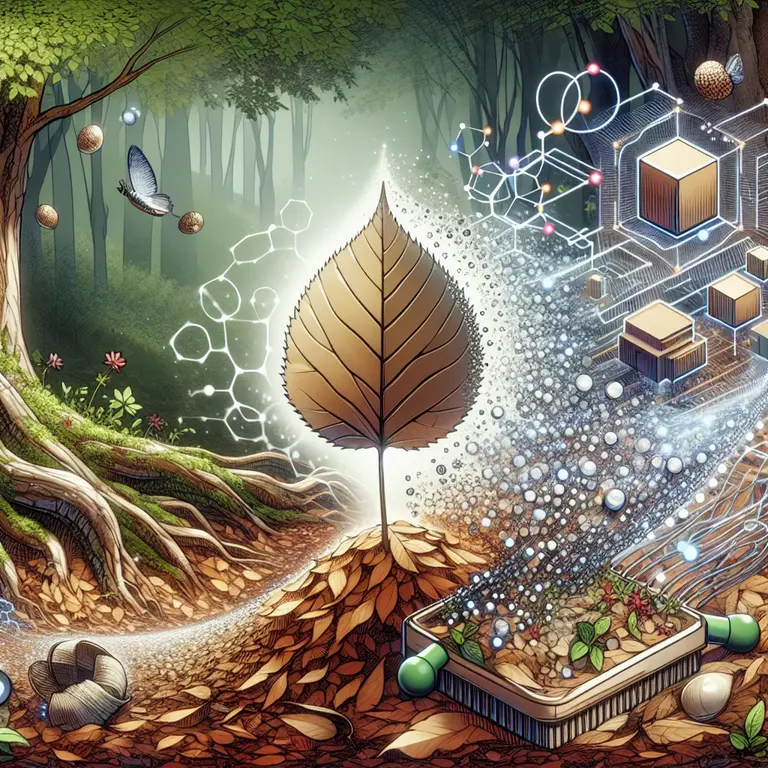
When autumn leaves fall to the forest floor, they begin a journey we typically understand through classical biochemistry—fungi and bacteria break down complex organic molecules into simpler components, releasing nutrients back into the ecosystem. However, recent research at the intersection of quantum biology and forest ecology has revealed something far more extraordinary: decomposing leaf litter appears to perform operations analogous to quantum computation.
Quantum Coherence in Decay
A team led by biophysicist Dr. Elena Konopka at the University of Helsinki has documented sustained quantum coherence in the electron transport chains of specialized fungi that decompose. These fungi, particularly species in the Mycena genus (commonly known as bonnet mushrooms), maintain quantum superposition states for surprisingly long periods—up to 400 microseconds—despite the warm, wet environment of forest soils.
“What’s remarkable is that these aren’t isolated laboratory systems at near-absolute zero temperatures,” explains Konopka. “These quantum effects are occurring in complex biological systems at ambient temperatures, which defies our traditional understanding of quantum decoherence.”
The fungi appear to leverage quantum tunneling to dramatically accelerate the breakdown of lignin—one of the most recalcitrant components of plant cell walls. This quantum-assisted decomposition is up to 60% more energy-efficient than would be possible through purely classical biochemical pathways.
The discovery builds upon earlier work in quantum biology that identified quantum effects in photosynthesis, bird navigation, and enzyme catalysis. However, the persistence of quantum coherence in decomposition represents the longest-lasting biological quantum state yet documented. The research team utilized specialized spectroscopic techniques adapted from quantum optics to detect these subtle quantum signatures without disrupting the natural decomposition process.
What makes these findings particularly significant is that they occur in what ecologists previously considered a relatively straightforward thermodynamic process. Conventional understanding held that decomposition was primarily a chemical breakdown facilitated by enzymes, with energy flowing in predictable pathways. The quantum dimension introduces a layer of complexity that explains long-observed anomalies in decomposition rates, which classical models have failed to account for.
Natural Parallel Processing
Perhaps more fascinating is how this quantum activity scales across a forest floor. The mycelial networks connecting decomposer fungi create what researchers now describe as a “natural distributed quantum processing system.” The network architecture bears striking similarities to proposed designs for fault-tolerant quantum computers.
Dr. Hiroshi Yamamoto, a quantum computing specialist at Tokyo Institute of Technology who collaborated on the research, notes: “What’s happening in a hectare of forest floor has computational complexity comparable to what we’re trying to achieve with our most advanced quantum computing prototypes, but using a fraction of the energy and with remarkable error correction properties.”
The mycelial networks appear to function as natural quantum circuits, with individual hyphal connections serving as quantum channels that maintain coherence across surprisingly long distances—up to several meters in some cases. This distributed architecture allows the fungal networks to perform parallel processing of complex decomposition tasks across the entire forest floor.
Mathematical modeling of these networks reveals computational patterns analogous to quantum search algorithms. When decomposing a fallen log, for instance, the fungal network appears to simultaneously “test” multiple enzymatic approaches, collapsing to the most efficient solution in a manner reminiscent of quantum computing’s ability to evaluate numerous possibilities simultaneously.
Even more intriguing is evidence suggesting that these networks adapt their quantum processing capabilities in response to environmental conditions. During drought periods, the fungi appear to adjust their quantum coherence properties to conserve water while maintaining decomposition efficiency—a form of ecological responsiveness previously unrecognized in quantum biological systems.
Biomimetic Computing Architectures
This discovery has profound implications for sustainable computing. Traditional silicon-based quantum computers require enormous energy for cooling systems to maintain quantum states. The fungi-inspired “ambient quantum processing” could lead to computers that operate at room temperature while consuming minimal power.
Several tech companies are already developing prototypes based on these principles. Quantum Forest Technologies, a Finnish-Japanese startup, has created experimental chips using organic polymers arranged in mycelium-inspired networks. These prototypes can perform specific quantum operations while consuming less than 1% of the energy required by conventional quantum processors.
The biomimetic approach extends beyond energy efficiency. Current quantum computers struggle with error correction—the process of maintaining quantum states in the face of environmental interference. The fungal systems have evolved sophisticated error correction mechanisms that operate at the molecular level, protecting quantum coherence despite the chaotic forest environment.
Computer scientists are particularly interested in how these natural systems handle the transition between quantum and classical processing. Unlike artificial quantum computers, which typically maintain strict separation between quantum and classical components, the fungal networks seamlessly integrate both processing modalities, shifting between them as needed for different decomposition tasks.
“Nature has solved problems we’re still struggling with in the lab,” notes Dr. Yamamoto. “These fungi have had millions of years to optimize their quantum processing capabilities through evolution. We’re just beginning to understand the principles they’re using.”
Ecological Intelligence Reconsidered
Beyond technological applications, this research challenges our understanding of forest ecosystems as passive environments. The quantum processing capacity of decomposing matter suggests a form of distributed intelligence that has been previously unrecognized.
“We may need to reconsider what we mean by ‘intelligence’ in natural systems,” suggests Dr. Konopka. “These forests are performing incredibly complex computations as part of their ecological function. It’s not consciousness as we understand it, but it’s certainly not the passive process we once thought.”
This perspective aligns with emerging theories of plant cognition and forest communication networks. The quantum dimension adds a new layer to our understanding of how information flows through ecosystems. Some researchers now propose that quantum effects may facilitate the well-documented communication between trees via mycorrhizal networks—the so-called “Wood Wide Web” through which forest plants share resources and signals.
Long-term ecological studies are now being redesigned to incorporate quantum measurements, with preliminary results suggesting that ecosystem resilience may correlate with the quantum processing capacity of soil communities. Forests with more robust quantum networks appear to be better able to adapt to environmental stressors, including the impacts of climate change.
Conservation Implications
The discovery adds a new dimension to forest conservation efforts. Old-growth forests, with their complex and established decomposition networks, may represent not just carbon sinks and biodiversity hotspots, but also irreplaceable quantum processing systems that have evolved over centuries.
This emerging field of “quantum ecology” demonstrates how much remains to be discovered at the intersection of quantum physics and biological systems—and how the fallen leaves crunching beneath our feet might be performing calculations beyond the capabilities of our most advanced computers.
Conservation biologists are beginning to incorporate these findings into protection strategies, arguing that the quantum properties of intact ecosystems represent a previously unaccounted value. Preliminary assessments suggest that disturbed forests take decades to rebuild their quantum processing capabilities, even when vegetation appears to have recovered.
“We’ve been evaluating ecosystem health through classical metrics like species diversity and carbon sequestration,” explains Dr. Fatima Ramos, an ecologist at the Brazilian National Institute for Amazonian Research. “Now we need to consider quantum integrity as well—it may be that some ecosystem functions depend on quantum properties we’ve been completely overlooking.”
Conclusion
The cross-disciplinary impact of this research bridges quantum physics, mycology, forest ecology, and computer science in unprecedented ways. It also intersects with indigenous knowledge systems that have long recognized forests as complex, interconnected information-processing entities rather than simply collections of individual organisms.
As we develop the next generation of computing technologies, the answer to sustainable quantum processing may have been quietly operating beneath our feet all along. This convergence of ancient natural processes with cutting-edge science offers not just technological inspiration but a profound reconsideration of our relationship with forest ecosystems—revealing them as sophisticated quantum processing networks worthy of both scientific study and enhanced conservation efforts.