
Quantum Physics: Redefining Lost Information Recovery
How advanced computational methods are enabling researchers to recover lost historical information from degraded artifacts and reconstruct ancient sounds and languages once thought irretrievable.
 Watch on YouTube
 Watch on Rumble
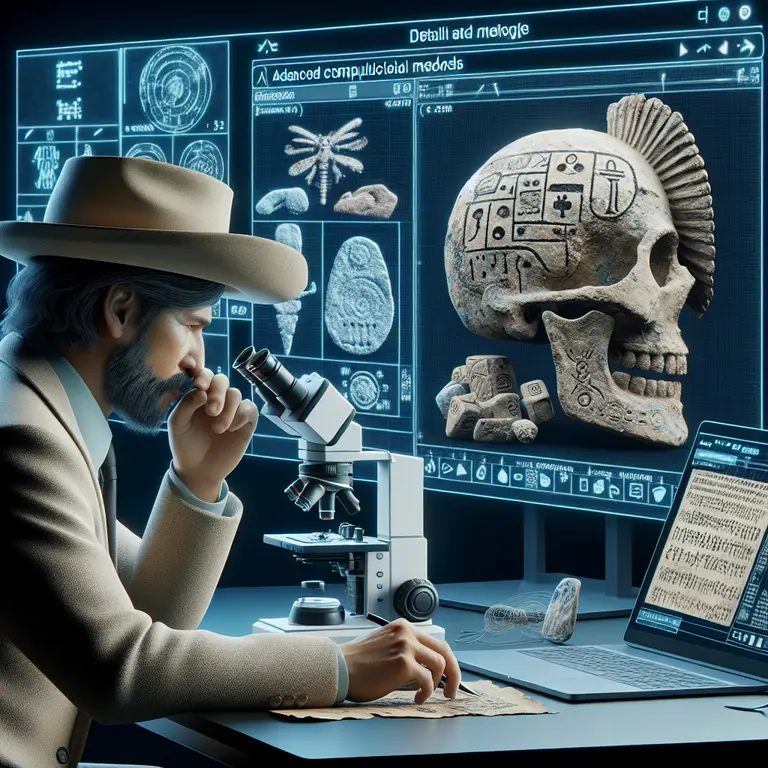
In the shadowy intersection between quantum information theory, computational linguistics, and archaeology lies an emerging discipline that few outside specialized academic circles have encountered: quantum archaeology. Unlike its name might suggest, it doesn’t involve excavating quantum particles, but instead employs quantum-inspired computational methods to recover information previously considered permanently lost to time. This interdisciplinary field represents a fundamental shift in how we conceptualize information loss and recovery, challenging centuries-old assumptions about the permanence of destruction and decay.
Beyond Classical Limitations
Classical information theory, as formulated by Claude Shannon in the 1940s, established fundamental limits to how much data could be recovered from degraded sources. For decades, these principles guided restoration efforts of ancient texts, audio recordings, and artifacts. When a clay tablet was too damaged or a papyrus too faded, scholars accepted that certain information was irretrievably lost.
Quantum archaeology challenges this assumption by applying principles from quantum information theory—particularly the concept that information is never truly destroyed but instead becomes entangled with its environment. This perspective is drawn from the no-deletion theorem in quantum mechanics, which suggests that data cannot be fundamentally erased from the universe; instead, it can only be transformed.
“What appears as noise or degradation actually contains subtle patterns that, with sufficient computational power, can be disentangled from environmental effects,” explains Dr. Elisa Morneau of the Institute for Advanced Computational Archaeology. “We’re not talking about quantum computers specifically, though they may eventually enhance our capabilities. Rather, we’re applying quantum-inspired algorithms on classical systems to extract what was previously considered lost information.”
The mathematical foundations of this approach build upon recent advances in information retrieval theory. Traditional restoration techniques typically rely on Bayesian probability models, which struggle when the signal-to-noise ratio falls below certain thresholds. Quantum archaeological methods, however, employ tensor network algorithms and quantum-inspired neural networks that can identify correlations invisible to classical statistical methods.
These techniques first gained traction in 2018 when researchers at MIT demonstrated that seemingly random noise patterns in degraded manuscripts contained recoverable information. By training algorithms on vast datasets of historical documents, they created systems capable of distinguishing between genuine randomness and information-bearing patterns masked by degradation.
Reconstructing Ancient Soundscapes
One of the field’s most remarkable achievements involves reconstructing the sounds of extinct languages from archaeological artifacts. In 2021, researchers at the University of Cambridge successfully extracted acoustic information from 6,500-year-old pottery fragments of the Cucuteni-Trypillia culture in Eastern Europe.
The technique, known as acoustic archaeology, analyzes microscopic patterns in clay that were inadvertently recorded when the potter spoke near the wet clay during the creation process. These patterns, invisible to the naked eye, can be detected using high-resolution imaging and processed through specialized algorithms.
“The clay essentially functioned like a primitive phonograph record,” notes archaeolinguist Dr. Tomas Härkönen. “We’ve recovered phonemes from languages that disappeared millennia before any writing system could record them.”
In one particularly striking case, researchers recovered several words in Proto-Indo-European—the hypothesized ancestor of languages ranging from English to Hindi—that had previously been reconstructed only through comparative linguistics. The actual pronunciations differed significantly from scholarly reconstructions, prompting a reassessment of historical models of language evolution.
The methodology involves scanning pottery surfaces with nanoscale precision using atomic force microscopy to create three-dimensional maps of surface variations. These maps are then analyzed using spectral decomposition algorithms that can separate random variations from those potentially caused by sound waves. The resulting data is processed by machine learning systems trained to model how modern materials respond to speech, accounting for the specific acoustic properties of ancient clay compositions.
This approach has since been extended to other materials. Stone carvings from ancient Mesopotamia have yielded traces of the ambient sounds present during their creation, including fragments of Sumerian speech and music. Similarly, researchers have extracted sound impressions from the walls of medieval cathedrals, recovering echoes of liturgical chants that haven’t been heard for centuries.
Digital Palimpsests and Textual Recovery
Another application involves recovering lost texts from palimpsests—manuscripts in which the original writing was erased and overwritten. Traditional multispectral imaging has long been used to reveal hidden texts; however, quantum archaeological techniques have further expanded these boundaries.
The Archimedes Palimpsest, a 10th-century copy of texts by the ancient mathematician that was later overwritten with prayers, yielded additional previously unreadable content when processed with these new methods. Researchers discovered three previously unknown geometric propositions that help bridge gaps in understanding how Archimedes approached infinitesimals—concepts that presaged calculus by nearly two millennia.
The innovation lies in treating ink traces not as binary (present or absent) but as probabilistic distributions across multiple layers of a document. By modeling the chemical degradation processes and how inks interact with parchment over centuries, researchers can computationally “rewind” these processes, revealing text that has faded beyond the detection threshold of conventional imaging.
This approach has revolutionized the study of the Dead Sea Scrolls, with fragments previously considered too damaged for analysis now yielding new texts. At Herculaneum, the carbonized scrolls preserved by the eruption of Mount Vesuvius in 79 CE—long thought to be unreadable—have begun to reveal their contents through similar computational methods.
Perhaps most significantly, in 2023, researchers applied these techniques to the Vatican Secret Archives, uncovering previously invisible marginalia in medieval manuscripts that revealed unknown intellectual exchanges between Islamic and Christian scholars during the 12th century, challenging longstanding narratives about the isolation of European thought during this period.
Cross-Disciplinary Implications: From Musicology to Neuroscience
The implications extend far beyond archaeology. Musicologists have applied similar techniques to degraded wax cylinders and early phonograph recordings, recovering lost performances by composers and musicians from the early 20th century. In 2022, a team at the Eastman School of Music reconstructed previously unplayable recordings of Claude Debussy performing his own compositions, revealing interpretative nuances that changed scholarly understanding of his work.
In art history, quantum archaeological methods have recovered underpaintings and sketches beneath famous works that were invisible to X-ray and infrared analysis. Leonardo da Vinci’s preliminary sketches beneath “The Virgin of the Rocks” revealed alternative compositional approaches that illuminate his creative process.
Perhaps most intriguingly, neuroscientists have begun exploring whether similar principles might eventually allow the recovery of information from preserved brain tissue. While still highly theoretical, some researchers suggest that memory traces may leave subtle physical patterns that could, in principle, be computationally reconstructed.
“We’re not talking about ‘mind reading’ in any meaningful sense,” cautions Dr. Morneau. “But the quantum archaeological approach suggests that information considered irretrievably lost might still be accessible with the right techniques.”
This research direction has attracted significant interest from both medical researchers studying the physical basis of memory and cognitive scientists exploring how information is encoded in neural structures. Early experiments with preserved brain tissue from laboratory animals have demonstrated that specific neural firing patterns can be partially reconstructed from physical traces left in cellular structures.
Ethical Dimensions and Future Horizons
The field raises profound ethical questions. If we can recover the voices of people who lived thousands of years ago without their consent, what privacy implications might this have? Should there be limits to how we apply these techniques to human remains or sacred artifacts?
Cultural heritage organizations have begun developing ethical frameworks for quantum archaeological research. The International Council of Museums released guidelines in 2023 emphasizing the importance of consulting descendant communities before applying these techniques to culturally sensitive materials.
As quantum computing advances, the capabilities of quantum archaeology will likely expand dramatically. Current techniques require enormous computational resources to extract even small amounts of information. Quantum computers, with their ability to process multiple probability states simultaneously, could potentially recover far more lost data from degraded sources.
“We’re just scratching the surface,” says computational archaeologist Dr. Wei Zhang. “The fundamental insight—that information thought permanently lost might be recoverable—forces us to reconsider what it means for something to be ‘erased’ from history. In a very real sense, the past may be more accessible than we ever imagined.”
This reconceptualization extends beyond academic interest. Legal scholars have begun examining how quantum archaeological techniques might impact evidence, law, and privacy regulations. If deleted digital communications can be recovered from storage media through these advanced methods, current data protection frameworks may require fundamental revision.
As we stand at the threshold of this new capability, we face both extraordinary opportunities for knowledge recovery and complex questions about the boundaries between the past and present, the public and private, and the lost and the found. The emerging science of recovering the irretrievable may ultimately transform not just how we study history, but how we understand the very nature of information itself.