Exploring the Hidden Lives and Mysteries of Slime Molds
Slime molds, despite not having a brain or nervous system, can solve complex puzzles and navigate mazes.

Discover strange, surprising, and little-known facts from science, history, nature, and beyond.

The Basse-Chaine bridge in France was brought down in 1850 due to the resonant frequency matches from French soldiers’ synchronized footsteps.
Read Article →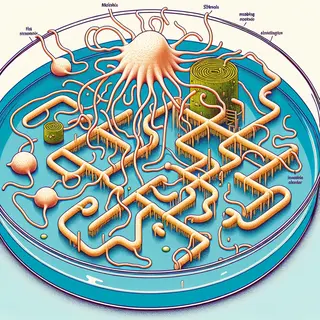 Science
Slime molds, despite not having a brain or nervous system, can solve complex puzzles and navigate mazes.
 Nature
Certain species of algae known as diatoms can move in a complex, choreographed 'dance' patterns in water.
 Nature
Some plants have a unique defense mechanism - they explode.
 Mysteries
Nine hikers mysteriously perished in the Ural Mountains in Russia in 1959. Their death's cause remains unclear.
 Nature
Seaweed contains carrageenan, an additive used to thicken, emulsify, and preserve foods and drinks.
 Mysteries
Star jelly is a gelatinous substance which, according to folklore, is deposited on the earth during meteor showers.
 History
Vinyl, the much-loved material used in records for music, was originally discovered by accident.
 Space
SpaceBubble Nebula, also known as NGC 7635, is a nebula located in the constellation Cassiopeia which gets its shape from the stellar wind of the star at its center.
 Science
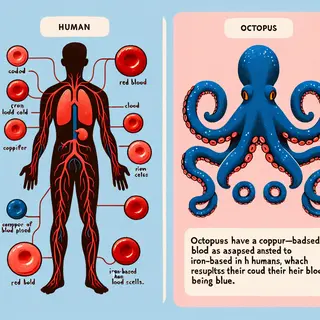
Octopuses have a copper-based blood as opposed to iron-based blood in humans, which results in their blood being blue.
 Animals
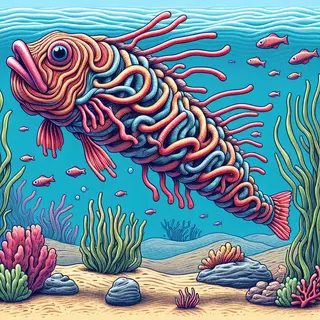
An unusual species of fish called the wigglefish that wiggles its body extensively to 'walk' on the ocean floor.
 Space
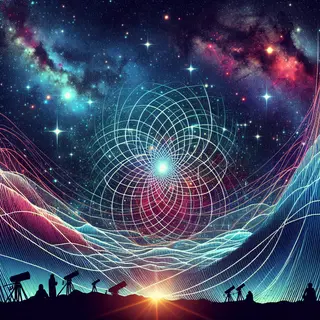
SpaceCosmologists discovered an unusual alignment of temperature fluctuations in the cosmic microwave background that goes against our understanding of the universe.
 Technology
A wind-up radio that does not require external electrical power or batteries, invented by Trevor Baylis.
 Science
A bigon is a two-dimensional geometric figure with two corners or 'vertices' and two sides or 'edges'. It is considered an illegal geometric figure in traditional geometry
 Mysteries
Lake Hillier in Australia is a bright pink color and scientists aren't sure why
 Engineering
The Duplex Drive (DD) Tank, best known as a 'swimming' Sherman, was an innovative design that aimed to solve infantry's support issues during invasions. Unfortunately, it also gained notoriety for its high number of losses during D-Day.
 Engineering
The invention of the electric doorbell was inspired by our body's inner ear anatomy, specifically the hammer and anvil mechanism.
 Science
The 'Elevator Paradox' is a lesser-known phenomenon that explains why elevators seem to mostly go in one direction when you're waiting for them.
 Animals
In Northeast Brazil, a termite supercolony extends over an area equivalent to the size of Great Britain.
 Animals
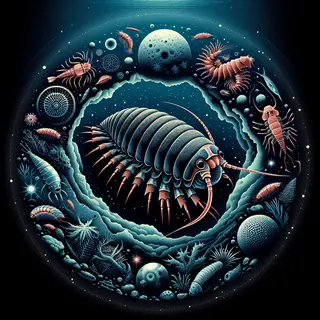
Recently discovered, the Bathynomus raksasa or the supergiant isopod stands out as an oddity of the marine world. Found in the Indian Ocean's deep waters, it's one of the largest isopods known so far.
 Space
SpaceThe cosmic microwave background radiation that fills up the universe was discovered accidently by two radio astronomers, Arno Penzias and Robert Wilson, while they were trying to eliminate noise from an antenna.
 Records
A chess player named Timur Gareyev played 48 games of chess simultaneously while blindfolded, setting a world record.
 History
Albert Hofmann, a Swiss chemist, unintentionally discovered the psychedelic effects of LSD (Lysergic Acid Diethylamide) in 1943.
 Mysteries
An unknown artist's masterpiece in the middle of Teller House bar in Central City, Colorado
 Science
Chemist Mas Subramanian and his team accidentally discovered a new vibrant shade of blue known as YInMn Blue in 2009 while experimenting on materials for electronics.
Many of our articles come with a video companion. Sit back and explore.




No spam. Just strange, useful, and fascinating knowledge.
We only use your email for site updates.