
Exploring Soviet Weather Control: Ambitions and Legacies
How the USSR built a secret industrial program to control weather during the Cold War, and why its methods are now influencing modern climate intervention research.
 Watch on YouTube
 Watch on Rumble
Rain on Command: The Soviet Ambition to Master the Sky
In the decades following World War II, the Soviet Union pursued weather modification not as a fringe experiment but as a coordinated state program backed by military funding, academic institutions, and industrial infrastructure. While the United States and other Western nations conducted their own cloud seeding trials — most famously Project Cirrus in 1947 and Project Stormfury in the 1960s — the Soviet effort was distinctive in its scale, ideological framing, and secrecy. Soviet scientists genuinely believed that controlling weather was a natural extension of socialist mastery over nature, a concept embedded in Marxist-Leninist philosophy that viewed the natural world as something to be reorganized in service of human progress. Nature, in this framework, was not a force to be respected or accommodated but a problem to be solved, a set of inefficiencies waiting to be corrected by the rational application of scientific planning.
This ideological foundation gave the Soviet weather program a quality that distinguished it from its Western counterparts. American and European cloud seeding experiments were largely driven by agricultural lobbying, military curiosity, and the entrepreneurial instincts of individual scientists. The Soviet program, by contrast, was embedded in the same institutional logic that built the Bratsk Dam and rerouted rivers in Central Asia. It was conceived as infrastructure, not research. The goal was not to understand precipitation so much as to command it, and the resources allocated to that goal reflected the seriousness with which the Soviet state took the ambition.
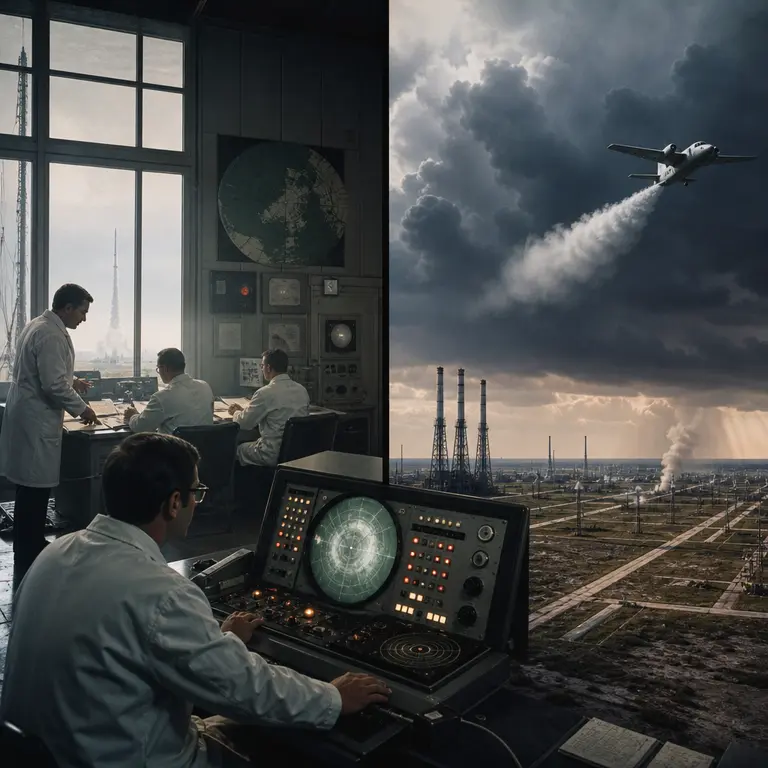
The program grew from roots in the 1930s, when Soviet meteorologist Nikolai Kamenskiy and others began experimenting with artificial precipitation. But it was the postwar period, particularly from the late 1950s through the 1980s, that saw the program institutionalized. The Central Aerological Observatory near Moscow became the nerve center of Soviet weather modification research, employing hundreds of scientists and operating a fleet of specially equipped aircraft. By the 1970s, the USSR had developed silver iodide dispersal systems, dry ice seeding protocols, and ground-based rocket systems capable of injecting aerosols into clouds at altitudes unreachable by conventional aircraft. The program operated simultaneously across multiple Soviet republics, coordinated by a centralized command structure that treated the atmosphere above Soviet territory as a managed resource, much like a river basin or a collective farm.
How It Worked — and What It Was Really For
Cloud seeding operates on a deceptively simple principle: introduce particles into a cloud that serve as nuclei around which water vapor can condense and eventually fall as precipitation. Silver iodide is particularly effective because its crystal structure mimics that of ice, triggering the formation of ice crystals in supercooled clouds. The Soviet program used this technique extensively in agricultural regions of Ukraine, Kazakhstan, and the North Caucasus, where drought was a recurring threat to grain harvests that the state depended on for both domestic consumption and export. The vulnerability of Soviet agriculture to weather variability was not merely an economic concern — it was a political one. Failed harvests had contributed to famines that killed millions in the 1930s, and the memory of that catastrophe shaped the urgency with which planners approached any technology that might reduce dependence on natural precipitation cycles.
But agriculture was only part of the story. The Soviet military saw weather modification as a potential strategic asset. Declassified documents from the Cold War era, as well as testimony from former Soviet scientists who emigrated after 1991, reveal that the program investigated the feasibility of inducing fog over enemy airfields, triggering early snowfall to slow troop movements, and even redirecting precipitation to deprive adversarial regions of water. These applications were never deployed in open conflict, but their development shaped the classified dimensions of the program throughout the 1960s and 1970s. The United States pursued parallel research under projects that remained classified for decades, and both superpowers were aware that the other was exploring the military dimensions of atmospheric intervention. This mutual awareness created a strange dynamic in which weather modification occupied a space somewhere between arms race and shared scientific frontier.
The most publicly acknowledged use of Soviet cloud seeding occurred during large public events. The program was routinely activated before major parades in Moscow, including celebrations on May Day and the anniversary of the October Revolution, to ensure clear skies over Red Square. Aircraft would seed clouds upwind of the city hours before the event, forcing precipitation to fall before it could drift over the capital. This practice, confirmed by Soviet meteorological records and later by Russian government officials, continued well beyond the Soviet period and is still employed by Russian authorities today for major outdoor events. There is something revealing in this application: a program conceived to serve the vast agricultural interior of a continental nation was also deployed, routinely and at considerable expense, to keep rain off a parade. The symbolic stakes of Soviet public spectacle were high enough to justify the intervention.
The Scientists Behind the Program
The intellectual architecture of Soviet weather modification was built by a generation of atmospheric physicists who operated largely in obscurity outside the Eastern Bloc. Alexander Kartsivadze, working at the High Mountain Geophysical Institute in Nalchik, developed some of the most effective ground-based hail suppression systems in the world during the 1960s and 1970s. His work focused on the Caucasus region, where hailstorms caused catastrophic losses to vineyards and orchards. Using networks of ground-based rocket launchers that fired silver iodide shells into developing cumulonimbus clouds, his team reported hail damage reductions of 50 to 80 percent in protected zones — figures that, while contested by some Western researchers, were consistent enough across multiple seasons to attract serious attention. The Caucasus program became one of the most-cited examples of operational weather modification in the world during this period, and delegations from Eastern European countries, Cuba, and several African nations visited Nalchik to study its methods.
Equally significant was the work of Yevgeny Fedorov, a polar explorer-turned-atmospheric scientist who served as director of the Main Geophysical Observatory in Leningrad. Fedorov was one of the few Soviet scientists with genuine international standing, having participated in the first Soviet drifting ice station in 1937. That expedition, which established a manned research station on a floating ice floe in the Arctic Ocean, made Fedorov a national hero and gave him a degree of institutional independence unusual for a Soviet scientist. In later decades, he became an outspoken advocate for international cooperation on weather modification, arguing at United Nations forums in the 1970s that unilateral weather intervention by any nation constituted environmental aggression. His position was prescient: the 1977 Environmental Modification Convention (ENMOD), signed by both the United States and the Soviet Union, was, in part, a response to the very concerns Fedorov had been raising for years.
What made Fedorov’s contribution particularly interesting was its internal tension. He worked within a state program that was, by its nature, unilateral — a program that seeded clouds over Soviet territory without consulting the nations downwind, and that investigated military applications of atmospheric manipulation. Yet he simultaneously argued, with apparent sincerity, that such activities required international governance. Whether this tension reflected genuine intellectual conflict or a strategic positioning aimed at limiting Western programs while protecting Soviet ones remains a matter of historical interpretation. What is clear is that his arguments helped shape the first international legal framework for weather modification, however inadequate that framework has proven to be.
What Went Wrong — and What Was Overstated
The Soviet program was not without its failures and controversies. The most damaging episode came in the aftermath of the Chornobyl nuclear disaster in April 1986. Soviet authorities, desperate to prevent radioactive rain clouds from drifting over Moscow and other major population centers, ordered cloud-seeding missions to force precipitation over rural Belarus and parts of western Russia before the clouds reached urban areas. The decision, made under extreme pressure and with incomplete information, resulted in localized radioactive rainfall in regions that might otherwise have received little contamination. Villages in the Gomel and Mogilev regions of Belarus received significantly elevated fallout as a result. The full extent of this intervention was suppressed for years and only emerged through independent research and the testimonies of former Soviet meteorologists in the 1990s and 2000s.
The Chernobyl episode illustrates a danger that extends beyond the Soviet context: the temptation to use weather modification as an emergency measure amid panic, without adequate understanding of second-order consequences. The logic of the intervention was not irrational on its face — preventing radioactive rain from falling on a city of eight million people seemed like a reasonable priority. But the people on whom that rain was redirected had no say in the decision and, for years, no knowledge of what had been done. The ethical structure of the choice treated rural Belarusians as acceptable recipients of a risk that urban Muscovites were spared. That structure has never been formally acknowledged, let alone addressed, by Russian authorities.
At the same time, some Western assessments of the Soviet program exaggerated its capabilities. Cold War-era intelligence reports occasionally attributed unusual weather events — a particularly severe drought in Central Asia, an anomalous freeze in Eastern Europe — to deliberate Soviet manipulation, when the evidence for intentional causation was thin or nonexistent. Separating genuine Soviet capability from Cold War projection became a recurring methodological problem for researchers on both sides. The tendency to assume that any unusual atmospheric event might be the product of enemy action was itself a kind of cognitive distortion produced by the arms race, and it contaminated the historical record in ways that researchers are still working to correct.
Present-Day Relevance: Cloud Seeding in the Age of Climate Crisis
In 2023 and 2024, a wave of renewed scientific and governmental interest in cloud seeding and broader solar geoengineering has brought the Soviet program back into scholarly focus. The United Arab Emirates has operated one of the world’s most active cloud seeding programs since the early 2000s, conducting hundreds of missions per year over the Arabian Peninsula. China has invested billions in a national weather modification program covering an area larger than Western Europe, with stated goals of increasing precipitation in drought-prone northern regions by tens of billions of cubic meters of water annually. The United States National Academies of Sciences released a major report in 2021 calling for a structured research program into stratospheric aerosol injection and marine cloud brightening. The language of that report — cautious, measured, insistent on governance frameworks — reads almost as a corrective to the Soviet approach, though the underlying ambition is not entirely different.
Against this backdrop, historians of science and atmospheric researchers have begun systematically reviewing Soviet-era data for the first time. A collaborative project between Russian, Ukrainian, and German researchers, ongoing as of 2024, is digitizing decades of suppressed meteorological records from the Central Aerological Observatory. These records, many of which survived in physical archives in Dolgoprudny, outside Moscow, contain decades of cloud-seeding trial data that were never published in peer-reviewed form during the Soviet period. Preliminary analysis suggests the Soviet hail suppression results in the Caucasus were more robust than Western skeptics assumed, and that certain dispersal techniques developed in the 1970s may be worth revisiting with modern atmospheric modeling tools. The irony is considerable: data collected by a state that suppressed its own findings may now contribute to the scientific foundation for a global conversation about deliberate climate intervention.
The ethical and geopolitical questions Yevgeny Fedorov raised at the United Nations in the 1970s have also returned with new urgency. If one nation seeds clouds to increase its own rainfall, it may simultaneously reduce precipitation downwind in a neighboring country. This transboundary dimension of weather modification has no agreed international legal framework beyond the largely toothless ENMOD convention, and as more nations develop active programs, the potential for conflict grows. Water scarcity is already a source of geopolitical tension across the Middle East, South Asia, and sub-Saharan Africa, and the addition of deliberate atmospheric intervention to this landscape introduces variables that existing diplomatic institutions are ill-equipped to manage.
A Legacy Hiding in Plain Sight
The Soviet weather modification program was never entirely secret. Soviet scientists published in domestic journals, presented at international conferences, and occasionally collaborated with counterparts in Eastern Europe and Cuba. What made it obscure was a combination of language barriers, Cold War information asymmetry, and the tendency of Western science to discount research from behind the Iron Curtain as ideologically distorted. Some of that skepticism was warranted — Soviet science was not immune to politically motivated data, and certain claims made during the Lysenko era had permanently damaged the credibility of Soviet biology in Western eyes. But the blanket dismissal of Soviet atmospheric science meant that a substantial body of empirical work — conducted over decades, across vast geographic areas, with real agricultural and military stakes — was largely ignored by the broader scientific community.
That dismissal also reflected a failure of imagination on the part of Western institutions. It was easier to categorize the Soviet program as propaganda or as a symptom of ideological overreach than to engage seriously with what it might actually have demonstrated. The result was a decades-long gap in the cumulative knowledge base of atmospheric science, a gap that is only now beginning to be filled as researchers gain access to the underlying records.
As the climate crisis forces a reckoning with humanity’s relationship to atmospheric systems, that work is being reconsidered. The Soviet program was neither a triumph of socialist science nor a mere propaganda exercise. It was a large, imperfect, sometimes reckless attempt to solve real problems using the tools available at the time. Its legacy is complicated by ideology, secrecy, and at least one catastrophic misapplication. But it also contains data, techniques, and hard-won lessons about what happens when a state decides it has both the right and the ability to manage the sky. The world, now facing the prospect of deliberate climate intervention on a planetary scale, can no longer afford to leave those lessons buried in Russian archives — or to repeat the mistakes that accompanied their first learning.
Sources & Further Reading
- Fleming, James Rodger. Fixing the Sky: The Checkered History of Weather and Climate Control. Columbia University Press, 2010.
- Robock, Alan, et al. 'Benefits, Risks, and Costs of Stratospheric Geoengineering.' Geophysical Research Letters, 2009. https://doi.org/10.1029/2009GL039209
- United Nations. Convention on the Prohibition of Military or Any Other Hostile Use of Environmental Modification Techniques (ENMOD). UN Treaty Collection, 1977. https://treaties.un.org/pages/ViewDetails.aspx?src=TREATY&mtdsg_no=XXVI-1&chapter=26
- Mikhaelides, Silas, ed. Precipitation: Advances in Measurement, Estimation and Prediction. Springer, 2008.