
Transglutaminase: Biology's Versatile Hidden Enzyme
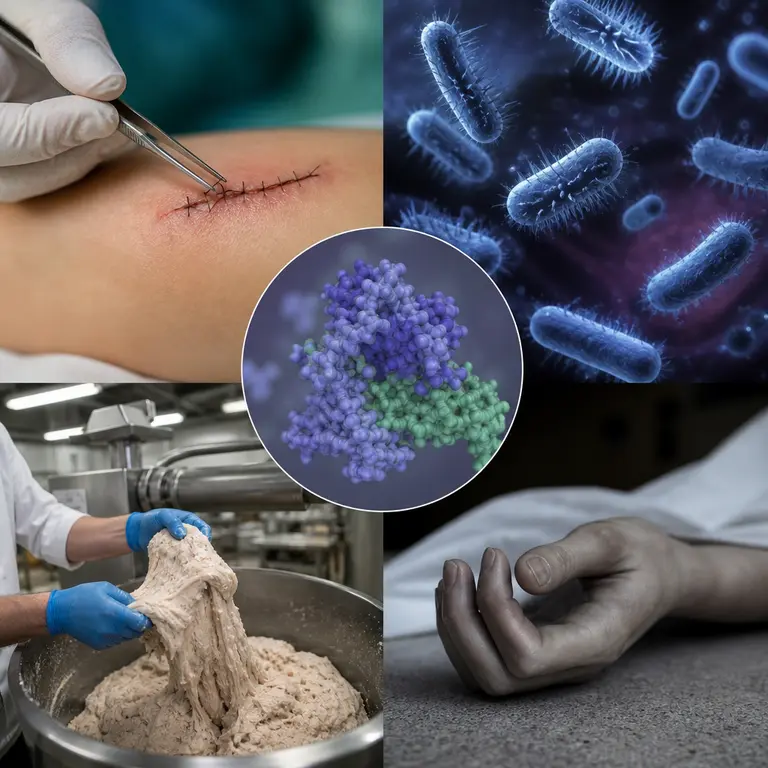
Transglutaminase, an enzyme found in blood, bacteria, and industrial kitchens alike, reveals a biochemical link between wound healing, food engineering, and the postmortem chemistry that stiffens the dead.
 Watch on YouTube
 Watch on Rumble
The Enzyme Nobody Talks About
In 1959, biochemist Heinrich Waelsch and his colleagues at Columbia University identified a curious protein in blood plasma capable of cross-linking other proteins together with extraordinary precision. They called it transglutaminase, a name derived from the amino acids it connects — glutamine and lysine — fusing them into covalent bonds that resist nearly every chemical assault the body can throw at them. At the time, the discovery seemed narrowly relevant to blood clotting. Within a few decades, it would turn out to be one of the most consequential enzymes in all of biology, operating in contexts ranging from the hardening of a corpse to the manufacture of imitation crab meat.
Transglutaminase belongs to a family of enzymes that catalyze a specific reaction: they create an isopeptide bond between the gamma-carboxamide group of glutamine residues and the epsilon-amino group of lysine residues in proteins. The result is a molecular weld — a cross-link so stable that it persists long after the proteins themselves have been degraded in other ways. This bond is not merely structural. It is a biological signature, and scientists have learned to read it as a record of physiological events spanning wound healing, fermentation, apoptosis, and death itself. The enzyme’s story is a lesson in how a single chemical reaction, repeated in different tissues and organisms and industrial vats, can underpin an almost absurdly wide range of phenomena.
What makes transglutaminase particularly unusual among enzymes is that it did not stay in its lane. Most enzymes are celebrated for their specificity — the lock-and-key elegance with which they recognize a single substrate and perform a single transformation. Transglutaminase is specific in its chemistry but promiscuous in its context. Evolution has recruited the same isopeptide bond-forming reaction for purposes as different as sealing a wound and dismantling a dying cell. Industry has borrowed the same mechanism to glue fish scraps into convincing seafood. Immunologists have discovered that the same enzyme, when it modifies the wrong protein in the wrong tissue, can trigger a cascade of autoimmune destruction affecting millions of people. To understand transglutaminase is to encounter one of biology’s most versatile molecular tools, hiding in plain sight beneath the surface of everyday life.
Blood, Clots, and the Original Discovery
The transglutaminase that Waelsch’s group first characterized is now known as Factor XIIIa, the activated form of coagulation Factor XIII. When a blood vessel ruptures, the coagulation cascade unfolds in a precise sequence, culminating in the conversion of fibrinogen into fibrin threads that form the scaffold of a clot. Factor XIIIa then cross-links those fibrin strands to each other and to a protein called alpha-2-antiplasmin, creating a reinforced meshwork that resists premature dissolution by plasmin, the enzyme responsible for breaking down clots.
This mechanism is so essential that individuals born with Factor XIII deficiency — a rare autosomal recessive disorder affecting roughly one in five million people — experience life-threatening bleeding from seemingly minor injuries, including umbilical cord bleeding in newborns. The clot forms, but it falls apart. The cross-linking step never happens, and what should be a temporary scaffold dissolves before the wound can heal. Recombinant Factor XIII concentrate, approved by the FDA in 2013, now treats this condition, and its development drew directly from the molecular biology of the enzyme Waelsch first described. The path from a 1959 biochemistry paper to an approved therapeutic took more than half a century, but it illustrates how foundational enzyme research eventually finds its way into the clinic.
What makes Factor XIIIa especially interesting from a regulatory standpoint is that it requires calcium ions and thrombin-mediated cleavage of a small activation peptide to become active. This double-lock mechanism ensures the enzyme does not fire prematurely and cross-link proteins in the wrong context. A transglutaminase loose in the bloodstream under normal conditions would be catastrophic, welding together proteins that are supposed to remain separate. The precision of this control has made Factor XIIIa a model system for understanding enzyme regulation more broadly, and the study of its activation sequence contributed to early insights into how coagulation factors are kept in reserve until the precise moment they are needed.
Researchers have also found that Factor XIIIa cross-links fibronectin and collagen into the extracellular matrix at wound sites, contributing to the structural integrity of healing tissue beyond the clot itself. This means the enzyme participates not just in stopping bleeding but in the longer process of tissue remodeling that follows injury — a role that was not appreciated until decades after the original discovery and that continues to be investigated in the context of chronic wound healing and surgical adhesion.
From Morgue to Kitchen: The Industrial Life of Transglutaminase
In the 1980s, researchers at Ajinomoto Co. in Japan — the company better known for inventing monosodium glutamate — were searching for a way to bind protein fragments together without chemical additives. They discovered that certain bacteria, particularly Streptoverticillium mobaraense, produce a transglutaminase that functions independently of calcium and works across a remarkable range of substrates. This microbial transglutaminase, commercialized under the trade name Activa, became the active ingredient in what food technologists call restructured meat products.
The enzyme allows chefs and food manufacturers to fuse separate pieces of protein — scraps of beef, portions of fish, shrimp fragments — into a seamless whole that has a texture like a single cut. It is the reason that some restaurant steaks are legally required to be labeled as formed or reformed in several countries, and it is the binding agent in surimi, the processed fish paste used to make imitation crab and lobster products. In Japan, it is also used to create novel dairy textures and to improve the elasticity of noodles by cross-linking gluten proteins. In high-end restaurant kitchens, it became fashionable in the early 2000s as part of the modernist cuisine movement, where chefs used it to construct dishes that would have been physically impossible with conventional cooking techniques — bonding chicken skin to scallops, for instance, or assembling mosaic terrines from disparate proteins that cook as a unified piece.
The food industry application raised early concerns about food safety, since restructured products can distribute surface bacteria throughout the interior of a piece of meat, thereby requiring higher cooking temperatures than a traditional steak. A consumer ordering a medium-rare formed steak may be consuming a product in which bacteria that would normally reside only on the exterior surface have been incorporated throughout, meaning that the interior temperature required for safety is higher than intuition would suggest. Regulatory bodies in the European Union and the United States addressed this through labeling requirements rather than prohibition, recognizing that the enzyme itself is destroyed during cooking and poses no direct chemical hazard.
Beyond safety concerns, the existence of microbial transglutaminase raises interesting questions about why bacteria produce it at all. The enzyme likely plays a role in bacterial cell wall maintenance and protein stabilization under environmental stress, though its precise ecological function in soil-dwelling Streptomyces relatives is still a matter of investigation. The fact that an enzyme evolved for microbial survival in soil was later recruited by the food industry to restructure proteins in a commercial kitchen is a reminder that biotechnology frequently borrows from biology in directions that no one anticipated.
Rigor Mortis and the Postmortem Chemistry of Cross-Linking
Perhaps the least discussed role of transglutaminase involves death. When an organism dies, calcium regulation collapses almost immediately. Calcium ions flood out of intracellular compartments and into the cytoplasm, activating transglutaminases that are normally held in check by the strict compartmentalization of living cells. The result is a wave of uncontrolled protein cross-linking throughout muscle tissue, contributing to the biochemical complexity of rigor mortis — the postmortem stiffening of muscles that begins within hours of death and resolves within two to three days as proteolytic enzymes eventually degrade the cross-linked proteins.
Forensic pathologists have long used the timing of rigor mortis to estimate time of death, but the molecular picture is more nuanced than the classical description suggests. Temperature, muscle mass, physical exertion before death, and the activity of tissue transglutaminase all influence the timeline. Research published in journals such as the International Journal of Legal Medicine has explored how measuring the degree of protein cross-linking in muscle samples might yield more precise postmortem interval estimates than observation alone, potentially offering forensic investigators a biochemical clock less subject to environmental variability than the classical signs of decomposition.
Tissue transglutaminase, also known as TG2, is the most widely expressed member of the transglutaminase family and operates in living cells under conditions of cellular stress. Its activation by calcium in dying cells is not incidental — it is part of a programmed response to apoptosis, the controlled cell death process, where cross-linking helps package cellular contents for safe disposal by immune cells. The enzyme essentially helps wrap up the contents of a dying cell so that neighboring cells are not exposed to inflammatory signals. When this process goes wrong, or when TG2 is activated in contexts where controlled apoptosis was not the intended outcome, the consequences range from the inconvenient to the catastrophic.
TG2 has been implicated in diseases ranging from celiac disease — where it modifies gluten peptides in the gut, triggering an autoimmune response — to neurodegenerative conditions including Huntington’s disease, where abnormal TG2 activity may contribute to the aggregation of misfolded proteins in neurons. The same enzyme that tidily packages dying cells under normal circumstances may, under conditions of chronic stress or genetic predisposition, contribute to the protein tangles and aggregates that characterize some of the most devastating neurological diseases known. This duality, protective in one context and destructive in another, is characteristic of transglutaminase at every level of biology.
Celiac Disease, Autoimmunity, and an Unexpected Diagnostic Tool
The connection between transglutaminase and celiac disease represents one of the most clinically significant discoveries to emerge from this field. In 1997, gastroenterologist Walburga Dieterich and her colleagues in Erlangen, Germany, identified TG2 as the autoantigen in celiac disease — the protein that the immune system mistakenly attacks in genetically susceptible individuals who consume gluten. This finding transformed celiac diagnosis almost overnight and opened an entirely new chapter in understanding how an enzyme involved in cell death and wound healing could become the target of a widespread autoimmune condition.
Prior to this discovery, diagnosing celiac disease required intestinal biopsy and the identification of endomysial antibodies through indirect immunofluorescence — a technically demanding and subjective test that required experienced laboratory personnel and was not available in many clinical settings. Once TG2 was identified as the target antigen, it became possible to develop simple blood tests that directly measure anti-TG2 antibodies. These tests, now standard in clinical practice worldwide, are both sensitive and specific, and they have dramatically increased the rate of celiac disease diagnosis. The condition had previously been estimated to affect one in several thousand people but is now understood to affect roughly one in one hundred — a tenfold increase in recognized prevalence that reflects not an epidemic but decades of underdiagnosis enabled by inadequate tools.
The mechanism by which TG2 triggers this autoimmune response is precise yet not fully understood at every step. TG2 deamidates specific glutamine residues in gluten-derived peptides, converting them to glutamate and making them far more immunogenic in individuals carrying certain HLA gene variants, particularly HLA-DQ2 and HLA-DQ8. The enzyme effectively transforms a relatively inert dietary protein into a potent trigger for autoimmune destruction of the small intestinal lining, a process that in untreated patients leads to villous atrophy, malabsorption, and a substantially elevated risk of intestinal lymphoma. Several pharmaceutical companies are currently developing TG2 inhibitors as potential treatments for celiac disease, aiming to block the deamidation step without disrupting the enzyme’s other physiological roles — a challenge that requires extraordinary selectivity given how many tissues depend on TG2 for normal function.
A Molecule at Every Boundary
What makes transglutaminase genuinely remarkable is not any single function but the breadth of contexts in which the same basic chemistry — the cross-linking of glutamine and lysine — has been recruited by evolution and industry alike. It stabilizes blood clots, stiffens dead muscle, triggers autoimmune disease, holds fish paste together, participates in programmed cell death, and may contribute to neurodegeneration. No other enzyme family operates so consistently across the boundary between life and death, between food and medicine, between normal physiology and catastrophic disease.
Research published in 2023 in Nature Communications identified new TG2 inhibitors with potential applications in fibrotic diseases, where uncontrolled cross-linking of extracellular matrix proteins contributes to organ scarring in conditions such as pulmonary fibrosis and liver cirrhosis. The same molecular weld that clots blood and binds imitation crab, when left unchecked in chronic disease, can seal organs into rigid, non-functional masses. In this sense, the enzyme’s pathological face in fibrosis is simply its normal wound-healing function running without an off switch — a reminder that biology’s most useful tools are often also its most dangerous ones when regulation fails.
The story of transglutaminase is also a story about how science proceeds. Waelsch’s 1959 observation about a cross-linking protein in plasma could not have predicted the enzyme’s role in celiac diagnosis, or its use in restructured meat, or its potential as a therapeutic target in fibrosis. Each of those connections emerged from researchers working in entirely different fields who happened to encounter the same chemical signature and followed it wherever it led. The isopeptide bond became a thread running through immunology, food science, forensic pathology, and gastroenterology simultaneously, connecting disciplines that rarely speak to each other. Understanding transglutaminase, it turns out, is inseparable from understanding the chemistry of life’s most fundamental transitions — and from appreciating how much of that chemistry remains hidden in the gaps between scientific specialties.
Sources & Further Reading
- Dieterich, W. et al. Identification of tissue transglutaminase as the autoantigen of celiac disease. Nature Medicine, 1997. https://www.nature.com/articles/nm0297-797
- Lorand, L. and Graham, R.M. Transglutaminases: crosslinking enzymes with pleiotropic functions. Nature Reviews Molecular Cell Biology, 2003. https://www.nature.com/articles/nrm1014
- Ajinomoto Co. Activa Transglutaminase Product Information. Ajinomoto Foods, 2020. https://www.ajinomoto-foods.com/products/activa/
- Rocca, B. and Bhatt, D.L. Factor XIII deficiency and treatment with recombinant Factor XIII. New England Journal of Medicine, 2014.