
Inaudible Waves: Earth's Global Acoustic Phenomena Revealed
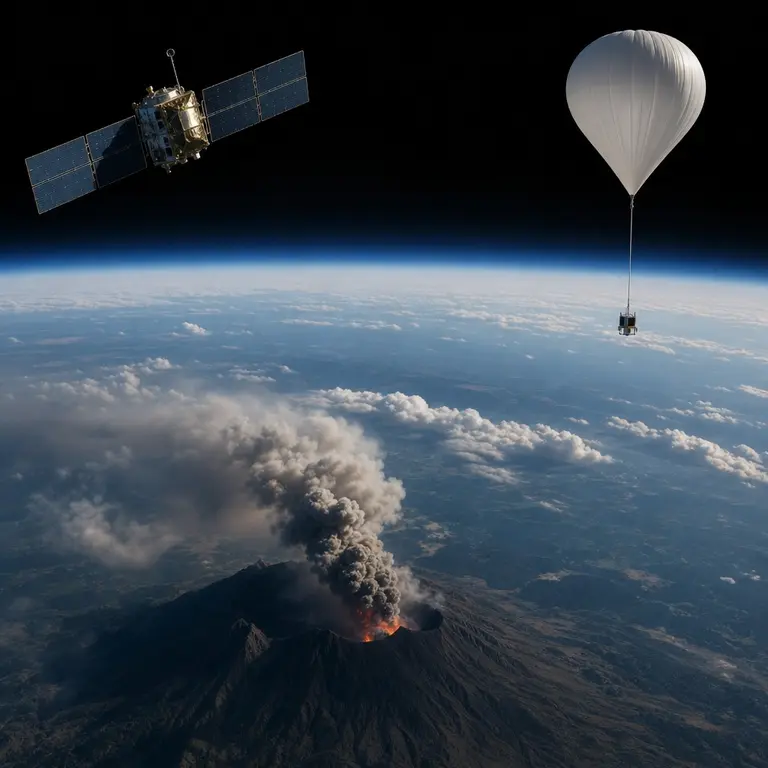
Infrasound sensors aboard satellites and high-altitude balloons are detecting the sub-audible roar of volcanic eruptions, earthquakes, and even ocean waves from the stratosphere, opening a new era of planetary listening.
The Sound You Cannot Hear, Traveling Farther Than You Imagine
When Hunga Tonga-Hunga Ha’apai erupted in January 2022 with the largest atmospheric explosion recorded in the modern instrumental era, it did something extraordinary beyond the destruction: it rang the Earth like a bell. Pressure waves from the blast circled the planet multiple times, measurable on barometers as far away as the United Kingdom. Ships in the Pacific reported sudden changes in atmospheric pressure. Tide gauges registered anomalous readings thousands of kilometers from the eruption site. People in New Zealand and Fiji reported a strange sensation of pressure in their ears without hearing any obvious sound. But what surprised researchers most was not the ground-level data. It was what instruments floating in the stratosphere, roughly 20 to 50 kilometers above sea level, had captured with startling clarity. The eruption had sent infrasound — acoustic waves below 20 Hz, entirely inaudible to human ears — surging upward into a layer of the atmosphere that, under the right conditions, acts as a near-perfect acoustic waveguide.
Infrasound itself is not rare. Elephants use it to communicate across kilometers of savanna. Whales generate it in frequencies that can travel ocean basins. Severe weather, avalanches, and large industrial machinery all produce it. What makes the stratospheric application remarkable is the combination of the signal’s scale, its persistence, and the extraordinary distances over which it can be tracked without meaningful degradation. This phenomenon is not new to physicists. What is new is the deliberate, systematic effort to exploit it. A growing coalition of atmospheric scientists, volcanologists, and defense researchers is now deploying infrasound sensors aboard high-altitude balloons and, increasingly, small satellites to listen to the planet from above. The field is called stratospheric infrasound monitoring, and it may fundamentally change how humanity detects natural disasters, tracks clandestine nuclear tests, and even studies other worlds.
The Stratospheric Waveguide: Nature’s Acoustic Duct
To understand why the stratosphere is such a useful listening environment, it helps to understand what makes it physically unusual. Most people learn in school that temperature decreases with altitude. This is true in the troposphere, the lowest layer of the atmosphere where weather occurs. But in the stratosphere, the relationship reverses. Temperature stops falling and begins to rise again, driven by ozone molecules absorbing incoming ultraviolet radiation from the sun. This thermal inversion creates a refractive boundary that bends sound waves back downward rather than allowing them to continue dispersing outward into space. Low-frequency infrasound becomes trapped in a channel, bouncing between the thermal ceiling above and the ground or ocean below, carrying signals thousands of kilometers with remarkably little attenuation. It is, in essence, a natural acoustic pipe wrapped around the entire planet.
Ground-based infrasound networks have exploited related atmospheric ducting for decades. The International Monitoring System, operated by the Comprehensive Nuclear-Test-Ban Treaty Organization, maintains 60 stations worldwide and detected the 2022 Tonga eruption at every single one of its nodes — an unprecedented achievement that underscored both the event's magnitude and the network's sensitivity. Yet ground stations have fundamental blind spots that no amount of additional surface infrastructure can fully eliminate. Oceans cover 71 percent of Earth’s surface, and placing sensors there is expensive, logistically demanding, and prone to interference from wave noise and biological activity. Remote continental regions present their own challenges of access, power supply, and maintenance.
Balloons and satellites operating in or above the stratosphere sidestep this problem entirely. A sensor drifting at 20 kilometers altitude sits inside the waveguide itself, sampling the acoustic field directly rather than inferring it from signals that have already partially dispersed and been modified by surface interactions. Research conducted by Daniel Bowman at Sandia National Laboratories and published in Geophysical Research Letters demonstrated in 2022 and 2023 that solar-powered polyethylene balloons costing as little as a few hundred dollars could successfully detect volcanic eruptions, earthquakes, and ocean microseisms from stratospheric altitudes, recording signals that ground stations hundreds of kilometers away either missed or received only weakly. The cost-to-capability ratio of these balloon platforms is extraordinary by any standard of scientific instrumentation. A single research balloon carrying an infrasound sensor can cover more acoustic real estate in a single flight than a permanent ground station covers in years of operation.
From Balloons to CubeSats: Listening Goes Orbital
The logical extension of balloon-borne infrasound detection is orbital deployment, though the physics involved become considerably more complex. Unlike conventional sound, infrasound at sufficiently low frequencies — below roughly 1 Hz, sometimes called acoustic-gravity waves — can propagate vertically through the entire atmosphere rather than being confined to horizontal ducting. These waves couple into the ionosphere, the uppermost ionized layer of the atmosphere, beginning around 60 kilometers altitude, where pressure fluctuations slightly alter the density of ionized gas. This ionospheric signature can be detected by GPS satellites that measure the total electron content of the atmosphere along their signal paths, a technique originally developed to correct for navigation errors rather than to conduct atmospheric science.
In the aftermath of the Tonga eruption, researchers at the University of Bath and NASA’s Jet Propulsion Laboratory independently confirmed that the blast’s acoustic-gravity waves caused detectable ripples in the ionosphere that GPS receivers around the world inadvertently recorded. The entire planet’s satellite navigation infrastructure had, unintentionally, served as a distributed infrasound detector. The implications were immediate and substantial. If passive GPS infrastructure could detect an event of Tonga’s magnitude, purpose-built sensors in orbit might detect far smaller events with much greater precision and speed.
This realization has catalyzed a new generation of purpose-built instruments. NASA’s Jet Propulsion Laboratory, in collaboration with the University of Louisiana at Lafayette, has been developing miniaturized infrasound microbarometers small enough to fit aboard CubeSats — satellites roughly the size of a shoebox that can be manufactured and launched at a fraction of the cost of conventional scientific spacecraft. A 2023 mission concept paper outlined how a constellation of as few as six such satellites in low Earth orbit could provide near-continuous global coverage of major infrasound-generating events, with a detection latency of under 15 minutes for eruptions comparable to the one in Tonga. For comparison, the ground-based International Monitoring System required several hours to fully characterize that event’s source parameters. In the context of tsunami warning systems, where minutes of additional lead time translate directly into lives saved, the difference between those timescales is not merely academic.
Nuclear Watchdogs and the Dual-Use Problem
The technology carries significant geopolitical implications that the scientific community is only beginning to grapple with openly. The Comprehensive Nuclear-Test-Ban Treaty, which opened for signature in 1996 and has been signed by 187 nations, though not yet formally ratified, relies on four verification technologies: seismic sensors, hydroacoustic sensors, radionuclide detectors, and infrasound stations. Each of these technologies has particular strengths and particular blind spots, and the system was designed with the assumption that the combination would be robust enough to detect any nuclear test above a certain yield threshold anywhere on the planet.
Stratospheric infrasound monitoring from space would dramatically enhance the treaty’s verification capability, particularly for small atmospheric or near-surface nuclear tests conducted over oceans or in remote regions where ground station coverage is sparse. The physics are straightforward. A sensor sitting inside the stratospheric waveguide, or above it with instruments sensitive to ionospheric coupling, receives signals that have not been degraded by the complex interactions between acoustic waves and terrain, ocean surface roughness, or local meteorological conditions that affect every ground-based receiver.
North Korea’s six declared nuclear tests between 2006 and 2017 were all detected by the ground-based IMS network, but yield estimates varied considerably between agencies, partly because atmospheric coupling was difficult to characterize from surface stations alone. A stratospheric sensor network would constrain source parameters more precisely, reducing the ambiguity that state actors might otherwise exploit by conducting tests at yields calibrated to fall into the gray zone of detection uncertainty. The same technology, however, also provides any nation that deploys it with an independent, sovereign monitoring capability outside international oversight structures. A country operating its own constellation of infrasound CubeSats would have verification intelligence that no international body controls or can access, creating an information asymmetry that arms control scholars have begun to examine with considerable unease. The question of whether such capabilities should be subject to international governance frameworks, and what those frameworks might look like, remains entirely unresolved.
Listening to Venus, Mars, and Titan
Perhaps the most philosophically striking application of stratospheric infrasound science is extraterrestrial, illustrating how a technology developed to solve one problem on Earth can unexpectedly illuminate entirely different worlds. In 2021, NASA’s Ingenuity helicopter on Mars inadvertently demonstrated that the thin Martian atmosphere, roughly 1 percent of Earth’s surface pressure, could transmit acoustic signals at all. The Perseverance rover’s microphones recorded the helicopter’s rotors at distances of up to 80 meters, confirming that acoustic monitoring of Mars is physically feasible even in an environment where the speed of sound is lower than on Earth, and the medium is almost vanishingly thin. A balloon-borne infrasound sensor floating in the Martian atmosphere could, in principle, detect marsquakes, dust devil vortices, and meteorite impacts with far greater sensitivity than surface seismometers, which must contend with wind noise and the thermal cracking of regolith as temperatures swing by more than 100 degrees Celsius between day and night.
Venus presents an even more compelling and more urgent case, given the renewed scientific and political attention the planet has attracted in recent years. Its surface, at 465 degrees Celsius and 92 atmospheres of pressure, destroys conventional landers within hours. The Soviet Venera probes of the 1970s and 1980s, the only spacecraft ever to successfully return data from the Venusian surface, survived for at most about 127 minutes before succumbing to conditions resembling those inside an industrial autoclave. But Venus’s upper cloud deck, at altitudes of 50 to 55 kilometers, has temperatures and pressures remarkably similar to Earth’s lower stratosphere. A balloon floating there could survive indefinitely on solar power and carry infrasound sensors to listen for Venusian volcanic activity, which orbital radar evidence from the Magellan mission and more recent analysis of data from the Venus Express spacecraft strongly suggests is ongoing and possibly active on timescales of years rather than millennia.
Saturn’s moon Titan offers a third target. Its thick nitrogen atmosphere, roughly 1.5 times Earth’s surface pressure at ground level, is the only dense atmosphere in the outer solar system besides Earth’s. NASA’s Dragonfly mission, currently scheduled for launch in 2028, will send a rotorcraft to Titan’s surface, but balloon-borne infrasound sensors have been proposed as a complementary approach for characterizing Titan’s internal activity and meteorological dynamics. The acoustic properties of a nitrogen-methane atmosphere at cryogenic temperatures are sufficiently different from those of Earth’s that even basic calibration of infrasound instruments for such an environment poses a significant scientific challenge, one that researchers are beginning to address through laboratory experiments and computational modeling.
The universe, it turns out, is extraordinarily loud. Volcanic worlds rumble. Icy moons crack and flex under tidal forces. Atmospheres ring with the passage of meteoroids, the churning of storms, and the slow exhalation of geological processes operating on timescales that dwarf human civilization. Humanity is only now building ears capable of hearing it properly — ears that began, improbably, as cheap polyethylene balloons drifting above the Pacific in the aftermath of a catastrophic eruption, recording sounds that no human could perceive, traveling distances that no human intuition would predict.
Sources & Further Reading
- Bowman, D.C. and Albert, S. Acoustic Event Detection in Stratospheric Balloon Flights. Geophysical Research Letters, 2023. https://doi.org/10.1029/2022GL101167
- Comprehensive Nuclear-Test-Ban Treaty Organization. CTBTO IMS Infrasound Network Overview. CTBTO, 2023. https://www.ctbto.org/monitoring-verification/the-ims/infrasound-stations/
- Garces, M. et al. Stratospheric Infrasound Propagation and the 2022 Hunga Tonga Eruption. Journal of Geophysical Research: Atmospheres, 2022. https://doi.org/10.1029/2022JD037076
- Kosmic, S. and Stevenson, D. Venus Balloon Infrasound Mission Concept. Bulletin of the American Astronomical Society, 2021. https://baas.aas.org/pub/2021n4i311p02