
Magnetic Marvels: Bacteria with Built-In Compasses
Magnetotactic bacteria build internal chains of magnetic crystals to navigate Earth's geomagnetic field — a biological feat that is reshaping nanotechnology, medical imaging, and our understanding of life's earliest sensory systems.
Organisms That Literally Contain Magnets
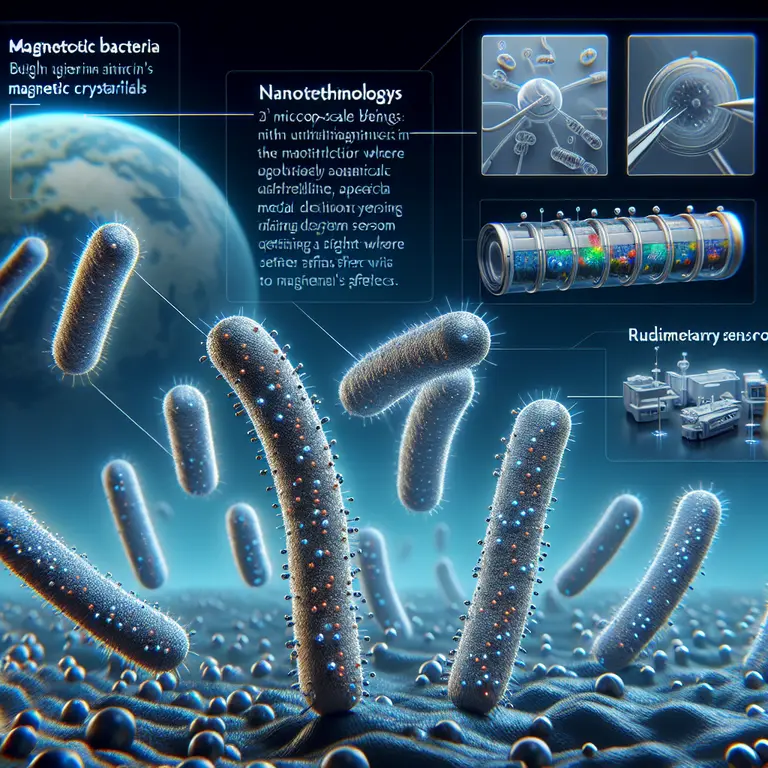
Somewhere in the sediment beneath a quiet pond, a bacterium no larger than two micrometers is orienting itself with the precision of a compass needle. It does this not through any nervous system or sensory organ as we conventionally understand them, but through a chain of iron-based crystals grown inside its own body. These are magnetotactic bacteria, and they represent one of the most startling intersections of geology, physics, and biology that science has uncovered in the last half century. To encounter them is to confront a kind of biological engineering so refined and purposeful that it challenges our intuitions about what single-celled life is capable of. They do not think. They do not learn. And yet they have solved, with molecular precision, a navigational problem that human engineers spent centuries trying to crack.
First formally described by marine biologist Richard Blakemore in 1975, magnetotactic bacteria were initially dismissed as a curiosity. Blakemore noticed that certain mud-dwelling microbes consistently swam toward the north pole of a bar magnet. When he examined them under an electron microscope, he found rows of electron-dense particles arranged in a precise chain running through the cell. These particles, later identified as magnetite or greigite crystals, function as a biological compass, a structure now called a magnetosome. At the time, the finding was met with skepticism from parts of the scientific community. The idea that a bacterium could manufacture its own internal compass seemed almost too elegant to be real. Subsequent decades of research have not only confirmed Blakemore’s observations but revealed that the phenomenon is far more widespread, more ancient, and more consequential than anyone initially suspected.
Engineering at the Nanoscale, Perfected by Evolution
What makes magnetosomes extraordinary is not merely their existence but their precision. Each crystal is grown within a membrane-bound vesicle under strict genetic control. The crystals are typically between 35 and 120 nanometers in diameter, a size range that sits within the single-magnetic-domain threshold, meaning each crystal holds a permanent magnetic moment without breaking into smaller magnetic regions. Produce them any smaller, and they lose stable magnetism. Produce them larger, and they subdivide into multiple domains, becoming less effective as compass elements. Over millions of years, the bacterium has evolved to the optimal size for a biological magnet. This is not an approximation or a functional compromise. It is, by the standards of materials science, the correct answer.
The crystals are then arranged in a linear chain, which multiplies their individual magnetic moments into a single, coherent dipole. This chain acts like a compass needle, aligning the bacterium along geomagnetic field lines. In the northern hemisphere, magnetotactic bacteria swim downward along field lines toward oxygen-depleted sediment layers where conditions suit their anaerobic or microaerobic metabolisms. In the southern hemisphere, the same strategy works in reverse. At the equator, where field lines run nearly horizontal, researchers have found populations with mixed magnetic polarities, a detail that confirms the navigational function is genuinely geomagnetic rather than incidental.
The genetic machinery behind magnetosome formation is itself a subject of intense study. A cluster of genes known as the magnetosome island encodes proteins responsible for vesicle formation, crystal nucleation, size regulation, and chain assembly. When researchers have deleted individual genes from this cluster in laboratory settings, the results are telling. Remove one gene and the crystals form but fail to align into chains. Remove another and the crystals grow to irregular sizes. The system is modular but interdependent, a genetic toolkit refined over geological time to produce a structure that would be difficult to improve upon even with modern nanotechnology. That a prokaryote with no nucleus, no organelles in the traditional sense, and no capacity for conscious planning arrived at this solution is one of the more humbling facts in contemporary biology.
The Fossil Record and Implications for Ancient Life
Magnetosomes do not simply vanish when a bacterium dies. The crystals are chemically stable and can persist in sediment for millions of years. Geologists have found chains of magnetite crystals, called magnetofossils, in sediment cores dating back hundreds of millions of years. The morphology of these fossil crystals, their size, shape, and chain arrangement, is distinctive enough that researchers can identify them as biologically produced rather than formed through ordinary geochemical processes. This distinction matters enormously, because it means magnetofossils can serve as evidence of life in ancient environments where other biosignatures have long since degraded.
More controversially, similar structures were identified in the Martian meteorite ALH84001 in 1996, briefly igniting debate about whether Mars once harbored microbial life. The meteorite, which originated from Mars and landed in Antarctica, contained tiny magnetite crystals whose size and shape fell within the range typical of magnetotactic bacteria on Earth. While the scientific consensus has since leaned toward abiotic explanations for those particular crystals, the episode demonstrated just how seriously the biological production of magnetic minerals is taken as a potential biosignature. The conversation about ALH84001 has never been entirely closed, and it reshaped the criteria planetary scientists use when evaluating potential signs of extraterrestrial life.
In more recent work, researchers analyzing deep-sea sediment cores have used magnetofossil assemblages to reconstruct ancient ocean chemistry and oxygenation events. Because different species of magnetotactic bacteria thrive under different redox conditions, the variety and abundance of their fossil crystals serve as a chemical diary of ancient marine environments. A 2021 study published in Nature Communications used magnetofossil records to trace changes in ocean stratification during the Paleocene-Eocene Thermal Maximum, roughly 56 million years ago, offering a proxy for understanding how marine ecosystems responded to rapid warming. As climate scientists search for reliable analogs to model future ocean behavior under elevated temperatures, the microscopic magnetic remnants of ancient bacteria have become an unexpectedly valuable archive.
From Mud to Medicine: Nanotechnology’s Biological Factory
The biotechnological implications of magnetotactic bacteria have accelerated dramatically in the past decade. The magnetosome crystals they produce are biologically coated with a lipid membrane, which makes them far more biocompatible than synthetically produced magnetic nanoparticles. This is a significant advantage in medical applications. Synthetic iron oxide nanoparticles used in MRI contrast enhancement often require elaborate chemical coatings to prevent toxicity and immune reactions. Magnetosome particles arrive pre-coated by the bacterium itself, with a membrane that the human immune system is less likely to treat as foreign.
Researchers in France, Germany, and China have explored the use of magnetosome chains for magnetic hyperthermia cancer treatment, a technique in which magnetic nanoparticles are delivered to tumor sites and heated by an alternating magnetic field to destroy cancer cells. Preliminary animal studies have shown that magnetosome-based hyperthermia outperforms synthetic nanoparticles in heating efficiency due to the crystals’ superior magnetic properties. The uniform size and chain organization of biological magnetosomes allow them to respond to alternating magnetic fields more consistently than synthetically produced particles, which tend to vary in size and cluster unpredictably. Clinical trials in humans remain in early stages, but the field has attracted serious pharmaceutical investment, and several research groups have received substantial government funding to accelerate development.
Beyond oncology, magnetosomes are being investigated as drug delivery vehicles, as contrast agents for magnetic particle imaging, a newer and radiation-free alternative to MRI, and even as components in biosensors designed to detect specific molecular targets. Genetic engineering has allowed scientists to modify the proteins on the magnetosome membrane, effectively turning the bacterium into a programmable nanoparticle factory. By inserting genes that cause the magnetosome membrane to display particular proteins or antibodies, researchers can direct the particles toward specific cell types in the body. The bacterium, in this context, becomes a living manufacturing platform whose product quality exceeds what human chemistry can currently replicate at scale. There is something striking about the fact that medicine in the twenty-first century may come to rely on a biological mechanism that evolved in pond sediment hundreds of millions of years ago.
A Sensory System That Rewrites Evolutionary Assumptions
The discovery of magnetosomes also carries philosophical weight for evolutionary biology. For decades, magnetoreception, the ability to sense magnetic fields, was considered a mysterious and poorly understood faculty found only in complex animals like birds, sea turtles, and sharks. The mechanisms behind it in those animals remain partially contested. The existence of a fully functional magnetic sensory organelle in single-celled bacteria suggests that the capacity to interact with geomagnetic fields is ancient, possibly predating multicellular life by billions of years. Whatever magnetoreception is, it is not a late innovation reserved for organisms with sophisticated nervous systems.
This raises a question that remains genuinely unresolved: did the magnetoreception observed in animals evolve independently, or does it trace back to magnetotactic ancestors? Some researchers have proposed that magnetite crystals found in the brains of certain birds and fish might be produced through a biomineralization pathway with deep evolutionary roots connecting back to bacterial magnetosome formation. Others argue the similarities are convergent, different solutions to the same navigational problem, arrived at through entirely separate evolutionary pathways. The debate remains open, and magnetotactic bacteria sit at its center.
What the bacteria make undeniable is that the geomagnetic field has been a biological resource for an extraordinarily long time. Life did not simply tolerate the presence of a planetary magnetic field. It incorporated that field into its own architecture, built physical structures to interact with it, and passed those structures down through billions of generations. The magnetosome is not a metaphor for biological ingenuity. It is a concrete, measurable, crystalline demonstration of it. And it exists in organisms so small that a thousand of them could fit across the width of a human hair, a microscopic reminder that some of life’s most sophisticated technologies were worked out long before anything with a brain arrived on the scene.