
Self-Destruction: The Role of Optic Glands in Octopus Death
After laying eggs, female octopuses undergo a genetically programmed self-destruction driven by their own optic glands — a bizarre hormonal cascade that kills them from the inside out, and what it reveals about the evolution of aging itself.
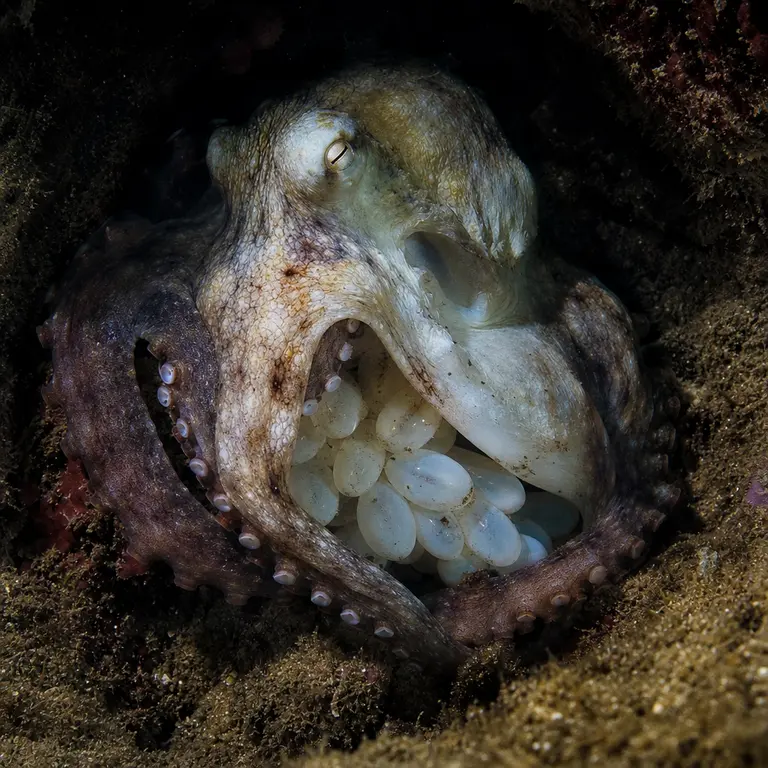
The Death Sentence Written in Glands
In the final weeks of her life, a female octopus does something that defies intuitive biology: she stops eating, tears at her own skin, and systematically destroys herself while guarding her eggs. For decades, marine biologists assumed this was a kind of maternal sacrifice — a behavioral adaptation to keep the mother focused on protecting her clutch rather than wandering off to feed. The truth, uncovered through a series of increasingly precise experiments, is far stranger. The octopus is being chemically executed by her own optic glands, which flood her body with a lethal cocktail of steroids, bile acid precursors, and pregnancy hormones after spawning begins.
The optic glands of cephalopods are small neuroendocrine organs located between the eyes and the brain. They were known for decades to regulate reproductive maturation — remove them before spawning, and a female octopus will abandon her eggs, resume eating, and live for months longer than she otherwise would. This was demonstrated in a landmark 1977 experiment by Jerome Wodinsky at Brandeis University, who showed that optic gland removal essentially reversed the death program entirely. But what the glands were actually secreting, and why it caused such catastrophic systemic collapse, remained unresolved for nearly half a century. The gap between knowing that a structure caused death and understanding how it caused death turned out to be one of the more remarkable blind spots in invertebrate biology. Filling that gap required tools that simply did not exist in Wodinsky’s era — and results that surprised even the researchers who found them.
The Biochemical Cascade of Self-Destruction
In 2022, researchers at the University of Chicago published a detailed analysis of the optic gland secretome in the California two-spot octopus, Octopus bimaculoides. Using transcriptomic and metabolomic profiling, they identified not a single death hormone but an orchestrated sequence of chemical signals. In the early post-spawning phase, the glands ramp up production of cholesterol-derived compounds, including intermediates in the bile acid synthesis pathway — molecules that, in vertebrates, serve digestive functions but, in octopuses, act as signaling agents that suppress feeding behavior and alter neurological function. The sheer unexpectedness of bile acid precursors appearing in this context was itself a significant finding, suggesting that evolution had recruited molecules with one job in one lineage and repurposed them for something entirely different in another.
As the weeks progress, the gland shifts its output to include steroid hormones structurally similar to progesterone, and then to compounds derived from glucocorticoid pathways — the same family of stress hormones that, in mammals, regulate inflammation and immune response. In octopuses, this late-phase hormonal flood appears to accelerate tissue breakdown, suppress wound healing, and impair the immune system’s ability to fight infection. The animal does not simply stop eating and waste away; it is actively dismantled by its own endocrine system on a biochemical schedule.
The researchers also detected elevated levels of 7-dehydrocholesterol, a precursor to vitamin D3, in the glands of post-spawning females. This compound, when present in excess in mammalian systems, is associated with developmental abnormalities, but its precise role in octopus senescence remains under investigation. What is clear is that the optic gland is not simply turning one signal on — it is running a sequential, multi-stage hormonal program that coordinates the animal’s death with the same precision that other endocrine systems coordinate growth or reproduction.
What makes this biochemical architecture particularly striking is its directionality. The program does not appear to be reversible once initiated beyond a certain point. Even if the optic glands were removed mid-sequence, it remains unclear whether the downstream hormonal effects could be fully arrested. The cascade has logic that, in a loose but suggestive way, resembles the signaling programs that govern apoptosis at the cellular level — the process by which individual cells execute their own destruction in an orderly, genetically directed fashion. The octopus appears to be doing something analogous, but at the level of the whole organism.
Why Evolution Would Select for This
The existence of a genetically encoded death program raises a question that cuts to the heart of evolutionary biology: why would natural selection preserve a mechanism that kills the parent? The answer lies in the octopus’s reproductive ecology. Unlike species that reproduce multiple times over long lifespans, most octopus species are semelparous — they reproduce once and die. In this context, the mother's continued survival after spawning offers no evolutionary return. Her genes have already been transmitted, and the resources she would consume by surviving — food, territory, oxygen — could theoretically compete with her offspring’s survival.
But the optic gland system appears to do more than simply allow death to happen passively. The hormonal cascade actively sustains the mother’s guarding behavior even as her body deteriorates. She continues to aerate and clean the eggs, repelling predators, for weeks or months after she has stopped eating and begun self-cannibalism. The chemical system seems to decouple feeding motivation from protective behavior, keeping the latter functional while eliminating the former. In this sense, the death program is not a failure of biology but an exquisitely tuned final function — the organism’s last act of evolutionary utility.
This has drawn significant attention from researchers studying the biology of aging. Octopuses represent a rare case of programmed senescence, a phenomenon more commonly associated with Pacific salmon, certain marsupials like the antechinus, and annual plant species. In each case, death is not a gradual accumulation of cellular damage but an active, hormonally directed process. Understanding the molecular logic of these systems may illuminate why aging in longer-lived species, including humans, takes the form it does — and whether the boundary between programmed and unprogrammed aging is as firm as once believed.
The antechinus offers a particularly instructive parallel. These small Australian marsupials undergo a breeding season so hormonally intense that males experience complete immune collapse and die within weeks of mating, their bodies flooded with corticosteroids that dissolve their own tissues to fuel continued sexual activity. Like the octopus, the antechinus does not die because something goes wrong with its biology — it dies because something goes exactly right, according to a program that evolution has maintained because the reproductive payoff justifies the cost. The octopus extends this logic further by sustaining parental behavior through the dying process itself, which may represent an even more refined form of the same underlying strategy.
Implications for the Science of Aging
The octopus optic gland findings have opened an unexpected window into geroscience — the study of the biological mechanisms of aging. One striking parallel is the hypothalamic-pituitary-adrenal axis in mammals, which also coordinates stress responses through cascading hormonal signals and, when chronically activated, produces effects strikingly similar to accelerated aging: immune suppression, muscle wasting, cognitive decline, and metabolic disruption. The octopus appears to run this axis at full throttle as a terminal program, whereas in mammals the same system operates at lower levels throughout life, contributing incrementally to age-related decline.
Some researchers have proposed that studying the specific molecular targets of the octopus optic gland’s late-phase hormones could identify conserved aging pathways — biological mechanisms shared across distantly related species that regulate the rate of organismal decline. If the same cholesterol-derived signaling molecules that accelerate octopus senescence have functional analogs in vertebrate aging, they could represent novel targets for longevity research. This remains speculative, but the biochemical overlap between cephalopod death hormones and mammalian stress steroids is sufficiently specific to warrant serious consideration as a research direction.
The broader implication for aging science is conceptual as much as molecular. For most of the twentieth century, the dominant framework for understanding aging treated it as a passive process — the inevitable consequence of accumulated damage, error propagation in cellular machinery, and the thermodynamic tendency of complex systems toward disorder. The octopus complicates this picture by demonstrating that at least some organisms age through active biological direction rather than passive deterioration. If programmed senescence exists on a spectrum rather than as a binary category, it raises the possibility that even in species like humans, some components of aging may be more directed — and therefore more modifiable — than the damage-accumulation model suggests.
This is not a settled question, and many geroscientists remain skeptical of strong programmed-aging hypotheses in long-lived species. But the octopus data has added a new and concrete data point to the debate. It is no longer possible to dismiss programmed senescence as a curiosity of a few unusual taxa. The molecular detail now available for the optic gland system gives researchers something specific to compare against — a fully characterized hormonal death program that can serve as a reference point for asking whether quieter, slower versions of similar processes operate elsewhere in the animal kingdom.
Conclusion
Beyond aging science, the octopus case challenges a persistent assumption in biology: that death is always the result of systems failing rather than systems succeeding. In Octopus bimaculoides, the body does not break down because something goes wrong. It breaks down because everything goes exactly right — a reminder that evolution’s only currency is reproductive success, and that survival has value only insofar as it serves that end.
There is something philosophically unsettling about this, though the discomfort is instructive. Human intuition tends to treat the body’s drive toward self-preservation as fundamental, almost axiomatic. The octopus reveals that self-preservation is not a biological given but a contingent strategy — one that evolution deploys when it is useful and dismantles when it is not. The optic gland does not malfunction at the end of the octopus’s life. It performs its final, and perhaps most important, function with complete biochemical fidelity, executing a program encoded in the genome over millions of years of selection pressure. That this program ends in the animal’s death is not a contradiction. It is the point. Understanding that distinction — between death as failure and death as function — may prove one of the more consequential reframings biology offers the science of aging, and perhaps to broader questions about what bodies are ultimately for.
Sources & Further Reading
- Z. Yan Wang, et al. Steroid hormones of the octopus self-destruct system. Current Biology, 2022. https://doi.org/10.1016/j.cub.2022.10.027
- Jerome Wodinsky. Hormonal inhibition of feeding and death in Octopus: control by optic gland secretion. Science, 1977. https://doi.org/10.1126/science.198.4320.948
- Andrew Kern and Clifton Ragsdale. The optic gland of Octopus vulgaris: a neuroendocrine organ. Journal of Experimental Biology, 2020.
- Thomas Flatt and Linda Partridge. Horizons in the evolution of aging. BMC Biology, 2018. https://doi.org/10.1186/s12915-018-0562-z