
Green Bank: A Silent Haven Fostering Scientific Progress
How a Cold War-era electromagnetic quiet zone in rural West Virginia became an unlikely cradle for genomic research, radio astronomy, and the future of deep-signal biology.
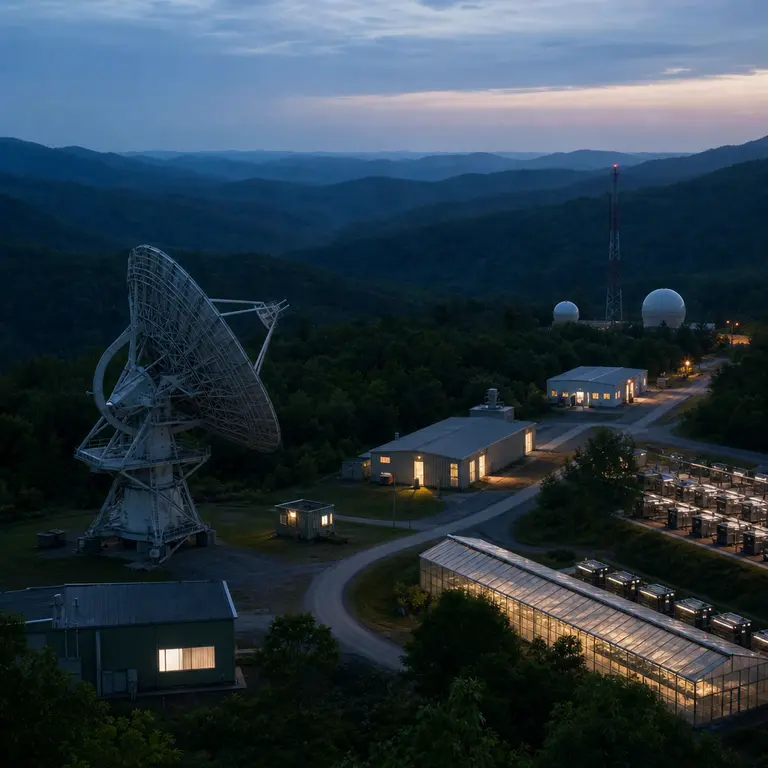
The Town Where Wi-Fi Is Illegal
In the Allegheny Mountains of West Virginia, the small community of Green Bank sits inside one of the most unusual legal jurisdictions in the United States. Within a 13,000-square-mile radius designated the National Radio Quiet Zone, residents are prohibited from using Wi-Fi routers, certain types of cell phones, and even some models of electric blankets. The zone was established in 1958 to protect the newly built National Radio Astronomy Observatory from electromagnetic interference. What began as a Cold War-era scientific precaution has since evolved into something far stranger and more consequential than its founders imagined.
The Green Bank Telescope, completed in 2000, is the world’s largest fully steerable radio telescope, standing 485 feet tall and weighing 17 million pounds. Its surface area spans 2.3 acres of precision-machined aluminum panels. The silence enforced around it has made it sensitive enough to detect signals billions of light-years away, including the faint hydrogen emissions from galaxies in the process of formation. But the quiet zone has also attracted researchers from an entirely different field, one that has nothing to do with outer space. The story of Green Bank is ultimately not just about astronomy. It is about what happens when a society decides, even briefly and for narrow technical reasons, to protect silence itself as a resource.
A Zone Built for Cold War Science
To understand why Green Bank became what it is today, it helps to understand the atmosphere in which the National Radio Quiet Zone was conceived. The late 1950s were a period of intense scientific nationalism. The Soviet Union had launched Sputnik in October 1957, and American scientific institutions were scrambling to assert their relevance and capability. The newly formed National Radio Astronomy Observatory at Green Bank was part of that response, a federally funded effort to push the boundaries of observational science using the electromagnetic spectrum rather than visible light.
Radio astronomy as a discipline was still young. Karl Jansky had only accidentally discovered cosmic radio waves in 1932 while working for Bell Telephone Laboratories, and the field had spent the intervening decades developing the theoretical and instrumental tools needed to make systematic use of that discovery. By the time the Green Bank Observatory was established, researchers understood that the sensitivity of a radio telescope was not limited only by the size of its dish or the precision of its electronics. It was also limited by the electromagnetic environment surrounding it. A single poorly shielded car engine, a faulty refrigerator motor, or a poorly designed radio transmitter could drown out signals that had traveled billions of years across the cosmos.
The federal government’s solution was unprecedented in American regulatory history. Rather than simply requiring nearby devices to meet emission standards, regulators drew a boundary around the observatory and entirely restricted the use of certain technologies within it. The result was a legal quiet zone unlike anything else in the country, one that has grown more scientifically significant with each passing decade as the devices it excludes have become more ubiquitous worldwide.
When Genomic Sequencing Needs Silence
In the late 2010s, bioinformaticians and genomic researchers began identifying a peculiar problem in next-generation DNA sequencing. Certain sequencing platforms, particularly those using nanopore technology developed by Oxford Nanopore Technologies, proved sensitive to ambient electromagnetic noise. Nanopore sequencing works by threading single strands of DNA through protein pores embedded in a synthetic membrane and measuring the tiny fluctuations in electrical current as each nucleotide passes through. The signal differences between adenine, thymine, guanine, and cytosine translate to current changes measured in picoamperes, or trillionths of an ampere.
At that scale, the electromagnetic environment matters enormously. Researchers at several institutions noted that sequencing runs conducted in electromagnetically noisy urban environments produced measurably higher error rates with certain base-calling algorithms than runs conducted in shielded or quiet environments. The effect was subtle but statistically reproducible, particularly in long-read sequencing of repetitive genomic regions such as centromeres and telomeres, which are notoriously difficult to decode accurately. A 2021 study published in Genome Research quantified baseline noise artifacts in nanopore sequencing and attributed a portion of them to ambient radiofrequency interference rather than biochemical error alone.
What makes this finding especially significant is that nanopore sequencing is not a niche or experimental platform. It has become one of the primary tools for real-time genomic surveillance, including tracking viral mutations during infectious disease outbreaks. During the COVID-19 pandemic, portable nanopore sequencers were deployed in field settings across multiple continents to monitor the emergence and spread of new variants. If the electromagnetic conditions of those field environments were introducing even marginal errors into the sequencing data, the downstream consequences for public health decision-making could have been meaningful. The question of where you sequence DNA, not just how, turns out to matter in ways the field is only beginning to take seriously.
The Quiet Zone as an Unintended Laboratory
This convergence of radio astronomy and genomics is not entirely coincidental. Both disciplines are fundamentally in the business of detecting extremely faint signals against overwhelming background noise. Radio astronomers speak of signal-to-noise ratio in terms of detecting a flashlight on the surface of Mars from Earth. Genomic sequencers face an analogous problem at the molecular scale, distinguishing the electrical whisper of a single nucleotide from the thermal and electromagnetic hum of the surrounding environment.
Several research groups have now proposed using the Green Bank Quiet Zone as a site for ultra-high-fidelity genomic sequencing experiments, particularly for resolving the so-called dark genome, the roughly 8 percent of the human genome that consists of endogenous retroviral sequences, highly repetitive satellite DNA, and other regions that standard short-read sequencing platforms struggle to resolve. The logic is straightforward: if electromagnetic interference contributes even fractionally to sequencing error, then removing it entirely could push accuracy past current technological thresholds.
The National Radio Astronomy Observatory itself has begun informal collaborations with biophysicists interested in this crossover. The same Faraday cage shielding principles used to protect radio telescope electronics from interference are now being adapted to create sequencing chambers for use in standard research environments, essentially portable quiet zones that replicate the electromagnetic conditions of Green Bank in any laboratory. This technology transfer from astronomy to molecular biology represents a kind of scientific recycling that rarely receives public attention but frequently drives progress. The tools built to listen to the universe are now being repurposed to listen to the genome, and the underlying physics connecting those two endeavors is the same.
The Broader Principle: Signal Fidelity Across Sciences
The Green Bank situation illustrates a broader and underappreciated principle in modern science: the infrastructure built for one discipline often becomes indispensable to another. The mathematics of signal extraction developed for radio astronomy, particularly matched filtering and Wiener filtering algorithms, have been directly adapted for use in brain-computer interface research, gravitational wave detection at LIGO, and, increasingly, for cleaning genomic sequencing data.
The concept of a quiet zone itself is spreading. The European Space Agency has proposed establishing electromagnetic quiet zones around future lunar far-side radio telescope installations, which would benefit from the Moon’s natural shielding from Earth’s electromagnetic cacophony. Researchers have also suggested that such zones could host next-generation quantum computing facilities, since quantum processors are among the most electromagnetically sensitive devices ever constructed, with some qubit systems requiring isolation from vibrations as small as those produced by a person walking in an adjacent room. The logic of protecting sensitive instruments from environmental interference, which seemed like a narrow technical concern in 1958, has become one of the organizing challenges of twenty-first-century science.
Green Bank, meanwhile, remains one of the last places in the continental United States where the night sky is genuinely dark and the electromagnetic spectrum is genuinely quiet. Its residents, who number fewer than 150, have adapted to a lifestyle without wireless internet or conventional cell service. Some have moved there specifically to escape electromagnetic hypersensitivity, a condition not yet formally recognized by mainstream medicine but actively studied by researchers interested in how the body’s own bioelectric signaling interacts with external fields. Whether that condition is real in the clinical sense or not, the town’s existence as an accidental refuge from modernity’s invisible noise has made it one of the most scientifically productive square miles on the planet.
A Lesson in the Value of Emptiness
Green Bank is easy to misread as a curiosity, a quirky footnote about a town frozen in a pre-wireless past. The more accurate reading is almost the opposite. The community represents a forward-looking experiment in what becomes possible when a particular kind of environmental condition is deliberately preserved rather than surrendered to technological sprawl. The electromagnetic quiet that makes Green Bank inconvenient for ordinary modern life is precisely what makes it invaluable for the most sensitive measurements science currently knows how to make.
There is a broader lesson here that extends well beyond radio astronomy or genomics. As measurement technologies become increasingly refined, the environments in which those measurements are taken become increasingly consequential. Noise, in the scientific sense, is not merely an inconvenience to be filtered out after the fact. It is a genuine limit on what can be known. The researchers who recognized that Green Bank’s enforced silence had applications beyond its original purpose were practicing a form of scientific imagination that remains rare and essential: the ability to see that a solution built for one problem might be the key to unlocking another that had not yet been fully articulated.
The town where Wi-Fi is illegal is, in this sense, not a place left behind by the modern world. It is a place that the modern world may increasingly need to visit.
Sources & Further Reading
- National Radio Astronomy Observatory. About the Green Bank Observatory. NRAO, 2023. https://greenbankobservatory.org
- Loose, M. et al. The Basecaller for Oxford Nanopore Sequencing. Genome Research, 2019. https://genome.cshlp.org
- Federal Communications Commission. National Radio Quiet Zone. FCC, 2022. https://www.fcc.gov/consumers/guides/national-radio-quiet-zone
- Oxford Nanopore Technologies. Nanopore Sequencing: Technology Overview. ONT, 2023. https://nanoporetech.com/applications/dna-nanopore-sequencing