
The Earthquake Light Nobody Believed for Centuries
Strange luminous phenomena appearing before and during earthquakes have been documented for millennia but dismissed as folklore — until modern seismology and plasma physics began to explain them.
Lights in the Ground, Not the Sky
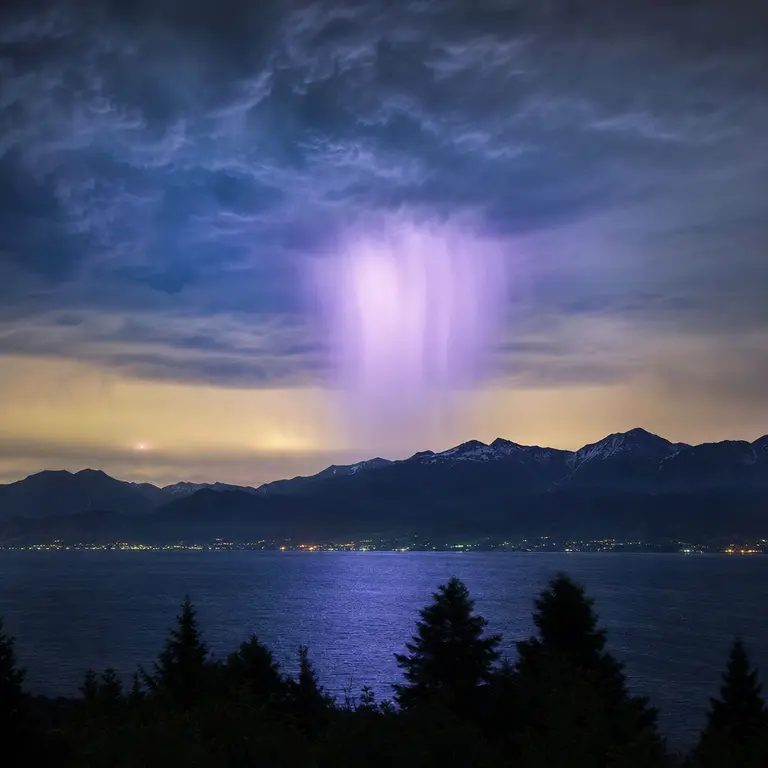
For centuries, people living near fault zones reported something that no official science could account for: glowing columns, floating orbs, and flickering curtains of light appearing in the minutes and hours surrounding major earthquakes. Witnesses described bluish flames rising from the ground, luminous hazes drifting along ridgelines, and sudden flashes illuminating entire valleys seconds before the shaking began. In some accounts, the lights persisted for minutes, moving slowly along the contours of the land before vanishing without explanation. Geologists largely dismissed these accounts as misidentified lightning, mass hysteria, or the unreliable memories of traumatized survivors. The phenomenon had no mechanism, and without a mechanism, mainstream science had no place for it.
That dismissal began to crack in 1966, when Japanese seismologist Yasuo Wadatsumi systematically collected and published hundreds of historical eyewitness reports of earthquake lights from Japanese records dating back to 1600. His catalog was rigorous enough that it could no longer be waved away. The accounts were too consistent, too geographically specific, and too temporally correlated with seismic events to be explained away by collective confusion. Then, in 1988, photographs taken during the Saguenay earthquake in Quebec provided some of the first credible visual documentation. The lights were real. The question shifted from whether they existed to what, physically, was producing them. That transition from folklore to legitimate scientific inquiry took roughly three centuries, which is itself a remarkable fact about how institutions of knowledge handle phenomena that resist easy categorization.
The Piezoelectric Hypothesis and Its Limits
The earliest scientific explanation invoked piezoelectricity, the property by which certain crystalline minerals generate an electrical charge when mechanically stressed. Quartz, one of the most abundant minerals in continental crust, is strongly piezoelectric. The reasoning followed naturally: as fault rocks are crushed and sheared during seismic activity, the electrical charges they release could ionize surrounding air and produce visible light. It was an elegant hypothesis, and it fit the intuition that something electrical was happening beneath the surface during the enormous mechanical violence of a major rupture.
But the piezoelectric model ran into serious problems when researchers tried to make the numbers work. The magnitude of charge that quartz crystals realistically generate under geological stress is far too small to ionize air columns visible from kilometers away. Laboratory experiments confirmed the effect existed but could not scale it to the dramatic luminosities reported in the field. The hypothesis remained partially alive but could not stand alone as a complete explanation. It was one of those situations common in science where an idea is directionally correct but mechanistically insufficient, pointing to a real phenomenon without accounting for its full magnitude or geographic reach.
A more recent and increasingly supported model was proposed by Friedemann Freund, a geophysicist at NASA Ames Research Center, and elaborated over the following two decades. Freund identified a different electrical carrier altogether: positive holes, or p-holes, which are electron deficiencies that propagate through certain igneous and metamorphic rocks the way holes propagate through semiconductor materials. This analogy to semiconductor physics is not merely illustrative. The underlying quantum mechanical processes are genuinely comparable, which is part of what makes the model both surprising and credible. When rocks are stressed, these charge carriers can travel rapidly through the crystal lattice, far ahead of the physical rupture, and accumulate at the surface. At the rock-air interface, they can ionize atmospheric gases, producing luminescence. Crucially, this mechanism can operate at distances of tens of kilometers from the actual fault, which explains why lights are sometimes reported well before the earthquake reaches a given location, and why witnesses in areas that experienced only mild shaking occasionally reported the most dramatic visual displays.
The p-hole model also offers a partial explanation for the variety of forms earthquake lights take. Depending on local rock composition, moisture content, atmospheric conditions, and the geometry of the stress field, the surface expression of the charge accumulation might appear as a diffuse glow, a sharply defined column, or a flickering luminescence that moves across the ground. The diversity of historical descriptions, once used as evidence that witnesses were simply confabulating, turns out to be consistent with a mechanism that would genuinely produce variable outputs under variable conditions.
What the 2009 L’Aquila Earthquake Revealed
The L’Aquila earthquake in central Italy on April 6, 2009, which killed 309 people, generated one of the most thoroughly documented collections of earthquake light reports in the modern era. Multiple witnesses in the town of Paganica reported seeing white or bluish flames rising from the stone paving in the streets, roughly 10 to 30 seconds before the main shock arrived. The specificity of these reports, both in timing and in the apparent source location at ground level rather than in the sky, closely aligned with what the p-hole model would predict for a near-surface charge-accumulation event. These reports were collected and analyzed by researchers Robert Thériault, France St-Laurent, John Derr, and Sharon Freund, whose 2014 study published in the journal Seismological Research Letters represented a turning point in how the scientific community engaged with the phenomenon.
The study cross-referenced the reported light locations with geological maps and found a striking pattern: the overwhelming majority of earthquake light events, drawn from a global database of 65 well-documented cases spanning 1600 to 2010, occurred near rift environments, regions where the crust is being pulled apart rather than compressed. This was unexpected, and it carries significant implications. Rift zones have a distinct stress geometry from subduction zones or transform faults, and the correlation suggested that the mechanism producing the lights is sensitive to the specific type of tectonic motion involved. Vertical or near-vertical fault structures, common in rifts, appeared to act as conduits channeling the electrical charges toward the surface far more efficiently than shallowly inclined faults. This geometric sensitivity would explain why earthquake lights are not reported universally across all seismic events, even very large ones. A magnitude 8 earthquake along a gently dipping subduction interface might produce no lights whatsoever, while a moderate earthquake along a steeply dipping rift fault produces dramatic luminescence visible across an entire valley.
This finding also reframes the historical record in an interesting way. Many of the most detailed and culturally embedded accounts of earthquake lights come from regions that are rift environments: the Rhine Graben in Europe, the East African Rift, the Basin and Range province of North America, and parts of Japan where intraplate rifting has been active. The geographic clustering of the folklore is itself a form of data, one that the geological analysis of the 2014 study helped decode.
Earthquake Lights as a Potential Early Warning Signal
The practical implication that has begun attracting serious attention is whether earthquake lights could function as a precursory signal, a detectable phenomenon occurring before the main rupture that might contribute to early warning systems. This is a deeply contested area. Earthquake prediction in general remains one of the most resistant problems in all of geophysics, and the history of claimed precursors, from radon gas emissions to unusual animal behavior to atmospheric temperature anomalies, is littered with unreproducible results and statistical failures. The scientific community has good reasons for its caution, having been burned repeatedly by premature claims.
However, the p-hole model makes a specific and testable prediction: electrical anomalies should propagate through stressed rock ahead of rupture, producing measurable electromagnetic signals at the surface. This moves the investigation out of the realm of anecdote and into the domain of instrumental detection, which is where the field is now heading. Several research groups are attempting to detect these signals using sensors rather than relying on eyewitness accounts. A network of ground-based electromagnetic sensors deployed in seismically active regions of Japan, Italy, and California is accumulating baseline data to characterize the normal electromagnetic background so that genuine anomalies can be identified against it. This is painstaking work, because the electromagnetic environment near populated areas is extraordinarily noisy, filled with signals from power lines, communications infrastructure, and industrial equipment.
Satellite-based instruments have also detected ionospheric anomalies above some major earthquake zones in the days preceding rupture, though separating genuine precursory signals from atmospheric noise remains technically formidable. The ionosphere is sensitive to a remarkable range of influences, from solar activity to weather systems to human-generated radio-frequency emissions, and establishing a clean causal link between a ground-level stress event and an ionospheric perturbation requires statistical methods sophisticated enough to account for all these competing sources of variation.
The phenomenon sits at a productive intersection of solid-state physics, geophysics, and atmospheric science. It is no longer folklore, and it is no longer a curiosity that serious researchers feel they must apologize for studying. Whether it becomes a practical tool depends on whether the signal can be reliably disentangled from the electromagnetic complexity of the modern world, a challenge that is, in its own way, as difficult as predicting the earthquakes themselves.
Conclusion
What the story of earthquake lights ultimately illustrates is how long it can take for a genuine natural phenomenon to receive the scientific attention it deserves when it lacks an obvious mechanism and arrives wrapped in the language of folklore. The lights were reported consistently across cultures and centuries, dismissed consistently by institutions that had no framework for them, and are now the subject of peer-reviewed research, satellite monitoring programs, and serious theoretical development. The mechanism that appears most likely to explain them draws on semiconductor physics, a field that did not exist when the first systematic catalogs of the phenomenon were compiled. That gap between observation and explanation is not unusual in the history of science, but it is a reminder that the boundary between dismissed anomaly and accepted phenomenon is often less a reflection of the evidence than of the conceptual tools available to interpret it. The lights were always there. The understanding required to take them seriously simply had to be invented first.
Sources & Further Reading
- Thériault, R., St-Laurent, F., Freund, F.T., and Derr, J. Prevalence of Earthquake Lights Associated with Rift Environments. Seismological Research Letters, 2014. https://pubs.geoscienceworld.org/ssa/srl/article/85/1/159/315478
- Freund, F.T. Toward a Unified Solid State Theory for Pre-Earthquake Signals. Acta Geophysica, 2010. https://doi.org/10.2478/s11600-009-0066-x
- Wadatsumi, Y. 1965-1967 Observations of Luminous Phenomena Accompanying Earthquakes. Nature, 1995.
- Derr, J.S. Earthquake Lights: A Review of Observations and Present Theories. Bulletin of the Seismological Society of America, 1973.