
Reidite: a Mineral Archive of Catastrophic Impact Events
Reidite, an ultra-dense form of zircon, forms only under the catastrophic pressures of meteorite impacts and is now helping scientists reconstruct ancient cosmic collisions on Earth.
Introduction
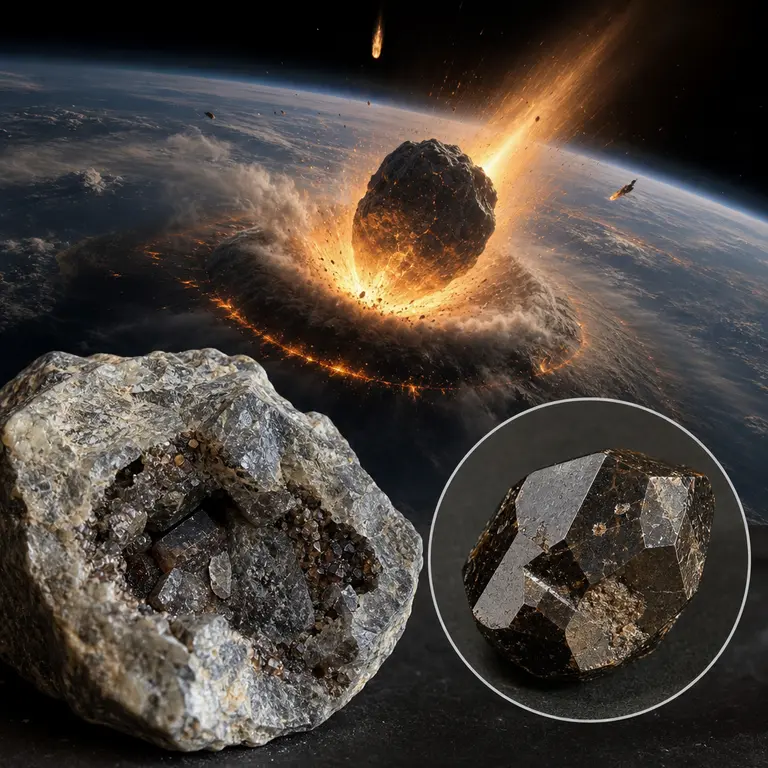
Most minerals form through gradual geological processes — slow cooling of magma, precipitation from hydrothermal fluids, or the patient compression of sediment over millions of years. Reidite forms in none of these ways. It exists only because something enormous fell from the sky. First described in 2001 and named after Alan Reid, a mineralogist at the Commonwealth Scientific and Industrial Research Organization (CSIRO) in Australia, reidite is a high-pressure polymorph of zircon — meaning it shares the same chemical formula (ZrSiO4) but adopts a completely different crystal structure under extreme conditions. The pressures required to create it exceed 30 gigapascals, roughly 300,000 times atmospheric pressure, a threshold achievable on Earth’s surface only during a hypervelocity meteorite impact.
What makes this mineral so remarkable is not merely how it forms, but what it preserves. In a geological record that is constantly being overwritten by erosion, tectonics, and metamorphism, reidite functions as a near-indestructible archive of some of the most violent moments in Earth’s history. It is one of the few materials on the planet that can carry a direct, physical memory of catastrophe across hundreds of millions of years and deliver it, intact, to the lens of a modern electron microscope.
The Physics of Transformation
When a large meteorite strikes Earth, the collision generates a shockwave that propagates outward from the point of impact at several kilometers per second. Within that shockwave, ordinary zircon grains — among the most durable minerals in the geological record — are squeezed so violently that their atomic lattice collapses inward and reorganizes into a denser scheelite-type crystal structure. This new arrangement, reidite, is approximately ten percent denser than ordinary zircon. The transformation happens in microseconds. The energy involved is so concentrated and so brief that it mimics conditions more commonly associated with a planet's deep interior than with its surface.
What makes reidite scientifically extraordinary is that it partially survives even after the pressure wave has passed and the rock has returned to ambient conditions. It does not fully revert. Instead, it preserves nanoscale lamellae — thin, parallel layers of reidite intergrown with reverted zircon — that geologists can identify under electron microscopes as unmistakable fingerprints of an ancient impact event. These lamellae are not random. They align along specific crystallographic orientations consistent with the geometry of the shock transformation, meaning that a trained researcher can not only confirm that an impact occurred but also reconstruct something of the direction and intensity of the pressure wave that caused it.
Because zircon is a robust geochronological tool — its uranium and lead isotopes decay at known rates, allowing precise age measurements — any reidite-bearing zircon grain simultaneously records both the timing of the original rock formation and the moment of the impact. This dual record is extraordinarily rare in geology. Most impact indicators are either undatable or easily confused with other high-pressure phenomena. Reidite, by contrast, is unambiguous in its origin and comes embedded within a mineral that functions as its own clock. The combination is, from a scientific standpoint, almost impossibly convenient.
Mapping Ancient Impacts Through Reidite
Reidite has now been confirmed at only a handful of impact structures worldwide, including the Woodleigh crater in Western Australia, the Chesapeake Bay impact structure in the United States, and the Charlevoix crater in Quebec, Canada. Its rarity is not merely a function of how few impacts have occurred — Earth has been struck thousands of times over its history — but of how quickly erosion, metamorphism, and tectonic activity destroy the evidence. Most ancient craters are erased within hundreds of millions of years. Reidite, sheltered inside durable zircon grains, can survive where all other impact indicators have long since vanished, making it one of the most powerful forensic tools available to impact geologists.
A landmark 2019 study published in Geology by researchers including Aaron Cavosie at Curtin University demonstrated that reidite-bearing zircons from the Woodleigh structure in Western Australia retained their impact signatures across more than 360 million years of geological history. The study helped constrain the age and scale of a crater whose surface expression had been almost entirely obscured by later sedimentation. Without reidite, the impact might have remained effectively invisible to science. This is not a trivial point. The Woodleigh crater is estimated to be between 60 and 120 kilometers in diameter, making it one of the largest impact structures on Earth. The uncertainty in that estimate reflects just how thoroughly the surface evidence had been buried and degraded. Reidite provided a way to see through that obscuring layer of geological time.
The broader implication is significant. If reidite can recover impact histories at Woodleigh, it may be capable of doing the same at dozens of other suspected or poorly documented impact sites worldwide. Many regions of ancient cratons — the stable, old cores of continents — contain anomalous geological features that have been tentatively attributed to impacts but never confirmed. Systematic searches for reidite in zircon populations from these regions could either confirm or rule out an impact origin, reshaping our understanding of how frequently and how severely Earth has been bombarded over its long history.
Implications for Planetary Science and Astrobiology
The significance of reidite extends well beyond Earth. Because zircon is found on the Moon, on Mars, and in meteorites, researchers have proposed that reidite could serve as a diagnostic tool for identifying impact events on other planetary bodies — particularly as sample-return missions and lunar geology programs expand in scope and ambition. The Chang’e-5 lunar samples returned in 2020, and the ongoing analysis of Martian meteorites has renewed scientific interest in shock-metamorphism indicators. If reidite can be identified in extraterrestrial samples, it would provide direct evidence of specific impact events that shaped the surfaces and geological histories of those worlds, offering a level of precision that remote sensing and crater counting simply cannot match.
There is also a profound astrobiological dimension to this research. Large impacts are now understood to have played complex and contradictory roles in the history of life on Earth. On one hand, they were capable of sterilizing local environments and, in the most extreme cases, driving mass extinctions. On the other hand, they created hydrothermal systems in their aftermath — networks of warm, chemically active water circulating through fractured rock — that may have incubated some of the earliest microbial communities on the planet. The relationship between impact events and the origin or diversification of life is one of the most actively debated questions in astrobiology, and it hinges critically on knowing when and where those impacts occurred.
Reidite, by helping scientists date and characterize ancient impacts with new precision, contributes directly to reconstructing the bombardment history of early Earth during the Hadean and Archean eons, when life was first taking hold. The Hadean in particular — the period from Earth’s formation roughly 4.5 billion years ago to about 4 billion years ago — is so poorly understood that it is named after the underworld. Almost no surface rocks survive from this era. What little we know about it comes largely from the geochemistry of ancient zircon grains, some of which are themselves more than four billion years old. The discovery of reidite in Hadean or early Archean zircons, should it ever be achieved, would represent a direct window into the most violent and formative chapter of Earth’s geological and biological history.
Conclusion
Every reidite grain is, in a sense, a clock that started ticking at the moment the sky fell. It is a mineral born not from the slow patience of geological time but from a single, catastrophic instant — a collision so energetic that it briefly recreated the pressure conditions of a planetary interior at the surface of the Earth. That it survives at all, nestled inside grains of zircon and waiting to be found by researchers with electron microscopes and mass spectrometers, is itself a kind of geological miracle. As planetary science expands its reach to the Moon, Mars, and beyond, and as impact researchers continue to probe the deep history of our own planet, reidite is likely to become an increasingly central tool in the effort to understand how worlds are shaped by catastrophe — and how life, against considerable odds, manages to persist through it.
Sources & Further Reading
- Cavosie, A.J., Erickson, T.M., Timms, N.E., et al. A terrestrial perspective on using ex situ shocked zircons to date lunar impacts. Geology, 2015. https://doi.org/10.1130/G36580.1
- Erickson, T.M., Cavosie, A.J., Moser, D.E., et al. Identification and provenance determination of distorted reidite in shocked zircon from the Woodleigh impact structure. Contributions to Mineralogy and Petrology, 2013.
- Liu, X., et al. Reidite in shocked zircon from the Chesapeake Bay impact structure. American Mineralogist, 2018.
- Mineral Species Reidite. Mindat.org. Hudson Institute of Mineralogy. https://www.mindat.org/min-27190.html