
Teeth: Timeless Archives of Childhood and Migration
Human teeth contain microscopic growth lines that archive stress, illness, weaning, and even migration events with extraordinary precision — turning dental enamel into a biological autobiography readable centuries after death.
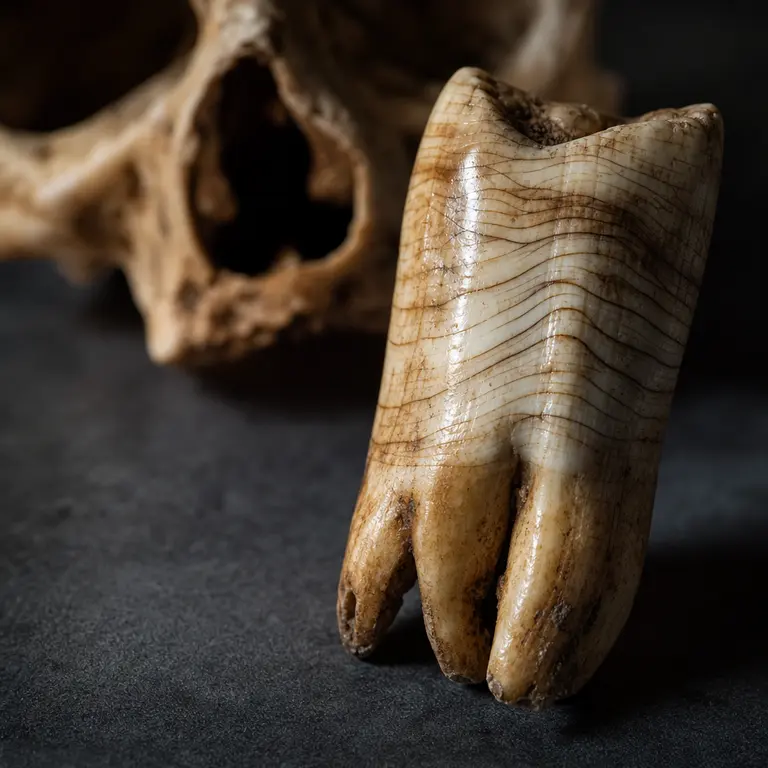
The Enamel Archive Hidden in Plain Sight
Every human tooth is a diary. Buried within the crystalline structure of dental enamel are incremental growth lines called striae of Retzius — periodic bands deposited during enamel formation that record physiological disruptions with the same logic a tree uses to record drought years. These lines form at regular intervals, roughly every six to nine days, and when a child experiences significant metabolic stress — illness, weaning, malnutrition, or even a prolonged fever — the disruption leaves a pronounced mark called an accentuated striae, or in its most dramatic form, a Wilson band. Bioarchaeologists and forensic anthropologists have spent decades learning to read these marks with increasing sophistication, and what they can now extract from a single molar is startling.
The technique relies on a biological accident of extraordinary convenience: enamel, unlike bone, does not remodel after it forms. Bone is metabolically active throughout life, constantly being broken down and rebuilt in response to mechanical stress, hormonal signals, and nutritional status. Enamel has no such capacity for revision. Once laid down by ameloblasts — the specialized cells responsible for its formation — the record is essentially permanent, sealed inside a mineral matrix harder than most metals. A tooth crown formed between birth and age three captures that entire developmental window in microscopic layers roughly 25 to 35 micrometers thick. By sectioning a tooth and examining it under polarized light or confocal microscopy, researchers can count the lines, measure their spacing, and identify the precise timing of stress events — sometimes to within a week of when they occurred in a child who died a thousand years ago.
This permanence is what makes teeth so extraordinary as archives. Soft tissue decays. Bone remodels and dissolves. DNA fragments under the pressure of time, heat, and microbial activity. But enamel persists. Teeth recovered from waterlogged archaeological sites, desert burials, mass graves, and cremated remains have all yielded readable incremental structures under the right analytical conditions. The archive does not require ideal preservation. It simply requires that the tooth survived at all.
Weaning, Migration, and the Chemistry of Place
The striae of Retzius provide timing, but modern isotopic analysis adds geographic context. Strontium isotope ratios locked into enamel reflect the local geology of the water and food a child consumed while that portion of the tooth was forming. Because different geological regions have distinct strontium signatures shaped by the age and composition of the underlying bedrock, a single tooth can reveal whether a person moved during childhood — and when. A tooth formed partly in one isotopic zone and partly in another contains a literal record of migration, with the transition visible at a specific growth line that can itself be dated using the incremental chronology.
This approach has produced remarkable findings. A 2019 study of Iron Age individuals from the British site of Winterbourne Kingston used combined strontium and oxygen isotope analysis alongside incremental enamel mapping to identify individuals who had migrated from continental Europe during early childhood. The timing of the isotopic shift could be matched to a specific developmental period, suggesting that movement occurred before age 5. The individuals in question showed no other obvious markers of foreign origin in their skeletal morphology, and without the isotopic evidence locked in their teeth, their journeys would have remained entirely invisible to the archaeological record. Similarly, studies of Roman-period skeletons from London have identified individuals with North African or Middle Eastern enamel chemistry, confirming the cosmopolitan nature of the city’s population in ways that documentary sources alone could never establish. These were not wealthy merchants or diplomats whose movements might have been recorded in texts. They were ordinary people, buried in ordinary graves, whose teeth quietly preserved the story of a childhood lived elsewhere.
Weaning itself leaves a chemical signature of a different kind. Breastfed infants receive nitrogen enriched in the heavier isotope nitrogen-15 relative to their mothers, because each step up the food chain concentrates the heavy isotope through a process called trophic fractionation. When a child transitions from breast milk to solid food, the nitrogen-15 ratio in newly forming enamel drops measurably, reflecting the shift to a diet derived from lower trophic levels. By pinpointing where in the tooth this shift occurs and correlating it with the growth line chronology, researchers can determine the approximate age of weaning in ancient populations — a metric with profound implications for understanding infant mortality, birth spacing, and maternal health in past societies. Earlier weaning is associated with shorter birth intervals and higher infant mortality, since weaned infants in pre-industrial societies were more vulnerable to waterborne pathogens and nutritional deficiencies. The teeth of children who did not survive infancy can therefore reveal something not only about their own short lives but about the reproductive strategies and health constraints of their mothers.
Forensic Applications and the Neonatal Line
The same principles that illuminate ancient childhoods are increasingly applied in forensic contexts. When an unidentified body is discovered, the incremental structure of teeth can help establish a biological profile with a specificity that other skeletal indicators cannot match. A 2021 paper in the Journal of Forensic Sciences demonstrated that accentuated striae patterns could be used to estimate the timing of known stress events in modern individuals, potentially corroborating or challenging claimed identities. In mass disaster scenarios, where multiple unidentified remains must be sorted and matched to missing persons reports, dental histology provides an independent line of evidence that does not depend on DNA, which degrades far more rapidly than enamel and is sometimes unavailable due to contamination, sample quality, or the absence of reference samples from living relatives.
There is also growing interest in what teeth might reveal about prenatal stress. The neonatal line — a particularly prominent stria that forms at birth due to the metabolic disruption of delivery and the abrupt transition from placental to independent nutrition — is visible in every tooth that was forming at the time of birth. This includes the first molars, which begin forming in utero, and the deciduous incisors and canines. Researchers have found that the thickness and character of the neonatal line correlate with birth complications, premature delivery, and maternal nutritional status. A thin, faint neonatal line suggests a relatively uncomplicated birth in a well-nourished mother. A broad, hypomineralized band suggests metabolic disruption severe enough to leave a lasting mark on the enamel being deposited in the hours and days surrounding delivery. In archaeological populations where maternal health records obviously do not exist, this single line has become a proxy for obstetric conditions across entire communities, allowing researchers to estimate rates of birth stress in populations separated from us by centuries or millennia.
Reading the Future Through the Past
The implications extend beyond archaeology and forensics into public health history. By analyzing large skeletal assemblages from known historical periods — plague years, famines, industrial transitions — researchers can construct population-level stress profiles that reveal how childhood health responded to systemic shocks. A 2022 study of post-medieval London skeletons found that children buried in poorer parish cemeteries showed significantly higher rates of accentuated striae than those from wealthier parishes, providing hard tissue evidence for what historians had long suspected about the health consequences of early industrial inequality. The bodies of the poor encoded the cost of poverty in their teeth, and those teeth survived long enough to be counted.
More recently, the field has been transformed by synchrotron X-ray microtomography, which enables imaging of the entire three-dimensional enamel structure of a tooth without sectioning or destroying the sample. This is particularly significant for rare or legally protected specimens, including teeth from named historical individuals or from museum collections where destructive sampling is prohibited or restricted. The resolution achievable with modern synchrotron sources — approaching one micrometer — means that growth lines invisible to conventional microscopy can now be detected and counted, pushing the temporal resolution of dental bioarchaeology to its theoretical limits. Researchers working with this technology have begun to extract developmental data from teeth that would previously have been considered unreadable, including heavily worn specimens and those recovered from harsh depositional environments.
The convergence of incremental enamel analysis, isotopic chemistry, and high-resolution imaging has produced a discipline that is still maturing but already capable of things that would have seemed implausible a generation ago. Individual life histories can be reconstructed from a single tooth with a granularity that rivals written biography for the earliest years of life. Population-level health trends can be tracked across centuries without a single surviving document. The movements of people who left no other trace can be mapped across continents.
What emerges from all of this is a quiet revolution in how scientists reconstruct individual lives from the deep past. A tooth that survived in the ground for five hundred years while all other biological evidence dissolved can still tell a researcher when its owner was sick as a toddler, when they stopped nursing, whether they moved across a continent, and how hard their early years were. The enamel does not forget. It does not revise, soften, or omit. It simply records, layer by layer, the biological truth of a childhood, and then it waits in the dark for someone with the tools to read it.
Sources & Further Reading
- Hillson, Simon. Dental Anthropology. Cambridge University Press, 1996.
- Gustafson, G. and Gustafson, A.G. Microanatomy and Histochemistry of Enamel. In: Structural and Chemical Organization of Teeth, Academic Press, 1967.
- Montgomery, Janet et al. Mobility, Seasonality and Isotopes: Strontium and Oxygen Analysis of Teeth from Iron Age Britain. Journal of Archaeological Science, 2019.
- Smith, Tanya M. The Tales Teeth Tell: Development, Evolution, Behavior. MIT Press, 2018.