
The Bacterium That Manufactures Its Own Magnetic Compass
Magnetotactic bacteria don't just sense Earth's magnetic field — they build nanoscale compass needles inside their own cells from scratch, a feat of biological engineering that is now inspiring breakthroughs in medicine, materials science, and navigation technology.
Introduction
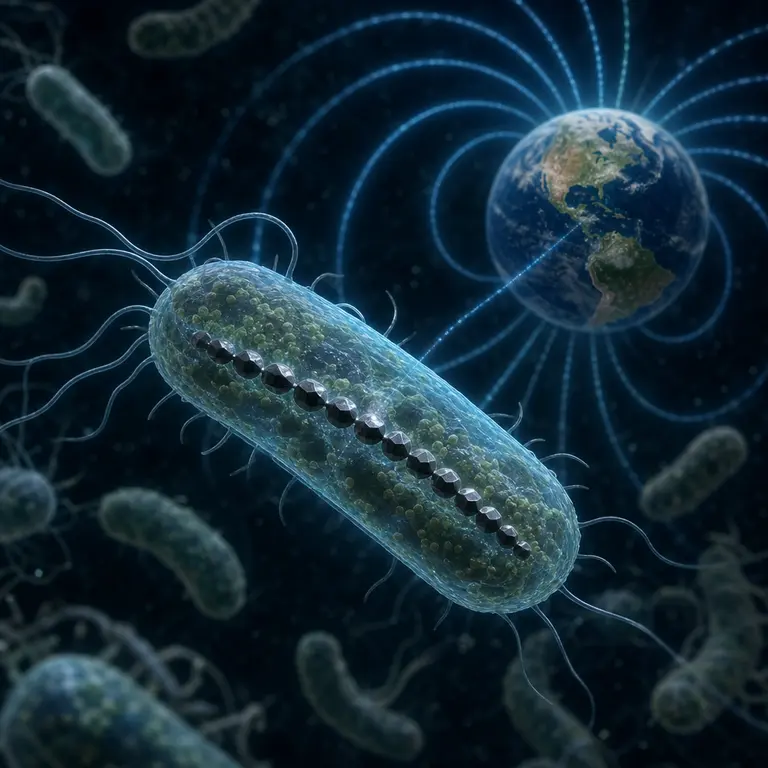
Somewhere in the muddy sediment at the bottom of a freshwater pond, a bacterium no larger than two micrometers is doing something that engineers have spent decades trying to replicate artificially. It is manufacturing, atom by atom, a perfectly crystalline chain of magnetic iron particles — each one geometrically precise, biologically enclosed, and oriented along the cell’s long axis like a string of microscopic compass needles. These structures, called magnetosomes, are not accidental mineral deposits. They are deliberately synthesized organelles, governed by a dedicated cluster of genes, and they allow the organism to navigate using Earth’s geomagnetic field with a sensitivity that has no equivalent in the animal kingdom at this scale.
Magnetotactic bacteria were first formally described in 1975 by the American microbiologist Richard Blakemore, who noticed that certain microorganisms in marine sediment consistently swam toward the north pole of a bar magnet placed near the microscope stage. He published his findings in Science, and the scientific community was initially skeptical. The idea that a single-celled organism without a nervous system could orient itself using magnetism seemed implausible. Blakemore was right, and the field of magnetotaxis has since grown into one of the more remarkable intersections of microbiology, geophysics, and nanotechnology. What began as a curious anomaly observed through a microscope has evolved into a discipline spanning evolutionary biology, paleoclimatology, cancer medicine, and advanced materials science — all anchored in the behavior of organisms too small to see with the naked eye.
How Magnetosomes Are Built
The magnetosome is not simply a grain of iron that precipitates inside a cell. It is an active construction project requiring molecular precision at every stage. The bacterium first invaginates a section of its inner cell membrane to form a lipid vesicle — a tiny enclosed sac. Iron ions are then actively pumped into this vesicle against a concentration gradient, requiring cellular energy. Within the controlled chemical environment of the vesicle, iron is biomineralized as either magnetite (Fe3O4) or greigite (Fe3S4), depending on the species. The resulting crystal is typically between 35 and 120 nanometers in diameter, which places it precisely within the single-magnetic-domain size range — meaning each crystal behaves as a permanent magnet rather than a weak, multi-domain one.
This size precision is not accidental. Crystals smaller than roughly 30 nanometers would be superparamagnetic and lose their magnetization randomly due to thermal fluctuations. Crystals larger than about 120 nanometers would fragment into multiple magnetic domains and become less efficient as navigational tools. The bacterium engineers its magnetosomes to fall precisely within the optimal window, achieving a level of quality control that materials scientists working with synthetic nanoparticles struggle to match, even with sophisticated laboratory equipment. The entire process is controlled by a genomic island of roughly 100 genes, collectively called the magnetosome island, which encodes proteins responsible for vesicle formation, iron transport, crystal nucleation, and magnetosome chain assembly. When scientists delete these genes, the bacterium loses its magnetic capability entirely and cannot recover it, confirming that this is a tightly integrated biological system rather than a loose collection of redundant mechanisms.
The chain arrangement is equally important to the organism’s function. A single magnetosome would produce only a weak magnetic moment, easily overwhelmed by thermal noise in the surrounding aqueous environment. By aligning dozens of them in a row, anchored to a cytoskeletal filament made of a protein called MamK, the bacterium creates a cumulative dipole strong enough to passively orient the entire cell along geomagnetic field lines, the way a compass needle aligns with north. The cell then uses its flagella to swim along this axis, navigating toward lower-oxygen zones in the sediment where anaerobic or microaerobic conditions suit its metabolism. In the Northern Hemisphere, magnetotactic bacteria tend to swim northward and downward. In the Southern Hemisphere, they swim southward and downward. At the magnetic equator, populations of both orientations coexist in roughly equal numbers, a geographic distribution that has been confirmed through field sampling across multiple continents and provides some of the most compelling evidence that the magnetic orientation is genuinely functional rather than incidental.
A Living Record of Earth’s Magnetic History
When magnetotactic bacteria die, their magnetosomes do not simply dissolve back into the surrounding chemistry. The lipid membrane degrades over time, but the mineral crystals — particularly magnetite — can persist in sediments for millions of years. These fossil magnetosomes, called magnetofossils, retain the magnetic orientation they had when the bacterium died, effectively recording the direction of Earth’s magnetic field at that precise moment in geological time. Geologists and paleomagnetists have found magnetofossil layers in deep-sea sediment cores dating to the Cretaceous, approximately 85 million years ago, making them among the oldest biological magnetic records on the planet.
This has made magnetotactic bacteria inadvertent archivists of geomagnetic history. By analyzing the orientation and composition of magnetofossil assemblages extracted from sediment cores, researchers can reconstruct past geomagnetic field reversals, variations in field intensity, and even ancient climate shifts that altered the chemistry of ocean sediments. The technique relies on the distinctive crystal morphology of magnetofossils — often cuboidal, elongated, or bullet-shaped — that distinguishes them from inorganic magnetic minerals, allowing researchers to isolate their signal from background geological noise.
A 2020 study published in Nature Communications identified a dramatic spike in magnetofossil abundance in sediments corresponding to the Paleocene-Eocene Thermal Maximum, roughly 56 million years ago, a period when global temperatures rose by five to eight degrees Celsius over a geologically brief interval. The researchers interpreted the bloom of magnetotactic bacteria as a response to warming oceans and altered sediment chemistry, suggesting that magnetofossil records could serve as a proxy for ancient ocean temperatures and oxygen levels. This opens the possibility of a paleoclimate tool that did not exist a decade ago — one that draws on the behavior of microorganisms to answer questions about planetary-scale events that occurred tens of millions of years before humans appeared. The irony that bacteria too small to see with the naked eye may help scientists reconstruct the thermal history of entire ocean basins is not lost on researchers in this field.
Medical and Technological Applications
The precision with which magnetotactic bacteria manufacture magnetic nanoparticles has attracted intense interest from materials scientists and biomedical engineers working on problems that seem entirely removed from muddy pond sediment. Synthetic magnetic nanoparticles produced in laboratories tend to be irregular in size, shape, and magnetic properties — a variability that limits their effectiveness in medical applications where consistency is critical. Bacterial magnetosomes are strikingly uniform, biologically encased in a lipid membrane that makes them inherently biocompatible, and tunable in their surface chemistry through relatively straightforward genetic modifications. These properties make them attractive candidates for targeted drug delivery, magnetic hyperthermia cancer treatment, and high-resolution MRI contrast agents.
In magnetic hyperthermia, iron oxide nanoparticles are introduced into tumor tissue and then exposed to an alternating magnetic field. The particles generate heat through magnetic relaxation, selectively destroying cancer cells while leaving surrounding tissue relatively unharmed. Clinical trials using synthetic nanoparticles have been conducted in Europe, particularly for glioblastoma treatment, but magnetosome-derived particles have shown superior heating efficiency in laboratory settings due to their size uniformity and single-domain character. Several research groups in Germany, France, and Japan are actively investigating magnetosome-based hyperthermia systems, and at least one European biotech company has begun early-stage development of bacterially produced nanoparticles for oncology applications. The challenge remains one of scale: magnetotactic bacteria are slow-growing and difficult to cultivate in large quantities, which limits the practical availability of magnetosomes for clinical use.
Beyond medicine, the magnetosome biosynthesis pathway has inspired synthetic biology efforts to engineer magnetosome production in non-magnetic bacteria such as Escherichia coli, which is far easier to cultivate at industrial scale and has well-established genetic tools available for manipulation. In 2021, researchers at the Chinese Academy of Sciences reported partial success in transferring core magnetosome genes into E. coli, producing rudimentary magnetic particles inside the foreign host. The particles were less ordered than those produced by native magnetotactic bacteria, but the experiment demonstrated that the core biochemical logic of magnetosome formation could function outside its original cellular context — a proof of concept suggesting that scalable biological magnetic nanoparticle manufacturing may be achievable within the decade. If that goal is realized, the downstream applications extend well beyond medicine into data storage, environmental sensing, and the fabrication of novel magnetic materials.
The Unanswered Questions
Despite fifty years of research, magnetotactic bacteria retain several deep mysteries that cut to the heart of evolutionary biology and cell physiology. The evolutionary origin of the magnetosome island remains contested among researchers who have examined it from multiple angles. Some phylogenetic analyses suggest it evolved once in a common ancestor and then spread via horizontal gene transfer across diverse bacterial lineages, explaining its presence in organisms that are otherwise only distantly related. Others propose it evolved independently multiple times in separate lineages, citing convergent evolution as evidence that magnetic navigation confers a sufficiently strong selective advantage to recur under the right environmental conditions. Distinguishing between these hypotheses requires detailed comparative genomics across a much wider range of magnetotactic species than are currently available for study.
The true global diversity of magnetotactic bacteria is also poorly characterized, and the organisms studied in laboratories represent only a narrow slice of what appears to exist in nature. Most known species cannot be cultivated under standard laboratory conditions, and environmental DNA surveys suggest that the magnetotactic community in ocean sediments is far more complex than the handful of well-studied model organisms implies. New lineages continue to be discovered through metagenomic sampling of extreme environments, including deep-sea hydrothermal vent fields and hypersaline lakes, suggesting that magnetotaxis may be more widespread and ecologically significant than current estimates suggest.
There is also the genuinely unresolved question of whether magnetotaxis is the primary function of magnetosomes at all, or whether navigation is a secondary benefit layered onto an organelle that originally served a different purpose. Some researchers have proposed that the iron storage capacity of magnetosomes may have been the original selective pressure, with magnetic navigation emerging later as a fortuitous consequence of accumulating large quantities of crystalline iron. Others have noted that magnetosome membranes contain antioxidant proteins, suggesting that the organelle originally served as a detoxification mechanism for reactive oxygen species in iron-rich environments, where free iron can catalyze damaging chemical reactions. The compass hypothesis remains the dominant explanation in the field, but the evolutionary story is almost certainly more complicated than a single clean narrative suggests, and the question of origins remains genuinely open.
Conclusion
What is not in doubt is that magnetotactic bacteria are among the most elegant examples of biological nanotechnology on Earth. These are single-celled organisms, lacking any nervous system, that have independently solved a problem of magnetic sensing and navigation that human engineers are still working to master through sophisticated synthetic chemistry. They build permanent magnets at the nanoscale with a precision that exceeds current industrial manufacturing, leave behind fossil records that encode the history of Earth’s magnetic field, and offer potential solutions to some of the most difficult challenges in cancer medicine and materials science. The story of magnetotactic bacteria is ultimately a story about the depth of ingenuity available to life when natural selection operates over geological timescales — and a reminder that the most consequential technologies on the planet are sometimes operating invisibly, in the dark, at the bottom of a pond.
Sources & Further Reading
- Blakemore, R. Magnetotactic Bacteria. Science, 1975. https://doi.org/10.1126/science.170679
- Faivre, D., and Schüler, D. Magnetotactic Bacteria and Magnetosomes. Chemical Reviews, 2008. https://doi.org/10.1021/cr078258w
- Schumann, D., et al. Gigantism in unique biogenic magnetite at the Paleocene-Eocene Thermal Maximum. Proceedings of the National Academy of Sciences, 2008. https://doi.org/10.1073/pnas.0803634105
- Lefèvre, C.T., and Bazylinski, D.A. Ecology, Diversity, and Evolution of Magnetotactic Bacteria. Microbiology and Molecular Biology Reviews, 2013. https://doi.org/10.1128/MMBR.00021-13