
The Subterranean Microbes Reshaping Arctic Geopolitics
How newly discovered deep permafrost microorganisms are transforming climate models and international Arctic policy
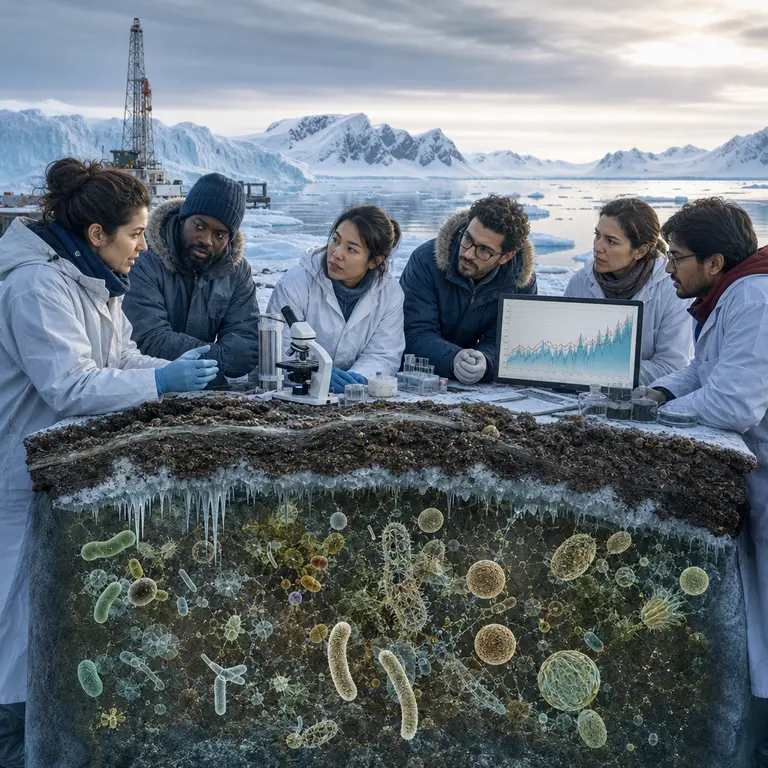
In the remote reaches of Eastern Siberia, a discovery that began as a routine permafrost sampling expedition has cascaded into what may become one of the most consequential scientific findings of the decade—with implications stretching from microbiology laboratories to diplomatic negotiating tables.
The Unexpected Discovery
A team of Russian and Norwegian microbiologists, drilling core samples from previously unexplored permafrost depths of 30-35 meters, identified a previously unknown class of methanotrophic archaea—microorganisms that consume methane rather than produce it. The discovery, led by Dr. Svetlana Orlova of the Siberian Branch of the Russian Academy of Sciences, revealed these microbes possess a unique metabolic pathway that allows them to process methane at temperatures as low as -20°C.
“These organisms challenge our fundamental understanding of extremophile metabolism,” explains Dr. Orlova. “They’re not merely surviving in these conditions—they’re actively processing greenhouse gases at rates we previously thought impossible at such low temperatures.”
The microbes, provisionally named Methanophagus cryogenicus, appear to have evolved specialized cellular membranes with unique lipid structures that maintain fluidity at temperatures at which most biological processes cease. This adaptation represents a remarkable evolutionary response to one of Earth’s most extreme environments, where temperatures have remained below freezing for thousands of years.
What makes this discovery particularly groundbreaking is the efficiency with which these microorganisms operate. Laboratory analyses indicate that a single gram of permafrost containing these archaea can process up to 30 micrograms of methane per day—a conversion rate approximately 15 times higher than previously documented cold-adapted methanotrophs. The microbes utilize a novel enzymatic pathway that appears to have evolved independently from other methane-consuming organisms, suggesting convergent evolution in response to similar environmental pressures.
Climate Modeling Disruption
The implications extend far beyond microbiology. Climate scientists have rushed to incorporate these findings into Arctic methane release models, which have long been considered one of climate science’s most concerning “tipping points.”
Dr. Henrik Svensson of the Norwegian Polar Institute explains: “Previous models predicted catastrophic methane release as permafrost thaws. These microorganisms appear to create a previously unknown biological buffer that could potentially mitigate up to 30-40% of expected methane emissions.”
The discovery has prompted the Intergovernmental Panel on Climate Change (IPCC) to announce an extraordinary session to reassess Arctic climate projections—a rare move highlighting the finding’s significance.
Traditional climate models have projected that permafrost thaw could release between 30 and 70 billion tons of methane by 2100, potentially accelerating global warming by 0.3°C to 0.5°C. However, the presence of M. cryogenicus and potentially related species throughout the circumpolar region could substantially reduce these projections. Preliminary recalculations suggest a reduction in expected methane release by 12-18 billion tons—equivalent to removing the annual emissions of approximately 2.5 billion passenger vehicles.
Dr. Fatima Ramirez, climate modeler at the Massachusetts Institute of Technology, notes: “We’re essentially discovering a natural biological thermostat that nobody knew existed. This requires us to reconsider fundamental assumptions about Arctic carbon cycling that have informed climate policy for decades.”
Geopolitical Reverberations
Perhaps most surprisingly, the microbial discovery has triggered a diplomatic chain reaction across Arctic nations. The revelation that permafrost thaw might proceed differently than expected has already influenced resource development policies.
Canada and Denmark have paused planned expansions of Arctic mineral exploration pending the completion of revised environmental impact assessments. Meanwhile, Russia has filed expanded territorial claims under the United Nations Convention on the Law of the Sea, citing the new biological findings as evidence of unique ecological zones under its stewardship.
“We’re witnessing science directly reshaping geopolitics in real-time,” notes Dr. Amina Khattak, specialist in international environmental law at the University of Toronto. “These microbes have essentially rewritten the diplomatic playbook for Arctic governance.”
The Russian Federation has taken the unprecedented step of declaring the permafrost regions containing high concentrations of these microbes as “critical carbon regulation zones” with special protected status—while simultaneously arguing that this designation strengthens their claims to expanded continental shelf rights in the Arctic Ocean. This apparent contradiction has not gone unnoticed by international observers.
The United States, which had previously maintained a more restrained position on Arctic territorial claims, has responded by fast-tracking its own scientific expeditions to Alaska’s North Slope. A State Department official, speaking on condition of anonymity, admitted: “We’re in uncharted waters here. Microbial communities are not typically factors in territorial negotiations, but we’re adapting to this new reality.”
Biotechnology Race
The commercial implications have not gone unnoticed. Three biotechnology companies have already filed preliminary patents related to the microbes’ unique cold-active enzymes, which show promise for applications ranging from carbon capture technology to low-temperature industrial processes.
Scandinavian investment in cold-climate biotechnology has surged by approximately 180% since the announcement, according to financial analytics firm Nordea Research.
Norwegian biotech startup CryoCapture has developed a prototype bioreactor that uses engineered versions of the microbes’ methane monooxygenase enzymes to process methane at industrial scale without the energy-intensive heating typically required for such reactions. The technology could potentially reduce the carbon footprint of natural gas processing by up to 60%, according to preliminary tests.
Meanwhile, pharmaceutical interests have identified several unique antimicrobial compounds produced by M. cryogenicus that show promise against antibiotic-resistant pathogens. These compounds appear to disrupt bacterial cell membranes through mechanisms distinct from existing antibiotics, potentially opening new avenues for combating antimicrobial resistance.
“The extremophile biochemistry we’re uncovering here represents an untapped reservoir of molecular innovation,” explains Dr. Yuki Tanaka, biochemist at Kyoto University. “These organisms have essentially been conducting a 3-million-year experiment in cold adaptation that we’re only now beginning to understand.”
Interdisciplinary Implications
The discovery highlights how deeply interconnected seemingly disparate fields have become in the 21st century. A finding in extreme microbiology has cascaded through climate science, international relations, resource economics, and biotechnology—all within months of the initial publication.
“This perfectly illustrates why we need more cross-disciplinary approaches to both science and policy,” argues Dr. James Whitcomb, director of the Center for Science Diplomacy at the American Association for the Advancement of Science. “A single discovery about microbes living in frozen soil is now influencing everything from international treaties to investment portfolios.”
The ripple effects continue to spread into unexpected domains. Indigenous communities across the Arctic have raised concerns about both the scientific and commercial exploitation of biological resources in their traditional territories. The Inuit Circumpolar Council has called for the establishment of Indigenous oversight committees for all research involving these microorganisms, citing both cultural sovereignty and intellectual property concerns.
Educational institutions have responded rapidly as well. The University of the Arctic, a cooperative network of northern educational institutions, has launched an interdisciplinary curriculum focused on the intersection of microbiology and Arctic governance—the first of its kind globally.
Looking Forward
Research teams from Canada, the United States, and China have launched expeditions to determine if similar microbial communities exist in their respective Arctic territories. Meanwhile, the original Russian-Norwegian team has secured funding to investigate whether these microbes could be cultivated or bioengineered for active deployment in climate mitigation strategies.
As Arctic nations prepare for a special summit on these findings next month in Reykjavík, the scientific community continues to marvel at how organisms invisible to the naked eye have managed to redraw maps of political influence and scientific understanding alike.
The most profound lesson may be about the limitations of our understanding. Despite centuries of scientific exploration, Earth’s most extreme environments continue to harbor fundamental surprises that can reshape our approach to some of humanity’s most pressing challenges. As we face an uncertain climate future, the humility to recognize how much remains undiscovered may prove as valuable as the discoveries themselves.