
The Bone Caves of Franconia and Ice Age Bear Cults
Tens of thousands of cave bear bones found in Germany's Franconian Jura point to puzzling ancient rituals—and new aDNA research is rewriting what we thought we knew about Ice Age human-animal relationships.
 Watch on YouTube
 Watch on Rumble
Introduction
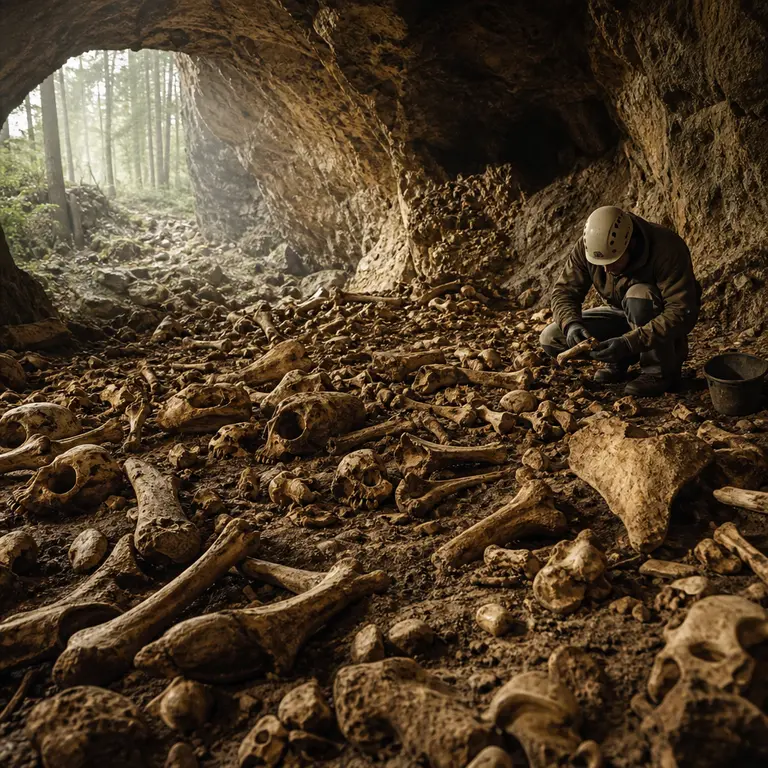
In the limestone karst of the Franconian Jura in Bavaria, a chain of caves runs beneath the forested ridges between the towns of Muggendorf and Streitberg. Nineteenth-century naturalists who first excavated these caverns — Zoolithenhöhle, Große Teufelshöhle, and others — were startled by what they found: layer upon layer of cave bear bones, sometimes stacked so densely that the sediment was more skeleton than soil. At Zoolithenhöhle alone, the paleontologist Johann Friedrich Esper documented the remains in 1774, making it one of the earliest recorded fossil excavations in German scientific history. Esper was so unsettled by the discovery of what appeared to be human remains alongside the bears that he initially proposed the bones had been deposited by the biblical flood. He was wrong about the mechanism, but right that something extraordinary had happened in those chambers.
The cave bear, Ursus spelaeus, was not a small animal. Adults stood roughly 1.5 meters at the shoulder and weighed up to 500 kilograms — considerably larger than today’s brown bear. The species evolved in Europe and western Asia during the Middle Pleistocene and vanished approximately 24,000 years ago, near the Last Glacial Maximum. Unlike its omnivorous cousin Ursus arctos, isotopic analysis of cave bear teeth indicates the species was overwhelmingly herbivorous, subsisting on grasses, roots, and sedges. This dietary profile makes the sheer density of their bones in caves easier to understand: the animals used caverns as hibernation dens across many generations, and many died there in their sleep. But the arrangement of certain bones — skulls placed on ledges, long bones apparently sorted and stacked — has resisted easy explanation for over two centuries. That resistance, and what it has drawn out of researchers across disciplines, is the real subject of this story.
Neanderthals, Rituals, and the Skull Controversy
The site that made the debate international was Drachenloch in Switzerland, excavated between 1917 and 1923 by the amateur archaeologist Emil Bächler. Bächler reported finding cave bear skulls arranged in stone-lidded chests built from rock slabs, with long bones threaded through the cheekbones of some skulls. He interpreted this as evidence of a Neanderthal bear cult — a deliberate, ritualized treatment of bear remains that implied symbolic thinking, possibly even proto-religious practice, tens of thousands of years before Homo sapiens arrived in Europe. The claim was electrifying. It suggested that Neanderthals possessed a spiritual interior life and recognized something sacred in the great bears that shared their landscape.
For decades this interpretation circulated widely in both academic literature and popular culture. The paleoanthropologist Ralph Solecki, who excavated Shanidar Cave in Iraq in the 1950s and famously proposed that Neanderthals buried their dead with flowers, was among those who cited Drachenloch as corroborating evidence for Neanderthal ritual behavior. The idea of a bear cult wove itself into broader arguments about the cognitive and cultural complexity of archaic humans. Novelists, filmmakers, and anthropologists alike found in it a compelling origin story for human spirituality — the notion that reverence for the animal world preceded, and perhaps gave rise to, every later religious impulse.
The trouble was that Bächler’s excavation methods were, by modern standards, catastrophically imprecise. He kept no stratigraphic profiles; his notes were impressionistic, and no independent observer verified his claims about the arrangement at the time of discovery. By the 1970s and 1980s, archaeologists including Philip Chase and Harold Dibble began publishing systematic critiques, arguing that the bone arrangements at Drachenloch and comparable sites could be entirely explained by natural processes: water flow through cave systems, the movement of hibernating bears themselves, frost-heave, and the accumulation of debris over thousands of years. A bear skull resting on a ledge, they pointed out, might simply have rolled there. The stone slabs might be natural rockfall. The bear cult, in this reading, was a projection — a human desire to find human meaning in geological accident.
This skeptical turn did not entirely close the question. Defenders of the ritual interpretation have noted that dismissing all evidence on methodological grounds risks overcorrection, and that the complete absence of deliberate behavior is as difficult to prove as its presence. The debate has since matured into something more nuanced: researchers now generally agree that Neanderthals were cognitively capable of symbolic behavior, but that specific claims require site-by-site scrutiny rather than wholesale acceptance or rejection. Drachenloch remains a cautionary tale about the dangers of excavating with a conclusion already in mind, but it also helped generate the methodological standards that make modern paleoarchaeology far more rigorous than it was a century ago.
What the Franconian Sites Actually Reveal
The Franconian caves, while less dramatic in their claims, have proven more scientifically durable. Zoolithenhöhle, which translates roughly as Bone-stone Cave, contains one of the longest continuous records of Pleistocene fauna in central Europe. The cave’s deposits preserve not only cave bears but also cave lions, cave hyenas, woolly rhinoceroses, and reindeer — a snapshot of a vanished ecosystem reconstructed, bone by bone, over two and a half centuries of intermittent study. Esper’s 1774 monograph, Ausführliche Nachricht von neuentdeckten Zoolithen, is now recognized as a founding document of vertebrate paleontology, predating Georges Cuvier’s systematic work on extinction by more than two decades. Esper tentatively raised the possibility that some of the creatures he described no longer existed anywhere on Earth — a radical suggestion in an era when extinction was theologically uncomfortable, implying as it did that God’s creation could be incomplete or reversible.
The Große Teufelshöhle near Pottenstein has yielded stratigraphically intact layers spanning roughly 100,000 years, allowing researchers to track changes in cave bear morphology across time. The gradual shifts in tooth size, limb proportion, and cranial structure visible in these layers reflect both genetic drift within isolated populations and environmental pressures that varied with each glacial and interglacial cycle. Crucially, some Franconian sites show evidence of Neanderthal presence in layers that overlap with cave bear remains — not in the form of arranged skulls, but in the form of cut-marked bones and stone tools. A 2019 study in the Journal of Human Evolution documented cut marks on cave bear bones from the German site of Hohle Fels consistent with skinning and defleshing, suggesting that Neanderthals did hunt or scavenge cave bears, at least occasionally. The bears were not only spiritual totems, if they were that at all — they were also, sometimes, food and raw material.
This evidence of practical interaction between Neanderthals and cave bears complicates the older binary between mundane subsistence and elevated ritual. The two categories need not be mutually exclusive. Many human cultures throughout history have treated animals they also hunt as spiritually significant. The question of whether Neanderthals did the same cannot be resolved by pointing to cut marks alone, but those marks do confirm a proximity and engagement with cave bears that makes some form of cultural response plausible, even if its precise character remains out of reach.
Ancient DNA and the Rewriting of Extinction
The most transformative recent development in cave bear research has come not from excavation but from the laboratory. Ancient DNA extracted from cave bear remains has allowed researchers to reconstruct the species’ population history with a resolution that would be impossible from bones alone. A landmark 2020 study published in Nature Ecology and Evolution, led by Axel Barlow at the University of Potsdam and collaborators across Europe, analyzed genomes from 64 cave bears spanning the species’ entire geographic range. The results overturned a long-standing assumption: cave bears did not decline primarily due to hunting pressure from Neanderthals or early modern humans. Instead, their population began collapsing approximately 40,000 years ago, coinciding with the arrival of Homo sapiens in Europe — but the genomic signal pointed to habitat loss driven by climate deterioration as the primary driver, with human competition for cave space as a secondary stressor.
The study also revealed that cave bears and brown bears interbred at low but detectable levels, exchanging genetic material across what had been assumed to be a firm species boundary. Traces of cave bear DNA appear in some ancient brown bear genomes, and vice versa. This finding places Ursus spelaeus within a broader pattern of Pleistocene megafauna hybridization that has emerged from ancient DNA research across multiple species — cave lions, woolly mammoths, and various hominin lineages included. The Ice Age world, it turns out, was genetically more entangled than its fossils suggested. Species boundaries that appear clean in the morphological record were frequently blurred at the genomic level, a reminder that taxonomy is a human tool imposed on biological processes that do not recognize its categories.
For the specific question of Neanderthal ritual, the ancient DNA work offers indirect but relevant context. If cave bears were already declining and increasingly rare by the time Homo sapiens arrived, encounters between late Neanderthals and cave bears would have been less common than previously assumed. The dramatic human-bear confrontations imagined by earlier researchers — and the rituals supposedly born from them — may need to be scaled back considerably. A species in demographic freefall, retreating from its former range, would have been a stranger and more occasional presence in the landscape than the abundant bones of earlier periods might suggest.
The Living Archive and What It Still Holds
In 2023 and into 2024, the Bavarian State Collection for Paleontology and Geology in Munich undertook a renewed digitization project covering its Franconian cave bear holdings, making high-resolution three-dimensional scans of key specimens publicly accessible through the GBIF biodiversity database. This initiative is part of a broader European effort to open Pleistocene faunal collections to remote researchers who previously had to travel to examine physical specimens. The project has already enabled comparative morphometric studies linking Franconian cave bear populations to contemporaneous populations in the Carpathians and the Cantabrian Mountains of Spain, tracing migration corridors across a Europe that looked very different when sea levels were lower, and glaciers covered the north.
Meanwhile, the philosophical question Esper raised in 1774 — what does it mean when an entire kind of creature disappears from the Earth — has acquired new urgency. De-extinction researchers have proposed cave bears as a candidate for genomic resurrection, given the quality of ancient DNA preserved in permafrost and high-altitude cave contexts. The proposal remains theoretical and faces substantial technical and ethical obstacles, but it illustrates how a dusty cabinet of nineteenth-century fossil bones can become the center of twenty-first-century biotechnology debates. Whether or not such a project ever advances beyond speculation, the conversation it generates forces a reckoning with questions that paleontology alone cannot answer: what obligations, if any, do we have to species whose extinction we may have hastened, and what kind of world would we be reconstructing if we brought them back into it?
The Franconian Jura today is a hiking destination, its caves open to tourists who walk past interpretive signs explaining the Pleistocene fauna. Few visitors pause long enough to consider that beneath their feet, in sealed lower chambers, bones still wait in the dark — the accumulated dead of a species that outlasted the Neanderthals, survived a dozen glacial cycles, and then quietly vanished while human beings were just beginning to paint horses on cave walls. The bear cult may or may not have been real. The bears themselves certainly were. And the sediment that holds them is still giving up its secrets, layer by careful layer, to anyone patient enough to ask the right questions.
Sources & Further Reading
- Barlow, A. et al. Partial genomic survival of cave bears in living brown bears. Nature Ecology and Evolution, 2021. https://doi.org/10.1038/s41559-020-01354-3
- Esper, J.F. Ausführliche Nachricht von neuentdeckten Zoolithen unbekannter vierfüssiger Thiere. Nürnberg, 1774.
- Chase, P.G. and Dibble, H.L. Middle Paleolithic Symbolism: A Review of Current Evidence and Interpretations. Journal of Anthropological Archaeology, 1987.
- Willis, K.J. et al. How 'virgin' is virgin rainforest? Science, 2004 — cited for context on long-term Pleistocene ecosystem reconstruction methods.