
The Legend of Honoo-Ishi: Japan’s Mysterious Flame Rock
Explore the legend and reality behind Japan's perpetually burning flint, a mystical stone believed to illuminate itself under specific conditions.
 Watch on YouTube
 Watch on Rumble
The Flame Rock of Japan: Myth, Mystery, and the Enduring Power of Honoo-Ishi
Japan, a land steeped in tradition and mystery, has long been home to tales that bridge the realms of myth and reality. Among its most captivating legends is the story of Honoo-ishi, or “flame rock,” a mythical stone said to ignite fires without conventional methods. This enigmatic narrative weaves together elements of folklore, spirituality, and humanity’s enduring fascination with fire, offering a glimpse into Japan’s extraordinarily rich cultural heritage. To understand why this legend has persisted across centuries, one must look not only at the story itself but at the broader world that gave rise to it — the ancient spiritual frameworks, the isolated mountain communities, the universal human relationship with fire, and the very nature of myth as a vehicle for truth.
Origins and Cultural Significance
The origins of the honoo-ishi legend are deeply rooted in Japan’s ancient history, possibly dating back to prehistoric times when early humans first harnessed fire. Initially a tool for survival, fire quickly became a cornerstone of human culture, symbolizing life and transformation. In Japan, as in many other ancient civilizations, fire held profound spiritual significance, often representing divine will, purification, and renewal. The act of kindling a flame was never purely mechanical. It carried weight, intention, and meaning that went far beyond warmth or cooked food.
Stones like the honoo-ishi were imbued with mystical qualities within this cultural framework. Ancient Japanese beliefs, influenced heavily by Shinto — the indigenous spiritual tradition centered on the veneration of kami, or spirits inhabiting natural phenomena — often ascribed supernatural powers to rocks, rivers, trees, and mountains. Sacred stones played a central role in rituals, believed to connect humans with the divine or appease unseen forces. The iwakura, or “rock seat,” was a common feature of Shinto practice, with large stones serving as resting places for kami during ceremonies. Within this tradition, a stone capable of producing fire autonomously would not have seemed implausible. It would have been interpreted as evidence of divine presence.
Honoo-ishi, with its supposed ability to ignite flames without human effort, was revered not merely as a tool but as a sacred object — a gift from the gods meant to protect or guide humanity. Legends of this flame rock were particularly prominent in remote mountain villages, where isolation often fostered a deeper connection to nature and its mysteries. In these communities, fire was essential for warmth and cooking, but it was also central to ceremonial practices marking births, deaths, harvests, and seasonal transitions. Stories of self-igniting stones may have arisen from the awe and reverence inspired by fire’s seemingly magical properties, blending practical necessity with spiritual wonder in ways that were entirely natural to the people who told them.
Unique Characteristics of Honoo-Ishi
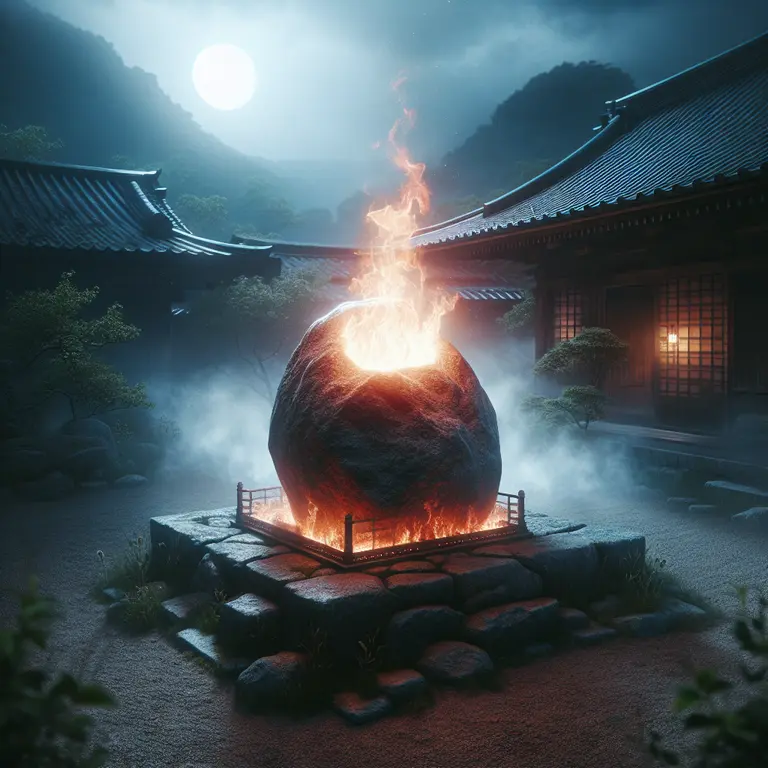
What sets the honoo-ishi legend apart from other fire-related myths is the stone’s purported autonomy. Unlike traditional flint, which requires deliberate human effort to produce sparks, honoo-ishi was said to ignite flames spontaneously. According to folklore, these stones could respond to natural elements such as wind and humidity, as well as to specific environmental energies that only certain individuals could sense or summon. This remarkable characteristic made the honoo-ishi both a source of fascination and fear, as it seemed to defy the observable laws of nature while simultaneously operating within a spiritual logic that ancient communities found entirely coherent.
Descriptions of the stone vary considerably across different regional accounts. Some depict it as a small, smooth rock with a faint inner glow, as though a flame burned at its core. Others describe it as rough and unassuming, indistinguishable from ordinary stones except for its extraordinary behavior. In some stories, honoo-ishi was said to emit a faint warmth even when untouched, and to grow noticeably warmer in the presence of danger or spiritual impurity. This sensory detail — the idea that the stone was somehow aware of its surroundings — reinforced its status as a living, spiritually animated object rather than a passive mineral.
In addition to its fire-producing qualities, honoo-ishi was often associated with protection and purification. Villagers believed that keeping the stone in their homes would ward off evil spirits, while others saw it as a divine tool to ensure the prosperity of their harvests. Fire in Japanese spiritual tradition has long been associated with both cleansing and transformation, and the honoo-ishi embodied this duality completely. It was a blessing and a potential danger, a source of life and a force capable of destruction. This tension between opposing qualities is a hallmark of powerful mythological symbols, and it helps explain why the legend endured across generations without losing its grip on the imagination.
Skepticism and Scientific Exploration
While the legend of honoo-ishi is captivating, it has long been met with skepticism from those who prefer empirical explanations. Modern science has yet to uncover any natural phenomenon that fully aligns with the stone’s supposed abilities, though researchers have explored various theories with genuine curiosity. The idea of a rock that spontaneously produces fire sits uncomfortably within the framework of contemporary chemistry and geology, yet the persistence of the legend invites a more generous and nuanced inquiry.
Some scientists and folklorists speculate that the honoo-ishi legend may have originated from misunderstood natural occurrences. Certain minerals, most notably pyrite — sometimes called “fool’s gold” — have been used as fire-starting tools since prehistoric times, capable of producing sparks when struck against flint or other hard surfaces. It is not difficult to imagine how, in the hands of a skilled elder or shaman who understood the stone’s properties, such a mineral might appear to produce fire almost effortlessly, giving rise to stories of autonomous ignition. Quartz and marcasite share similar properties, and both have been found at ancient Japanese archaeological sites in contexts suggesting ritual use.
There are also geological phenomena that could plausibly have inspired elements of the legend. Japan sits on one of the most volcanically active regions of the planet, and encounters with warm or unusually hot rocks near geothermal vents would not have been uncommon for mountain communities. Similarly, spontaneous combustion events — in which organic materials like peat, hay, or decomposing plant matter ignite due to heat buildup — have been documented across cultures and could easily have been attributed to a nearby stone rather than to the organic material itself. In environments where scientific literacy was not available to offer alternative explanations, the most logical conclusion was often the most spiritually resonant.
Despite lacking scientific validation, the honoo-ishi legend persists in Japan’s cultural memory, and its persistence is itself meaningful. It serves as a reminder of humanity’s enduring fascination with fire and its transformative power. Fire has always held a paradoxical role in human history: a force of creation and destruction, survival and danger, sacredness and utility. Any legend that captures all of those dimensions simultaneously will always find an audience willing to believe.
Honoo-Ishi in the Broader Context of Japanese Folklore
The honoo-ishi legend also reflects broader themes that run throughout Japanese folklore, distinguishing Japanese mythology from many of its global counterparts. Traditional Japanese tales frequently emphasize the harmonious and reciprocal relationship between humans and the natural world, highlighting the importance of respect, restraint, and reverence in all dealings with nature. Unlike Western mythological traditions that often frame nature as something to be conquered or subdued, Japanese folklore tends to position humans as participants in a larger living system rather than its masters.
Honoo-ishi, as a manifestation of fire’s elemental power, symbolizes this delicate balance. It is not a resource to be extracted or a tool to be commanded at will. It is a presence to be approached with humility, and the stories surrounding it consistently reinforce this point. In some variations of the legend, the stone is said to choose its owner, appearing only to those deemed worthy by virtue of their character or appearing in times of great communal need. This narrative element transforms the honoo-ishi from a passive object into something closer to a spiritual agent, a being with preferences and judgments of its own.
This motif of the chosen recipient is common across Japanese folklore and connects honoo-ishi to a wider tradition of objects and creatures that test human worthiness. The tengu, the kitsune, and the tanuki of Japanese legend all share this quality of discernment, engaging differently with people based on their moral character. By placing honoo-ishi within this tradition, storytellers were communicating an important ethical message about human relationships with the natural world. The stone’s fire was not freely given. It was earned, and it could be withdrawn.
Conclusion
The tale of honoo-ishi continues to ignite imaginations with its blend of mysticism, historical intrigue, and cultural symbolism. Whether regarded as a mere folktale or an echo of ancient truths encoded in narrative form, the legend holds a timeless appeal that speaks to a fundamental aspect of human experience. It reflects our oldest and most persistent questions about where power comes from, who has the right to wield it, and what our relationship to the natural world ought to be.
In a modern world increasingly shaped by technology and defined by the assumption that nature exists to serve human purposes, the story of honoo-ishi offers a moment to pause and reconsider. It reminds us that fire, one of humanity’s earliest and most consequential discoveries, was never simply a resource. It was a mystery. The people who first coaxed sparks from stone understood that they were participating in something larger than themselves, and they built entire spiritual traditions around that understanding. The enduring allure of the flame rock is a testament to the power of storytelling and the deep cultural wisdom embedded in Japan’s rich tapestry of myths and traditions — wisdom that, far from being obsolete, may be more relevant now than ever.