
The Bizarre Story of the Aleya Ghost Lights in India
Explore the mystery and allure surrounding the Aleya Ghost Lights, an enigmatic phenomenon witnessed by fishermen in West Bengal's marshy swamps.
 Watch on YouTube
 Watch on Rumble
The Ghost Lights of the Sundarbans: Where Folklore Meets Science
In the heart of Eastern India, nestled within the expansive mangrove swamps of West Bengal, lies a mystery that has captivated and perplexed locals for generations. Known as “Aleya” or ghost lights, these mysterious illuminations have intrigued those who navigate the murky waters after dark. This phenomenon is enveloped in folklore and scientific speculation, making it a subject of fascination and debate that stretches far beyond the borders of the Sundarbans itself. What makes the Aleya particularly compelling is not simply the lights themselves, but the way they sit at the intersection of lived human experience, ecological science, and the deep need that communities everywhere have to make meaning from the inexplicable. Few natural phenomena in the world have sustained such a rich parallel life in both the laboratory and the imagination for so long.
The Setting: The Sundarbans
The Sundarbans region, where these lights are frequently observed, is renowned for its rich biodiversity and enigmatic allure. Spanning approximately 10,000 square kilometers across India and Bangladesh, this UNESCO World Heritage site is home to the iconic Bengal tiger, saltwater crocodiles, Irrawaddy dolphins, and an intricate ecosystem of flora and fauna that has evolved over millennia in response to the unique pressures of tidal flooding and brackish water. The name itself derives from the Sundari tree, a mangrove species that dominates the landscape and whose tangled root systems create a labyrinthine world beneath the waterline.
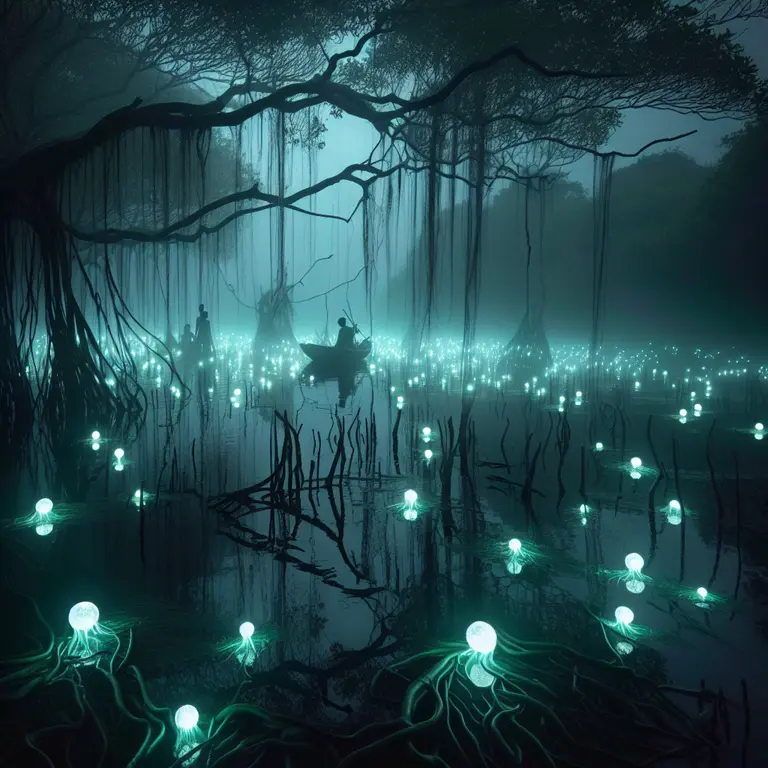
As night falls, the marshes transform into an eerie landscape, with whispers of spectral activity echoing through the tall grasses and the sounds of unseen animals moving through the undergrowth. The region's geography makes navigation genuinely treacherous, even for those who have spent their entire lives on these waters. Tidal channels shift seasonally, landmarks disappear beneath flood surges, and the dense mangrove canopy blocks starlight and moonlight with equal indifference. In this setting, fishermen first reported seeing flickering lights hovering above the swamp surface, casting an otherworldly glow on the brackish waters below. That these reports have persisted consistently across centuries, described in remarkably similar terms by people who had no contact with one another, lends the phenomenon a credibility that is difficult to dismiss outright.
Folklore and Legends
According to local lore passed down through countless generations, these glowing orbs are believed to be harbingers sent by restless spirits, perhaps lost souls of fishermen who met untimely fates in these treacherous waters. With its labyrinth of waterways and unpredictable tides, the Sundarbans has claimed many lives over the centuries, and the communities built along its margins have developed a rich oral tradition for processing that grief and danger. Witnesses recount that encounters with Aleya lights often lead to disorienting experiences. Folktales describe how unwary individuals following these mesmerizing lights become hopelessly lost amid twilight’s shadows, never to return home.
Interestingly, while some narratives suggest ominous outcomes such as being led astray or encountering fatal accidents, others propose protective qualities that complicate any simple reading of the Aleya as purely malevolent. In some stories, the lights guide seafarers safely home when visibility diminishes to nothing and familiar landmarks have vanished beneath the tide. Elders often tell tales of mysterious lights appearing during storms, steering boats away from submerged sandbars and hidden obstacles. Such duality in the folklore surrounding Aleya lights reflects the complex relationship between the region’s inhabitants and their natural environment, one in which the boundary between threat and salvation is never entirely fixed.
This ambivalence is not unique to the Sundarbans. Across cultures and continents, communities living in close proximity to wetlands, bogs, and marshes have developed strikingly similar traditions around unexplained lights. The will-o’-the-wisp of English and Irish folklore, the Scandinavian Lyktgubbar, the Hitodama of Japanese tradition, and the Chir Batti of the Rann of Kutch in Gujarat all describe lights that hover over waterlogged ground and either lead travelers to safety or doom, depending on the circumstances and the moral standing of the observer. The Aleya belongs to this global family of luminous mystery, suggesting that whatever is generating these lights does so consistently enough across very different environments to inspire independent mythological traditions on opposite sides of the world.
Scientific Speculation
This legend stands at a crossroads between mysticism and reality. Haunting stories compete against scientific attempts to rationalize the phenomenon, and in the case of the Aleya, the scientific community has offered several credible hypotheses without yet arriving at a single definitive explanation. The difficulty lies partly in the nature of the Sundarbans itself, which is an environment that resists easy study. Deploying sensitive instruments in a tidal swamp populated by Bengal tigers and saltwater crocodiles presents obvious logistical challenges, and the lights themselves appear irregularly and without reliable warning.
One prominent theory involves bioluminescence, a process in which microorganisms emit light through chemical reactions within their bodies. This natural illumination is similar to what is seen in fireflies and deep-sea creatures and could account for some sightings of Aleya lights. The mangrove swamps are extraordinarily rich in organic matter, providing a highly suitable environment for bioluminescent organisms, including certain species of bacteria, fungi, and dinoflagellates, to thrive in large concentrations. Under specific environmental conditions, such as warm temperatures, high humidity, and low wind, these microorganisms could create the flickering, drifting lights observed by fishermen moving through the channels at night.
Another compelling explanation involves the combustion of gases produced by decaying organic matter. Under certain conditions, methane and phosphine produced from rotting vegetation and animal remains can accumulate near the water’s surface and spontaneously ignite upon contact with oxygen, creating brief but vivid phosphorescent displays. This mechanism, widely accepted as the most likely explanation for will-o’-the-wisp sightings in European wetlands, is particularly plausible in the Sundarbans given the enormous volume of organic material cycling through the ecosystem at any given time. The lights produced by this process would indeed flicker, drift with air currents, and disappear abruptly, matching the descriptions offered by witnesses across generations.
Additionally, theories that point to electromagnetic fields aim to explain why such phenomena arise globally across different cultural contexts. Researchers studying similar lights in other parts of the world have found correlations between sightings and fluctuations in local geomagnetic activity, suggesting that the Earth itself may be generating visible energy under certain geological conditions. The Sundarbans sits atop a complex geological substrate shaped by the accumulated sediment of the Ganges-Brahmaputra delta, and it is not implausible that localized electromagnetic anomalies could contribute to the visual phenomena reported there. None of these theories is mutually exclusive, and the most intellectually honest position may be that the Aleya represents not a single phenomenon but several distinct natural processes unified under a single cultural label because they share a haunting visual character.
The Cultural Impact and Modern Legacy of Aleya Lights
Beyond folklore and science, Aleya lights have a profound cultural impact on the communities surrounding the Sundarbans. The stories of these ghostly illuminations are woven into the region’s traditions, influencing art, music, and ritual practice in ways that extend far beyond simple superstition. Local festivals sometimes incorporate elements of the Aleya legends, blending reverence with entertainment in performances refined over many generations. Songs and dances depict the lights as mystical beings, embodying the dual nature of fear and hope that characterizes life in one of the world’s most demanding natural environments.
For the fishermen and their families, these lights are more than just a mystery. They represent a deep and lived connection to the environment and a constant reminder of the dangers of their trade. The Aleya lights are part of daily life, shaping behaviors and decisions, particularly during nighttime journeys through the marshes. Experienced fishermen share knowledge of safe routes and cautionary advice, often attributing their hard-won wisdom to past encounters with the lights. In this sense, regardless of the ultimate scientific explanation, the Aleya tradition performs a genuinely protective social function, encoding environmental knowledge in a form that is memorable, emotionally resonant, and easily transmitted across generations.
In recent years, the Aleya lights have transcended their local roots, gaining attention through documentaries, academic papers, and widespread media coverage. Paranormal enthusiasts and independent researchers have visited the Sundarbans in hopes of capturing definitive evidence of the phenomenon. While many return with inconclusive footage, the stories continue to captivate audiences worldwide. The internet has amplified these accounts, with social media circulating videos and photographs that blend genuine curiosity with creative interpretation. In popular culture, the Aleya lights have inspired novels, short films, and adventure tourism packages, with visitors to the Sundarbans frequently requesting guided nighttime tours to witness the phenomenon firsthand.
Conclusion
The mystery of Aleya remains an intriguing blend of folklore and science, a testament to humanity’s enduring fascination with unexplained phenomena and the landscapes that give rise to them. Whether viewed as spectral guides born from the grief of drowned fishermen or as natural wonders arising from the complex chemistry of a living wetland, these ghost lights continue to captivate imaginations and inspire both cautionary tales and serious scientific inquiry in equal measure.
As we explore this enigma further, it becomes clear that understanding such mysteries requires a balance between respecting traditional beliefs and pursuing rigorous scientific explanations, and that these two approaches need not be in conflict. The folklore of the Aleya has preserved genuine observational data about a real phenomenon for centuries, long before any scientist thought to look for it. The allure of Aleya lies not only in its haunting beauty but in its capacity to bridge cultures, connect communities to their environments, and spark curiosity about the hidden processes that animate our world. With its natural and supernatural marvels existing side by side, the Sundarbans remains a place where the distance between reality and myth feels unusually small, inviting all who venture into its misty waterways to sit with uncertainty and find that it is not entirely uncomfortable.