
The Forgotten Science of Bog Butter in Medieval Ireland
For over a thousand years, people across Ireland and Scotland buried large quantities of butter in peat bogs. The reasons remain debated, but the chemistry of preservation is extraordinary — and newly recovered samples are reshaping what we know about medieval food, ritual, and trade.
 Watch on YouTube
 Watch on Rumble
A Peculiar Discovery Beneath the Peat
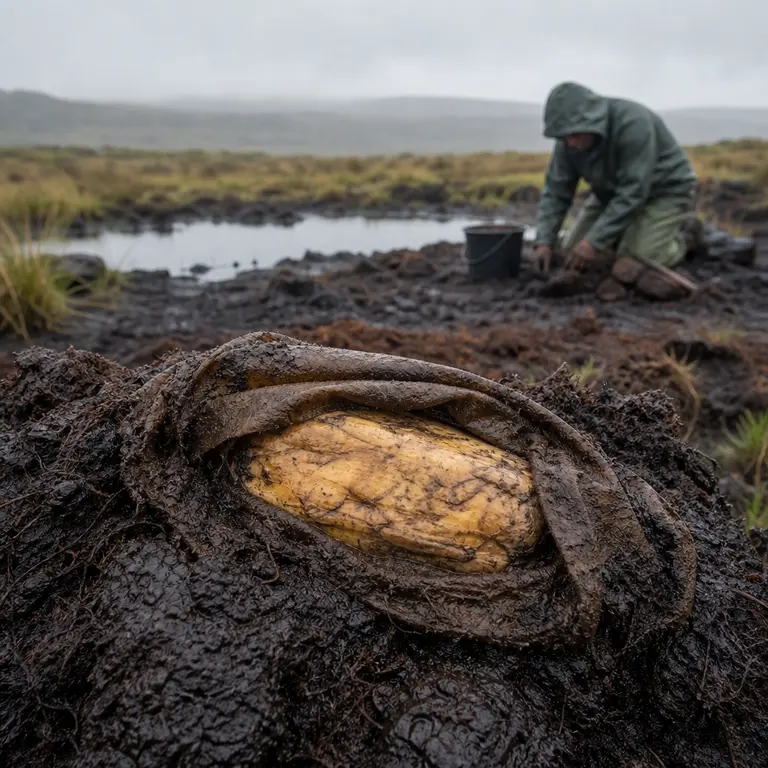
In 2013, a man cutting peat in County Offaly, Ireland, unearthed a wooden container packed with a pale, waxy substance. It weighed roughly 10 kilograms and had been sitting in the bog for an estimated 3,000 years. This was not an isolated find. Since the 18th century, more than 270 similar deposits have been recorded across Ireland and Scotland, with a smaller number found in Scandinavia and the Baltic region. The substance in question is bog butter — actual dairy fat, or sometimes animal tallow, deliberately buried in the waterlogged, oxygen-poor environment of a peat bog and left there for reasons that remain genuinely contested among archaeologists.
Most of these deposits date to the medieval period, roughly 400 CE to 1600 CE, though some reach back into the Iron Age and a handful into the Bronze Age. The County Offaly lump is among the oldest ever found. What makes these discoveries remarkable is not just their age but their condition: the fat is often still identifiable as butter or tallow, sometimes retaining traces of its original smell, and occasionally still technically edible in a sense that few people would be eager to test. The 2013 find was described by museum conservators as smelling strongly of aged cheese, with a texture somewhere between candle wax and soft clay. That a food product could survive three millennia in recognizable form is, on its own, a striking fact. That it survived in such quantities, across such a wide geographic range, and over such a long span of time suggests that something more systematic was happening — something worth understanding.
The Chemistry of Peat Preservation
Peat bogs are among the most effective natural environments for preservation on Earth. The conditions that make them so unusual are the product of several overlapping chemical factors working in concert, none of which would be sufficient alone. Sphagnum moss, which forms the bulk of most northern European bogs, releases compounds called sphagnan polysaccharides as it decays. These compounds bind to nitrogen, effectively starving the bacteria that would normally decompose organic matter. Without available nitrogen, microbial populations cannot sustain themselves, and the usual processes of biological breakdown slow dramatically or stop altogether.
The water in a bog is also extremely acidic, typically at pH 3.5-4.5, which further inhibits microbial activity. Combined with cold temperatures, low oxygen levels, and the physical compression of peat layers over time, these conditions create an environment that can preserve organic material for millennia. The same chemistry that has kept bog butter intact is responsible for the extraordinary preservation of bog bodies — human remains recovered from peat across northern Europe that retain skin, hair, and internal organs after thousands of years underground. The bog does not distinguish between the significant and the mundane. It preserves what it receives.
For butter specifically, the bog environment does something chemically interesting beyond simple preservation. Over centuries, the fat undergoes a process called saponification, in which fatty acid esters react with minerals in the surrounding water — particularly calcium and magnesium — to form a soap-like substance. This compound, sometimes called adipocere when it forms in human tissue, is chemically stable and resistant to further degradation. Bog butter that has been in the ground for a thousand years is not the same substance as fresh dairy butter, but it is recognizably derived from it, and modern analytical techniques can identify the original source animal, the season of milking, and sometimes even the diet of the herd. The fat has been chemically transformed, but it has not been erased. It carries its history in its molecular structure, waiting for instruments capable of reading it.
Burial in the Medieval World
During the medieval period in Ireland, butter was not a minor commodity or a simple household staple. It was a primary source of calories, a medium of economic exchange, and a recognized form of tribute payment embedded in the culture's legal and social fabric. The Brehon Laws, the ancient Irish legal code that governed society until the 17th century, specified butter as an acceptable form of rent and legal settlement. The annals record it being paid to monasteries, chieftains, and kings. A wealthy household’s status could be partially measured by how much butter it could produce and store, and the management of dairy herds was a serious economic undertaking rather than a subsistence activity.
Given this context, the deliberate burial of butter in bogs has attracted several competing explanations, none of which fully accounts for all the evidence on its own. The most straightforward is preservation and storage: bogs maintain a consistently cold temperature year-round, and the anaerobic environment slows spoilage considerably. Burying butter in a bog may have served as a natural refrigerator, with the intention of retrieving it later. The fact that so many deposits were apparently never retrieved complicates this theory but does not eliminate it. People die unexpectedly, memories fail across generations, property changes hands during conflict or famine, and a buried cache can simply be forgotten. The absence of retrieval does not necessarily indicate the absence of an intention to retrieve.
A second explanation involves ritual or votive offering. Bogs across northern Europe were clearly used as sites of deliberate deposition throughout prehistory and the early medieval period. Weapons, jewelry, tools, and human bodies were placed in bogs in ways that suggest intentional sacrifice or offering rather than practical storage. Some researchers argue that bog butter deposits, particularly those in unusual containers or placed in geographically significant locations, should be understood within this tradition of votive practice. The line between practical storage and ritual offering may not have been as clear to medieval people as it appears to modern analysts working within a secular framework. An act could be simultaneously practical and sacred, and the bog itself may have been understood as a threshold space where such transactions with the non-human world were appropriately conducted.
A third hypothesis, advanced by some food historians, is that long-term burial was used to intentionally transform the butter — to age it deliberately, much as cheese is aged — producing a pungent, highly flavored product valued precisely for its intensity and unusual character. Historical records from Ireland and Scotland describe a food variously referred to as ancient butter or potted butter, which was considered a delicacy and commanded a premium. Some accounts suggest it was buried for months or even years to develop its flavor. This explanation does not account for deposits of centuries-long duration, but it may plausibly describe a subset of the finds, and it raises the intriguing possibility that some of what archaeologists are recovering was already considered an aged, transformed product at the time of its deposition rather than fresh butter placed in storage.
What the Fat Remembers
Modern analytical chemistry has turned bog butter into a surprisingly rich historical document, capable of yielding information about agricultural practices, animal husbandry, seasonal patterns, and trade networks that written records do not capture. Gas chromatography and mass spectrometry can identify the specific fatty acid profiles of a sample, distinguishing dairy fat from animal tallow with high reliability and, in some cases, differentiating milk from different species. Stable isotope analysis can narrow down the geographic origin of the animals involved, and in some cases suggest the season during which milk was produced — a detail that speaks directly to the rhythms of agricultural life and the timing of dairying activity within the year. Radiocarbon dating provides age estimates, and in exceptional cases, ancient DNA analysis has been attempted on residues within the container material itself.
A 2019 study published in the Journal of Archaeological Science examined 32 Irish bog butter samples using a combination of these techniques. The researchers found that the majority were dairy-derived and consistent with cattle milk, and that the deposits clustered in certain periods — particularly the early medieval centuries between 400 and 900 CE — suggesting organized, possibly institutionalized patterns of deposition rather than random individual acts scattered across time. Several samples showed evidence of having been processed with plant material, possibly as a flavoring or preservative additive, though the specific plants could not always be identified from the residues that remained. This finding points toward a level of intentionality and craft in the preparation of these deposits that goes beyond simple storage.
The containers themselves provide additional layers of information. Many deposits are wrapped in wood, bark, or wicker. Some are enclosed in animal stomachs or bladders, which would have been natural, readily available containers in a pastoral economy. A few are placed in purpose-made wooden vessels, some of which have been dendrochronologically dated independently of the fat they contain. In at least one case, the container was significantly older than the butter inside it, suggesting the deliberate reuse of a valued or meaningful wooden object — a detail that complicates simple functional interpretations and hints at the social life of objects in medieval Ireland.
Present-Day Research and the National Museum of Ireland
In 2024, the National Museum of Ireland in Dublin announced an expanded research initiative focused on its collection of bog butter samples, many of which have been stored for decades without systematic modern analysis. The project, undertaken in collaboration with University College Dublin and several European partners, aims to apply current proteomics and ancient DNA techniques to samples that were collected long before these methods existed. The goal is to build a comprehensive database of bog butter chemistry that could allow future finds to be rapidly contextualized and compared against a standardized reference set, transforming individual discoveries into data points within a larger interpretive framework.
The initiative also has a public-facing dimension. Several bog butter samples are now on permanent display in the museum’s prehistoric Ireland galleries, accompanied by updated interpretive materials that reflect the current state of research. For visitors, the lumps of pale, waxy material are easy to overlook — they lack the visual drama of gold torcs or illuminated manuscripts, and they require some explanation before their significance becomes apparent. But they represent something equally important: the preserved residue of daily economic life, of herds and seasons and labor, of decisions made by ordinary people whose names and circumstances are entirely unknown to us. They are agricultural history made physical, and they survive in a form that can still be chemically interrogated.
Bog butter is also still found today. Ireland’s peat bogs are still commercially harvested in some areas, and mechanized cutting regularly turns up organic material of various kinds. Each new find is now required by Irish law to be reported to the National Museum, and a protocol exists for rapid assessment and sampling before the material degrades upon exposure to air and light. The window for analysis is narrow and unforgiving — bog butter that has survived for millennia in a stable chemical environment can deteriorate visibly within days of excavation, as oxygen and fluctuating temperatures undo in hours what the bog preserved across centuries.
A Substance That Outlasted Its World
What bog butter ultimately offers is a rare form of material continuity across an otherwise fragmented historical record. Medieval Ireland left behind legal texts, annals, ecclesiastical documents, and archaeological structures, but almost nothing of the texture of ordinary agricultural life — the daily decisions, the seasonal rhythms, the practical knowledge that sustained communities across generations. The bog butter deposits fill a small but meaningful part of that gap. They are evidence of cattle and dairying seasons, of containers made by hand from available materials, of decisions made by people whose names are entirely unknown — to store something valuable, or offer it to forces they understood in ways we cannot fully reconstruct, or transform it into something more complex and desirable — and then of the long, indifferent accident of preservation that kept those decisions legible across centuries.
There is something worth pausing over in the fact that the chemistry of peat did not care about the intentions of the people who buried these deposits. It simply preserved what was placed in it, without discrimination or judgment, in accordance with physical and chemical laws that operate independently of human meaning. The work of understanding what that preservation means — of recovering the intention behind the act, the social context of the burial, the economic significance of the commodity, the identity of the animals whose milk was churned into fat — belongs entirely to the researchers who are now, with instruments that would have been incomprehensible to the people who made the butter, reading the molecular record of a medieval afternoon. That the record is still there to be read at all is a function of geology and chemistry. That it is being read is a function of human curiosity that spans the same centuries the butter did, reaching backward across time toward a world that left its traces in the peat.
Sources & Further Reading
- Riddell, Fionnuala, et al. Organic residue analysis of Irish bog butters. Journal of Archaeological Science, 2019.
- National Museum of Ireland. Bog Butter Collection and Research Programme. museum.ie, 2024. https://www.museum.ie
- Kerr, T. and McCormick, F. The dating and analysis of Irish bog butter deposits. Ulster Journal of Archaeology, 2013.
- Caulfield, Seamas. Bog Butter: A History of an Ancient Irish Food. Irish Heritage Trust, 2009.