
The Thing: Theremin's Ingenious Cold War Spy Device
How a Soviet-era eavesdropping device hidden inside a wooden Great Seal gifted to the U.S. Ambassador in 1945 went undetected for seven years and changed the history of espionage technology.
 Watch on YouTube
 Watch on Rumble
A Gift Concealing a Secret
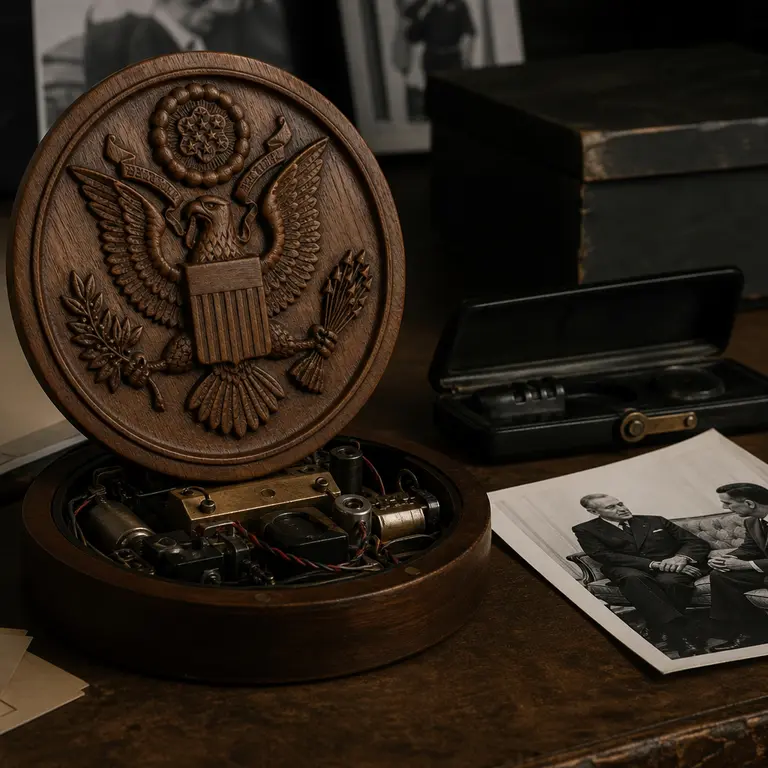
In August 1945, a delegation of Soviet schoolchildren presented U.S. Ambassador Averell Harriman with an ornately carved wooden replica of the Great Seal of the United States. The gesture appeared to be a token of postwar goodwill, a symbol of the fragile alliance between Washington and Moscow that had just helped defeat Nazi Germany. Harriman hung it proudly in his study at Spaso House, the official residence of the U.S. Ambassador in Moscow. It remained there for seven years, through the tenures of multiple ambassadors, through the earliest and most volatile years of the Cold War, through the Berlin Blockade, the formation of NATO, and the outbreak of the Korean War. Nobody suspected a thing, because there was, technically, almost nothing to find.
Inside the seal, Soviet intelligence had concealed a device so conceptually radical that Western engineers, when they finally discovered and examined it, struggled for months to understand how it functioned. There were no batteries. No active electronic components. No transmitter in the conventional sense. The device, later nicknamed “The Thing” by American intelligence and formally known as the Leon, was a passive resonant cavity microphone. It represented one of the most elegant and technically audacious acts of deception in the entire history of espionage, and it sat in plain sight on a diplomat’s wall for nearly a decade while the most sensitive conversations of the early Cold War unfolded around it.
The story of The Thing is not simply a story about a clever gadget. It is a story about genius under duress, about the strange intersections between art and surveillance, and about how a single imprisoned physicist working in a secret Soviet laboratory inadvertently laid the conceptual groundwork for technologies that now touch nearly every corner of modern life.
Leon Theremin’s Hidden Masterpiece
The device was invented by Lev Sergeyevich Termen, better known in the West as Leon Theremin, the Russian physicist and inventor most famous for creating the theremin, the eerie electronic musical instrument played without physical contact by moving the hands through the air near two antennas. The instrument became a cultural curiosity in the 1920s and 1930s, appearing in science fiction film scores and concert halls alike. Theremin himself became something of a celebrity during his years in the United States, socializing with figures including Albert Einstein and John D. Rockefeller, and reportedly romancing the young Clara Rockmore, who became the instrument’s most celebrated virtuoso performer.
Far less widely known is what happened after Theremin returned to the Soviet Union in 1938. The circumstances of his departure from New York remain disputed to this day. Some accounts suggest he was forcibly abducted by Soviet agents; others indicate he returned voluntarily under pressure or inducement. What is not disputed is that shortly after his return, he was arrested by the NKVD, the Soviet secret police, and sentenced to a labor camp in Siberia. He was later transferred to a sharashka, one of the secret research facilities staffed by imprisoned scientists and engineers that formed a shadow research infrastructure within the Soviet state. Alexander Solzhenitsyn depicted life inside such institutions in his novel The First Circle, and the conditions Theremin experienced were consistent with those accounts: relative physical comfort compared to the camps, but total loss of freedom and constant pressure to produce results for the state.
The device Theremin produced within this system was a masterpiece of passive engineering. It consisted of a small cylindrical cavity with a thin metallic membrane at one end and a short antenna embedded within the carved wooden body of the Great Seal. When an external radio signal at a specific frequency was beamed at the object from a nearby vehicle or building, the cavity resonated, reflecting the signal back. Crucially, the frequency of the reflected signal shifted slightly with the membrane's movement, which vibrated in response to sound waves in the room, including the voices of anyone speaking nearby. The receiver on the other end could then decode those acoustic modulations and reconstruct the conversations with reasonable fidelity.
The device required no internal power source whatsoever. It was entirely inert when not actively interrogated by an external signal, meaning it produced no electronic emissions that the era's sweep technologies could detect. Those technologies were designed to find active transmitters, devices that generated their own signals. The Thing generated nothing. It simply waited, invisibly, for someone to ask it what it had heard.
This concept, now referred to as a passive cavity resonator or a re-radiating bug, predated by several decades the commercially developed radio frequency identification technology that now powers contactless payment cards, inventory management systems, building access badges, and a vast array of consumer and industrial applications. When a reader device activates a modern passive RFID chip, it is performing a conceptually identical operation to what Soviet intelligence officers did when they illuminated the Great Seal with a radio beam from a nearby building. Theremin had, under compulsion, invented the conceptual ancestor of an entire branch of modern wireless sensing technology.
Discovery, Embarrassment, and the Race to Understand
The device was discovered in 1952, not through any deliberate or systematic counterintelligence sweep but almost entirely by accident. A British radio operator stationed near the U.S. Embassy and monitoring Soviet air traffic communications picked up an anomalous signal that appeared to carry fragments of English-language conversation. The signal was intermittent and difficult to characterize, but its content was unmistakable. The discovery triggered a classified joint investigation involving British MI5 and the American CIA and FBI, and when the wooden seal was finally removed from the wall of the Ambassador’s study and disassembled, the engineers assigned to examine it were genuinely baffled.
Peter Wright, who would later become famous, and considerably infamous, for writing the controversial intelligence memoir Spycatcher, was among the British scientists assigned to reverse-engineer the device. Wright described the experience in his memoir as one of the most technically humbling of his professional career. The team understood almost immediately that the device was passive and contained no conventional electronic components, but the precise mechanism by which it functioned took months of careful analysis to fully reconstruct. Once they understood it, the implications were deeply unsettling. If a device this simple and this undetectable could be concealed inside a decorative object, then the entire framework of embassy security and classified facility management needed to be reconsidered from the ground up.
The United States government suppressed news of the discovery for several years, deeply embarrassed that a foreign intelligence service had been listening to classified conversations inside the Ambassador’s private study for the better part of a decade. The device was finally revealed publicly in 1960, during one of the most theatrically charged moments of the early Cold War. U.S. Ambassador Henry Cabot Lodge displayed it before the United Nations Security Council during a session convened to address the downing of an American U-2 reconnaissance aircraft over Soviet territory. By producing The Thing as evidence of Soviet espionage, Lodge was attempting to reframe the narrative: the United States had been spying from the air, yes, but the Soviet Union had been spying from inside the Ambassador’s own home. The diplomatic theater of the moment was considerable, and the device itself became a brief international sensation before fading from public awareness.
The revelation prompted an immediate and lasting transformation in how embassies and sensitive government facilities approached physical security. The concept of a passive, unpowered listening device forced intelligence agencies worldwide to develop entirely new detection methodologies. These included nonlinear junction detectors, which can identify electronic junctions in semiconductor components even when those components are not powered, and active illumination techniques, in which a room is flooded with radio-frequency energy and the reflected spectrum is analyzed for signs of resonant structures. Both of these approaches remain in use today.
Legacy in Technology and Tradecraft
Leon Theremin was rehabilitated following Stalin’s death in 1953 and eventually released from the sharashka system. He received a Stalin Prize for his work on the eavesdropping device, though for decades he was forbidden to discuss it publicly or even acknowledge its existence. He continued working at Soviet acoustic research institutions through the 1960s and later gradually returned to public life, giving occasional interviews and demonstrations of his musical instrument to audiences who often had no idea they were speaking with one of the most consequential figures in the history of both electronic music and modern surveillance technology. He died in 1993 at the age of 97, having outlived the Soviet state that imprisoned him.
The technical legacy of The Thing extends well beyond Cold War espionage history. The passive resonant cavity principle directly informed subsequent research into wireless sensing, structural health monitoring, and the development of chipless RFID systems that require no semiconductor components. Modern researchers at institutions including MIT and the Georgia Institute of Technology have published substantial work on passive wireless sensors designed for use in medical implants, where battery replacement is impossible, and for long-term environmental monitoring in remote or inaccessible locations. These systems operate on exactly the mechanism that Theremin designed under compulsion in a Soviet prison laboratory, though the researchers working on them today do so with full academic freedom and access to seven decades of subsequent engineering knowledge.
The original device recovered from the Great Seal is held by the National Security Agency museum at Fort Meade, Maryland, where it is one of the few artifacts on display that documents a foreign intelligence success against the United States rather than an American operational achievement. A replica is also held by the International Spy Museum in Washington, D.C., where it is exhibited alongside objects that tend to be more immediately dramatic: miniature cameras, poison-tipped umbrellas, and hollowed coins. The Thing looks like almost nothing at all, which was precisely the point.
Conclusion
What makes the story of The Thing persistently remarkable, decades after its public revelation, is not only its technical ingenuity but the specific circumstances of its creation. One of the twentieth century’s most genuinely creative scientific minds, a man who had charmed New York society and corresponded with Einstein, was imprisoned by the state he served and ordered to produce surveillance tools or face consequences that required no elaboration. Under those conditions, he produced a device that shaped the architecture of modern surveillance, transformed counterintelligence methodology, and seeded the conceptual foundations of wireless sensing technologies that now operate invisibly throughout daily life.
The carved wooden eagle that hung in a diplomat’s study was not simply a spy tool. It was a monument, in a deeply uncomfortable sense, to what compelled genius can produce when stripped of every freedom except the freedom to think. The Cold War generated many such monuments. Few of them are as elegant, as technically prescient, or as quietly strange as the one that hung on Averell Harriman’s wall while history unfolded in the room around it.
Sources & Further Reading
- Wright, Peter. Spycatcher: The Candid Autobiography of a Senior Intelligence Officer. Viking Press, 1987.
- Glinsky, Albert. Theremin: Ether Music and Espionage. University of Illinois Press, 2000.
- Central Intelligence Agency. 'The Thing: Leon Theremin's Passive Cavity Resonator.' CIA Historical Review Program, declassified documents. https://www.cia.gov/readingroom/
- National Security Agency. 'The Bug in the Great Seal.' NSA/CSS, 2012. https://www.nsa.gov/Portals/75/documents/news-features/declassified-documents/cryptologic-histories/bug_in_the_seal.pdf