
Thermite's Role in Uncovering Ancient Iron Smelting History
How a century-old industrial incendiary reaction is now being repurposed to date ancient iron artifacts and rewrite the timeline of early metallurgy.
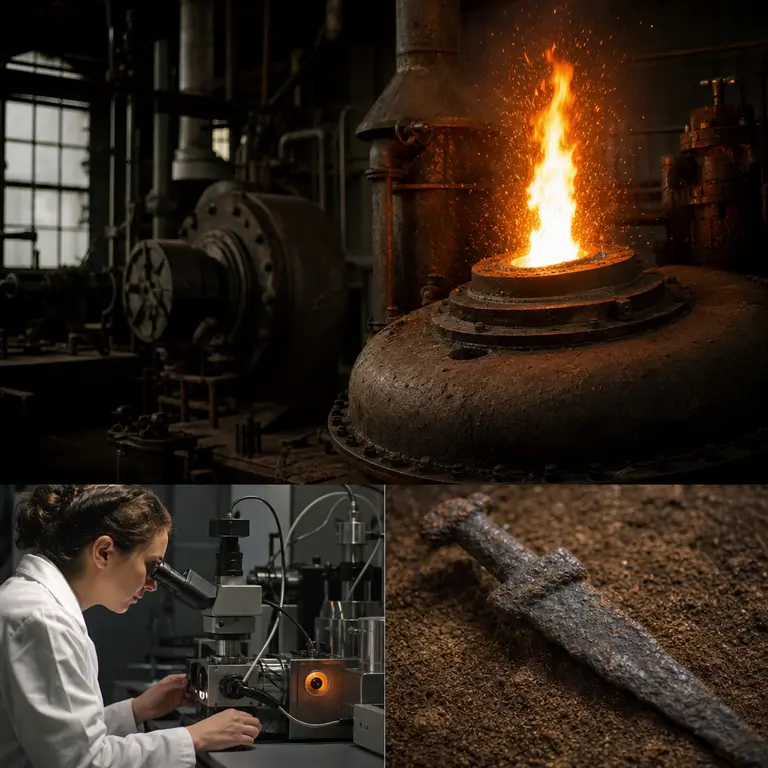
Fire That Writes History
In 1893, German chemist Hans Goldschmidt patented a reaction so violent it could weld railway tracks together without an external flame. Thermite — a mixture of aluminum powder and iron oxide — burns at roughly 2,500 degrees Celsius, hot enough to melt through steel in seconds. For most of the twentieth century, it was the domain of welders, demolition engineers, and, controversially, incendiary warfare. Military forces deployed thermite grenades during World War II precisely because the material could not be extinguished with water and would burn through vehicle armor, engine blocks, and artillery barrels with indifferent efficiency. But in recent years, archaeometallurgists have turned to the chemistry of thermite to solve one of the most stubborn puzzles in human prehistory: when exactly did ancient peoples first learn to smelt iron?
The question matters far more than it might initially appear. Iron smelting is not merely a technological milestone. It is the material foundation of agricultural expansion, military dominance, and urban infrastructure across nearly every civilization on Earth. Whoever smelted iron first, and wherever that knowledge spread, shaped the political and economic geography of the ancient world in ways that continue to echo through the present. Getting the timeline wrong means getting the entire story wrong.
The Problem with Ancient Iron
Dating iron artifacts is notoriously difficult, and the difficulty is rooted in chemistry. Unlike organic material, iron cannot be carbon-dated directly. The radiocarbon method requires biological carbon — the carbon that was once part of a living organism and therefore carries the measurable signature of atmospheric carbon-14 at the time of death. Iron smelted from ore contains virtually none of this biological carbon, and any trace amounts that do survive are often contaminated by subsequent environmental exposure or by the fuels used in smelting itself.
For decades, archaeologists relied on stratigraphy, the layering of soil deposits, and comparative typology, which involves matching tool shapes and construction techniques to known cultural periods. Both methods carry significant uncertainty. A spearhead found in a sealed Bronze Age context in Anatolia might be intrusive, meaning it fell or was buried there centuries after the surrounding deposit formed. Soil disturbance from animal activity, root growth, water movement, and human reoccupation of sites is far more common than the tidy layered diagrams in textbooks suggest. The margin of error in placing early iron use in sub-Saharan Africa, for instance, has historically spanned several centuries — enough to completely overturn theories about whether iron smelting was independently invented in Africa or diffused southward from the Near East and North Africa.
The breakthrough came not from thermite itself but from slag, the glassy, iron-rich waste left behind when ore is reduced in a furnace. Slag contains microscopic charcoal fragments trapped during the smelting process, and these fragments are datable by conventional radiocarbon methods, providing researchers with an organic anchor for an otherwise undatable material. But slag also preserves something far more precise than charcoal alone: the magnetic signature of the Earth’s geomagnetic field at the exact moment the slag cooled. This technique is called archaeomagnetism, and it depends on the same physics that makes thermite so extreme.
When iron-bearing minerals cool below their Curie point — the specific temperature at which magnetic domains lock permanently into place — they freeze a snapshot of the ambient geomagnetic field as it existed at that precise moment. Because Earth’s magnetic field has varied in known, carefully reconstructed ways over millennia, shifting in both intensity and direction across different regions, matching a slag sample’s frozen magnetic signature to the geomagnetic record can date a smelting event to within decades rather than centuries. The result is a precision that stratigraphy and typology cannot approach, and it has begun to redraw maps that historians considered settled.
Rewriting the African Iron Age
The implications of archaeomagnetic dating have been most dramatic for African metallurgy, and the revision of the conventional timeline has been striking enough to unsettle decades of established scholarship. For most of the twentieth century, the dominant academic view held that iron smelting entered sub-Saharan Africa from the north, diffusing from Carthage or Meroe sometime around 500 BCE. In this model, African iron technology was derivative — a secondary adoption of a Near Eastern innovation that spread via trade routes and cultural contact. The model was not necessarily proposed in bad faith, but it aligned conveniently with broader colonial-era assumptions about the direction of technological progress.
Archaeomagnetic dating of slag deposits at sites in Rwanda, Tanzania, and Cameroon has pushed the evidence back to at least 1,400 BCE and possibly earlier, predating the conventionally accepted arrival of iron technology from the north by nearly a millennium. Sites in the Great Lakes region of central Africa now appear to have been producing carbon steel — not just crude wrought iron — at a time when European smiths were still working bronze and had no access to the high-temperature techniques required for steel production. The Haya people of northwestern Tanzania, for example, developed a preheated forced-draft furnace capable of reaching temperatures above 1,400 degrees Celsius. This temperature requires carefully engineered airflow, specific fuel management, and detailed empirical knowledge of ore composition. A technology of equivalent sophistication would not appear in Europe until the medieval period, roughly two thousand years later.
These findings, pioneered in part by anthropologist Peter Schmidt and materials scientist Donald Avery in the 1970s and confirmed by subsequent archaeomagnetic studies from independent research groups, remain somewhat contested in their broadest implications but are no longer seriously disputed in their core physical claims. The slag does not lie. Its frozen magnetic memory places African iron technology in a lineage that is at minimum parallel to, and possibly predates, Near Eastern developments in ways that conventional archaeological narratives have been slow to incorporate into textbooks and public understanding. The resistance is partly institutional inertia and partly the genuine difficulty of revising frameworks on which entire subfields of scholarship have been built.
The Thermite Connection and Modern Forensic Metallurgy
The link between thermite chemistry and archaeometallurgy is more than metaphorical. Understanding the extreme-heat chemistry of iron oxide reduction — the same fundamental reaction at the heart of thermite — has allowed materials scientists to reverse-engineer ancient smelting conditions directly from slag microstructure, without requiring any charcoal or magnetic signature at all. By examining the ratio of wustite to fayalite crystals under electron microscopy, researchers can calculate the peak temperature reached inside a furnace that ceased operation three thousand years ago. The crystalline structures that form in cooling slag are exquisitely sensitive to temperature, and they preserve that sensitivity indefinitely. This technique, developed largely at the University of Bradford and refined at institutions in South Africa and Japan, is now being applied to contested artifacts in museum collections worldwide, reopening cases that were considered closed.
One significant recent application involved a cache of iron objects associated with the Shang dynasty site of Sanxingdui in Sichuan, China, where excavations resumed in 2020 and 2021 after a long hiatus and yielded a remarkable collection of bronze masks, gold foil artifacts, and iron fragments that have challenged existing assumptions about the chronology and character of early Chinese metallurgy. The Sanxingdui culture has long been recognized as anomalous within the broader picture of Bronze Age China, displaying artistic and technical traditions that appear to have developed in relative isolation from the Yellow River civilizations that dominate conventional historical accounts. The presence of iron objects in this context raises immediate questions about whether the technology arrived from outside or developed locally.
Thermite-informed slag analysis of associated furnace debris from the Sanxingdui site is ongoing, but preliminary microstructural data suggest smelting temperatures that are inconsistent with simple bloomery technology, the most basic form of iron reduction. This implies either a more sophisticated furnace design than previously credited to this culture and period, or contact with metallurgical traditions from further west along routes that are not yet well documented archaeologically. Neither conclusion is comfortable for existing models, and the research community is closely watching the analysis.
What the Slag Remembers
There is something quietly remarkable about the fact that the same chemical reaction that allows a thermite charge to cut through a steel beam in seconds is also the reaction that, when run more slowly and deliberately inside a clay furnace thousands of years ago, left behind a frozen record of its own occurrence. The slag is not merely waste. It is a document. It carries within its crystalline structure the temperature of the fire, the direction of the Earth’s magnetic field on the day it cooled, and the chemical signature of the ore and fuel that produced it. Each of those data points can be read by the right instrument, and each one narrows the uncertainty around questions that once seemed permanently beyond resolution.
The story of thermite has come full circle in a way that Goldschmidt, working in his laboratory in the final years of the nineteenth century, could not have anticipated. A reaction discovered to join metals is now helping humanity understand when our ancestors first learned to make it. The deeper lesson may be that the boundaries between industrial chemistry, forensic science, and ancient history are more permeable than any of those disciplines typically acknowledges. The past is not silent. It has merely been waiting for instruments sensitive enough to hear it, and for researchers willing to look for evidence in places — African furnace sites, Chinese ritual deposits, the crystalline memory of ancient waste — that older frameworks of inquiry had trained them to overlook.
Sources & Further Reading
- Schmidt, Peter R. and Avery, Donald H. Complex Iron Smelting and Prehistoric Culture in Tanzania. Science, Vol. 201, No. 4361, 1978. https://www.science.org/doi/10.1126/science.201.4361.1085
- Degryse, Patrick and Poblome, Jeroen. Archaeometry: Bridging the Gap Between Science and Archaeology. Cambridge Archaeological Journal, 2018.
- Dubin, Lois Sherr. Iron in Africa: Revising the History. African Archaeological Review, Cambridge University Press, 2005.
- Sanxingdui Museum and Sichuan Provincial Cultural Relics and Archaeology Research Institute. Sanxingdui Excavation Reports 2020-2021. National Cultural Heritage Administration of China, 2021. https://www.ncha.gov.cn