
The Cochineal's Impact: Red Dye and the Course of History
Long before synthetic pigments, a parasitic scale insect called cochineal produced the most vivid red in the world — and its trade reshaped colonial economies, military uniforms, and even the art of the Renaissance.
Introduction: The Unremarkable Appearance of Something Extraordinary
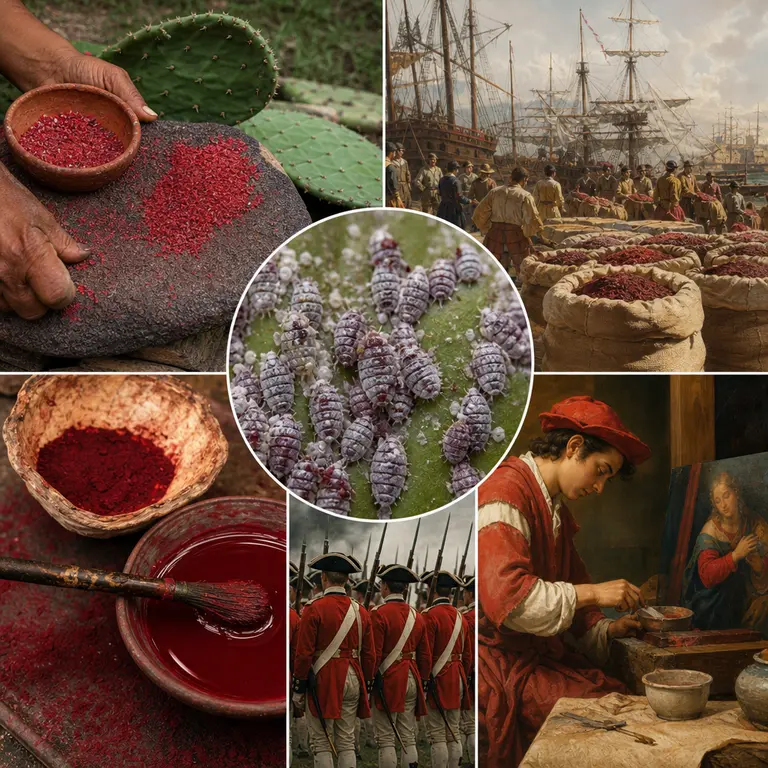
In 1523, Spanish conquistadors arriving in the markets of Tenochtitlan encountered something that puzzled them deeply: small, reddish-brown, dried seeds, unremarkable in appearance, being traded alongside gold and jade. These were not seeds at all. They were the desiccated bodies of Dactylopius coccus, a scale insect barely two millimeters long that feeds exclusively on the pads of Opuntia cacti. When crushed, they released a pigment so intensely crimson it appeared almost supernatural. The Aztecs called the dye nocheztli, meaning blood of the prickly pear, and had cultivated it for centuries before European contact. Within decades, it would become the second most valuable export from the Americas after silver.
What made this discovery so consequential was not just the color itself but the scale of the need it filled. Red had long occupied a privileged position in the visual language of power across nearly every civilization on Earth. Emperors, cardinals, generals, and aristocrats had always sought to clothe themselves in the deepest, most saturated reds available, and the dyes that produced those reds were perennially expensive, unstable, or both. The arrival of cochineal in European markets was not merely a commercial event. It was a chromatic revolution that would reshape the economics of empire, the aesthetics of fine art, and the politics of global trade for the next three centuries.
The Chemistry of a Natural Weapon
The active compound in cochineal is carminic acid, a molecule the insect produces as a chemical defense against predators. Comprising roughly 17 to 24 percent of the insect’s dry weight, carminic acid bonds to proteins and metal ions with remarkable tenacity. When combined with aluminum sulfate as a mordant, it produces a brilliant scarlet. With tin salts, it shifts toward a vivid vermillion. With iron, it deepens to violet. This range of achievable hues from a single-source compound was without precedent in the history of natural dyeing, and it gave craftspeople and artists an unprecedented degree of control over the precise shade of red they wished to achieve.
No other natural red dye available to early modern Europe could rival its saturation, lightfastness, or versatility. Kermes, derived from a different Mediterranean scale insect of the genus Kermes vermilio, had been the European standard for luxury red for centuries, appearing in the textiles of ancient Greece and Rome and throughout the medieval period. But cochineal produced roughly ten times the colorant yield per unit weight, making it dramatically more efficient and ultimately far cheaper per unit of color produced. Madder root, another widely used red dye, faded comparatively quickly and lacked the depth of tone that cochineal could achieve. The new dye did not merely compete with existing options. It rendered them obsolete almost overnight in the markets that could access it.
What is particularly striking from a modern biochemical perspective is that carminic acid was not evolved by the insect for human benefit. It is an anthraquinone derivative that deters ants and other arthropod predators by interfering with their nervous systems. The Aztecs recognized and exploited a defensive chemistry that the insect had spent millions of years refining, and that exploitation eventually connected two hemispheres through one of the most lucrative commodity trades in early modern history. The insect had no interest in the empire. It was simply trying to survive on a cactus.
The Geopolitics of Red
Spain recognized the strategic value of cochineal almost immediately and moved to monopolize its production. For over two centuries, the Spanish Crown maintained a near-total embargo on the export of live insects or viable eggs, restricting trade to processed dye alone. This made cochineal one of history’s earliest examples of deliberate industrial secrecy enforced at a state level, a precursor to the kind of intellectual property protectionism that characterizes modern pharmaceutical and technology industries. The processed dye could be sold and traded freely, but the means of producing it were to remain exclusively in Spanish hands.
European powers, desperate to break the monopoly, launched intelligence operations that would not look out of place in a Cold War thriller. For decades, there was genuine scientific confusion in Europe about what cochineal actually was. Some naturalists argued it was a plant seed. Others believed it was a mineral. The Spanish, for their part, did little to correct these misconceptions. The French, Dutch, and British all attempted to smuggle living specimens out of Mexico and establish rival cultivation operations, with almost universal failure throughout the seventeenth century. The difficulty was partly logistical, since keeping the insects alive during a transatlantic voyage required maintaining living cactus plants under conditions that shipboard environments made nearly impossible.
The British eventually succeeded in the late eighteenth century, establishing cochineal cultivation in the Canary Islands, which was, with considerable irony, a Spanish territory. The breakthrough came after a French botanist named Nicolas-Joseph Thiéry de Menonville smuggled live insects out of Oaxaca in 1777. His account, published as Traité de la culture du nopal, described bribing officials and concealing the insects in a portable greenhouse of his own construction. The Canary Islands operation eventually became a significant supplier to European markets, but Mexico remained the dominant producer until the 1850s, and the Spanish monopoly, though weakened, had lasted long enough to generate enormous wealth and to shape the political geography of the Atlantic world.
The dye’s reach across that world was extraordinary. The British Redcoats wore cochineal-dyed wool, meaning that the most visible symbol of British military power was literally colored by an insect farmed in Spanish colonial territory. Cardinal robes in Rome were dyed with it. Paintings by Vermeer, Rembrandt, and Velázquez contain cochineal-based lakes, which are pigments made by precipitating the dye onto a mineral substrate such as chalk or aluminum hydroxide. Analysis of Vermeer’s Girl with a Pearl Earring has confirmed the presence of cochineal lake in the red glazes of the jacket. The dye appears in Persian carpets, Ottoman textiles, and the ceremonial dress of the Mughal court, all supplied through the same Spanish colonial trade network that stretched from the mines of Potosi to the ports of Seville.
The Synthetic Disruption and the Unexpected Revival
The cochineal trade collapsed with startling speed after 1856, when the eighteen-year-old British chemist William Henry Perkin accidentally synthesized mauveine while attempting to produce quinine in his home laboratory. His discovery opened the door to an entirely new class of colorants derived from coal tar, and within two decades, the synthetic dye industry had rendered most natural colorants economically obsolete. Cochineal production in Mexico, which had peaked at around 1.5 million kilograms annually in the 1870s, fell to almost nothing by the early twentieth century. The farmers of Oaxaca, who had maintained cochineal cultivation for generations, found themselves unable to compete with dyes manufactured in factories at a fraction of the cost.
What followed was one of the stranger reversals in industrial history. By the late twentieth century, synthetic red dyes, particularly FD&C Red No. 2 and Red No. 40, came under increasing regulatory scrutiny over concerns about carcinogenicity and hyperactivity in children. The food and cosmetics industries began searching for alternatives that could satisfy both regulators and increasingly health-conscious consumers, and cochineal, now sold under the names carmine or Natural Red 4, staged a quiet but commercially significant comeback. Today, it colors strawberry yogurt, fruit juices, red velvet cake, lipsticks, eye shadows, and pharmaceutical tablet coatings worldwide. Annual global production is estimated at roughly 700 to 800 metric tons of carminic acid, with Peru accounting for approximately 85 percent of the supply, having overtaken Mexico as the primary producer during the twentieth century.
The revival has not been without controversy. Carmine is derived from an animal product, making it incompatible with vegan diets and with some kosher and halal certification frameworks. The European Food Safety Authority requires it to be labeled as E120 on packaging. In 2012, a public outcry erupted when Starbucks acknowledged using cochineal extract to color its Strawberry Frappuccino, leading the company to switch to lycopene-based coloring after significant consumer pressure. The episode illustrated how thoroughly the insect’s origins had been obscured by centuries of industrial abstraction, and how quickly that abstraction could become a source of genuine public discomfort when the underlying biology was once again made visible.
What the Insect Still Teaches Us
Beyond commerce and controversy, cochineal has become a modest yet genuine subject of research in biomimetics and green chemistry. Carminic acid’s stability across a wide pH range and its strong metal-chelating properties make it a candidate for use in pH indicator systems, corrosion-resistant coatings, and even as a molecular scaffold in certain experimental drug delivery systems. Researchers at the University of Copenhagen published a 2019 study examining carminic acid’s antioxidant properties and its potential as a natural food preservative with functions beyond mere coloring, suggesting that the molecule’s utility may not yet have been fully mapped.
The insect itself remains a model organism for studying extreme host specificity in parasitic and semi-parasitic relationships. Dactylopius coccus will feed on almost no plant other than Opuntia cacti, a dependency so absolute that introduced cochineal populations have been used as biological control agents to suppress invasive Opuntia in Australia and South Africa. The results have been ecologically mixed. In some regions, the insect introduced to kill the invasive cactus has itself become an invasive pest, threatening populations of native cacti that have no evolutionary history of exposure to it, creating a secondary ecological problem in the attempt to solve the first. The story serves as a reminder that biological systems do not respect the intentions of the humans who intervene in them.
Conclusion: The Long Shadow of a Small Creature
The story of cochineal is ultimately a story about how biology, empire, chemistry, and commerce have always been entangled in ways that outlast any single era’s understanding of them. A two-millimeter insect shaped the color of European military and ecclesiastical power for three centuries, survived the synthetic revolution that should by rights have made it permanently obsolete, and now quietly colors the inside of a strawberry yogurt on a supermarket shelf in a country that has likely never heard of Oaxaca or nocheztli or Nicolas-Joseph Thiéry de Menonville and his improvised greenhouse.
There is something worth sitting with in that continuity. The carminic acid in a tube of lipstick purchased at a pharmacy this afternoon is chemically identical to the pigment that colored the robes of a Renaissance cardinal or the coat of a soldier at Bunker Hill. The insect that produced it is the same one Aztec farmers cultivated in terraced cactus fields centuries before the Spanish arrived to monetize it. Most consumers have no idea it is there. Most never will. But the history is present nonetheless, compressed into a molecule that a small creature invented for its own survival and that human civilization has spent five hundred years finding new uses for.
Sources & Further Reading
- Amy Butler Greenfield. A Perfect Red: Empire, Espionage and the Quest for the Color Scarlet. HarperCollins, 2005.
- Elena Phipps. Cochineal Red: The Art History of a Color. The Metropolitan Museum of Art, 2010. https://www.metmuseum.org/art/metpublications/Cochineal_Red_The_Art_History_of_a_Color
- European Food Safety Authority. Re-evaluation of cochineal, carminic acid, carmines (E 120) as a food additive. EFSA Journal, 2015. https://doi.org/10.2903/j.efsa.2015.4288
- R. A. Donkin. Spanish Red: An Ethnogeographical Study of Cochineal and the Opuntia Cactus. Transactions of the American Philosophical Society, 1977.