
Greek Fire: The Byzantine Empire's Lost Weapon of Legend
Byzantine Greek Fire was one of history's most devastating and secretive weapons, yet its precise chemical composition remains unknown. New materials science research is finally offering credible answers.
 Watch on YouTube
 Watch on Rumble
Introduction
For nearly five centuries, the Byzantine Empire wielded a weapon so destructive, so psychologically overwhelming, and so jealously guarded that its formula was never written down in any surviving document. Greek Fire — the incendiary compound that could burn on water, cling to ships and human flesh, and resist ordinary attempts to extinguish it — was not merely a military tool. It was a theological symbol, a state secret, and a geopolitical lifeline for an empire perpetually under siege.
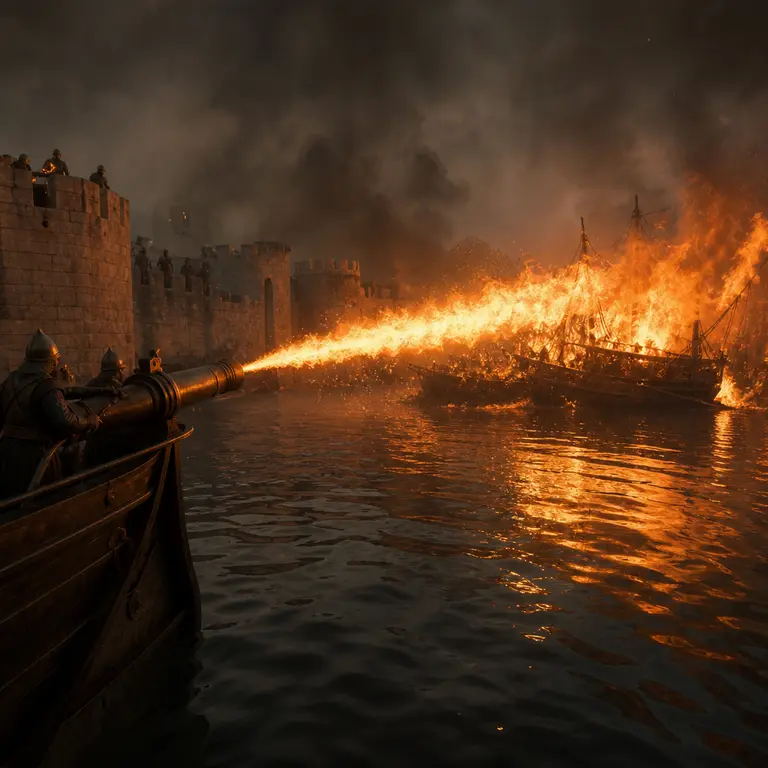
The first confirmed battlefield use of Greek Fire occurred in 672 CE, during the Arab naval siege of Constantinople. The Byzantine fleet, equipped with siphon-mounted projectors called siphonophoroi, unleashed streams of burning liquid onto the Arab armada in the Sea of Marmara. Contemporary Arab chroniclers described their sailors leaping into the water in panic, only to find the fire followed them there. The siege collapsed. Constantinople held. And the Byzantine Empire, which had seemed on the verge of annihilation, would survive for another eight centuries partly on the strength of this single technological advantage.
What makes this story remarkable is not simply the weapon itself, but everything surrounding it: the culture of secrecy that preserved it, the engineering sophistication required to deploy it, the chemical ingenuity embedded in its formula, and the strange finality with which it vanished from history. Greek Fire is one of the ancient world’s most compelling case studies in the intersection of science, statecraft, and military psychology. To study it is to understand not only how the Byzantines fought, but how they thought about power, knowledge, and survival.
The Architect Behind the Formula
Byzantine sources credit the invention to Kallinikos of Heliopolis, a Syrian-Greek architect and engineer who reportedly fled from the Arab-controlled Levant to Constantinople around 668 CE, bringing the formula with him. The historian Theophanes the Confessor, writing in the early 9th century, described Kallinikos as the originator, though some historians have argued the weapon may have been a collaborative development refined by imperial chemists after Kallinikos provided a foundational concept. The distinction matters less than it might seem: what the Byzantine state did with the knowledge, regardless of its precise origin, was extraordinary.
What is clear is that the imperial administration immediately recognized the compound’s strategic value and classified it at the highest level. The formula was entrusted exclusively to the Kallinikos family for several generations, and later to a small circle of imperial artificers whose identities and methods were kept from even senior military commanders. Emperors reportedly swore oaths to never share the secret with foreign powers, even allies. When Constantine VII Porphyrogennetos wrote his famous manual on imperial administration in the 940s, he explicitly warned his son that Greek Fire must never be given to barbarian peoples, framing its protection as a divinely ordained imperial duty. The language he used was not that of military strategy but of sacred obligation, suggesting the weapon had become bound up with Byzantine conceptions of divine favor and imperial legitimacy.
The weapon was deployed from bronze tubes mounted on the prows of Byzantine dromons — fast warships purpose-built for naval combat — as well as from hand-held siphons and clay grenades called cheirosiphona. The projector system required pressurized delivery, suggesting the Byzantines had developed a form of pump technology capable of forcing the liquid through nozzles under controlled pressure, a remarkable feat of engineering for the 7th century. The psychological effect of this delivery system should not be underestimated. A stream of burning liquid that appeared to emerge from the mouth of a gilded bronze lion — as some Byzantine dromons were decorated — would have seemed to enemy sailors less like a weapon and more like a divine punishment. The Byzantines understood this dimension and deliberately cultivated it, timing deployments for maximum theatrical effect and allowing stories of the fire’s supernatural properties to circulate uncorrected among their enemies.
What Was It Made Of?
The question that has occupied chemists, historians, and military scholars for centuries is deceptively simple: what was in it? The surviving Byzantine sources are deliberately vague. They mention that the compound was prepared using fire and manufactured in a secret location, that it was liquid at room temperature, that it ignited on contact with water, and that it could only be extinguished with sand, urine, or strong vinegar — a detail that has itself become a major clue for modern researchers attempting reconstruction.
The most widely cited hypothesis for much of the 20th century involved crude petroleum or naphtha as a base, combined with quicklime to produce an exothermic reaction upon contact with water, and thickened with pine resin or pitch to create adhesion. The quicklime hypothesis elegantly explains why water intensified the fire rather than quenching it: calcium oxide reacts violently with water, generating heat sufficient to reignite the mixture. This theory was championed by British historian John Haldon and chemist Maurice Byrne in a 2006 paper published in the journal Byzantine and Modern Greek Studies, and it remains influential in popular accounts of the weapon.
However, the quicklime theory has significant practical problems that its proponents have not fully resolved. Quicklime is extremely unstable in a liquid mixture and would be nearly impossible to store safely aboard wooden warships for extended periods. The Byzantine sources suggest the weapon was stored in quantity and deployed repeatedly over long campaigns, which would be difficult if the mixture were continuously reacting with ambient moisture and generating dangerous heat in the ship’s hold. An alternative hypothesis proposes that the key ingredient was a form of distilled petroleum — essentially an early naphtha distillate — combined with sulfur and pine resin, producing a compound that burned intensely and clung to surfaces due to its viscosity, without requiring a water-reactive component at all. Under this model, the apparent affinity for water was not a chemical property but a physical one: the compound was less dense than water, spread across its surface, and continued burning because water simply could not penetrate the oily film to deprive it of fuel.
A third theory, proposed by Greek chemist Christos Makrypoulias, suggests that the compound may have incorporated potassium nitrate — saltpeter — which would give it oxidizing properties and allow it to burn even when submerged. The presence of saltpeter would also explain the vinegar-and-urine extinguishing method, as both contain compounds capable of disrupting oxidation reactions, and it would place Byzantine chemistry tantalizingly close to the early precursors of gunpowder, though without the explosive qualities that would later transform warfare. No single theory has achieved consensus, and the honest answer is that the precise formula of Greek Fire remains one of history’s most durable unsolved chemical mysteries, a gap in the record that speaks directly to how effectively the Byzantines kept their secret.
The Weapon’s Decline and the Loss of Knowledge
Greek Fire’s effectiveness was not unlimited, and understanding its tactical constraints helps explain why the weapon eventually fell out of use. It appears to have been less decisive on land, where enemies could more easily avoid concentrated streams, where wind direction created dangerous unpredictability for the operators themselves, and where the logistical challenges of transporting pressurized siphon systems were severe. The Byzantines used it most effectively in naval engagements and in the defense of Constantinople’s sea walls, where the weapon’s ability to spread across water gave it a natural amplifying environment. During the two great Arab sieges of Constantinople — 674 to 678 CE and again in 717 to 718 CE — Greek Fire played a decisive role in both Byzantine victories, and its reputation alone may have deterred several subsequent campaigns that might otherwise have been attempted.
By the 12th and 13th centuries, however, references to Greek Fire in Byzantine sources become increasingly sparse and vague. Scholars debate whether this reflects a genuine loss of the formula, a deliberate suppression of written records for security reasons, or simply a shift in military priorities as Byzantine naval power declined and the empire contracted toward a land-based defensive posture. The erosion of the Kallinikos family’s custodial role, the disruptions caused by successive military crises, and the general institutional decay of the middle Byzantine period may all have contributed to a gradual degradation of the knowledge base required to produce and deploy the weapon effectively.
When the Fourth Crusade sacked Constantinople in 1204 CE, the Crusaders apparently found no functioning Greek Fire apparatus, or at least left no record of encountering one. The Latin Empire that replaced the Byzantines for the next 57 years showed no evidence of deploying the weapon, and the Crusader chronicles, which document Byzantine treasures and curiosities in considerable detail, are conspicuously silent on the subject. The Byzantines who reconstituted their empire from Nicaea in 1261 CE never seem to have recovered the technology in its original form. By the time Constantinople finally fell to the Ottoman Turks in 1453 CE, Greek Fire had vanished from the historical record entirely, replaced by gunpowder artillery — the very technology that finally breached Constantinople’s legendary walls and ended a civilization that Greek Fire had helped sustain for so long.
Modern Materials Science Closes In
In 2024, a research team at the University of Patras in Greece, collaborating with chemists from the University of Athens, published new experimental findings aimed at reconstructing a plausible Greek Fire formula using only materials and distillation techniques available to 7th-century Byzantine craftsmen. Their work, which drew on recent advances in archaeochemistry and the analysis of residues found in excavated Byzantine amphorae, suggested that a mixture of Crimean naphtha, pine resin, and sulfur — distilled and thickened to a specific viscosity — could produce a compound matching the behavioral descriptions in Byzantine sources, including sustained burning on water and adhesion to wood and fabric.
The Patras team’s approach is notable for not relying on anachronistic chemistry. Every ingredient and every process they used was demonstrably available in the Byzantine world, and their reconstruction was guided as much by historical context as by modern chemical analysis. Their reconstructed compound ignited readily, was difficult to extinguish with water, and clung to test surfaces in ways consistent with historical accounts. While they stopped short of claiming to have definitively solved the mystery — acknowledging that Byzantine chemists may have used regional naphtha sources with compositions different from those of modern samples — their work represents the most methodologically rigorous attempt at reconstruction to date, and it has been received seriously within both the chemistry and Byzantine studies communities.
The study has renewed interest in Byzantine materials science more broadly, prompting historians to reconsider how sophisticated Byzantine technical knowledge actually was. The empire, often remembered primarily as a political and religious institution, a keeper of Roman administrative traditions and Greek theological debate, was also home to a continuous tradition of practical engineering that stretched from late Roman antiquity through the early Renaissance. Byzantine craftsmen produced advanced silk-weaving machinery, sophisticated water-lifting devices, and mechanical automata that astonished foreign visitors, including a famous golden throne room device described by the ambassador Liutprand of Cremona in 968 CE, in which mechanical golden birds sang and mechanical lions roared. Greek Fire fits within this broader pattern of technical sophistication that Byzantine historiography has historically underemphasized.
A Legacy Written in Fire
Greek Fire occupies a peculiar place in the history of technology. Unlike most ancient weapons, it was not gradually improved upon and superseded — it simply disappeared, taking its secrets with it. Its influence on later incendiary technology is indirect at best. Medieval European armies used various incendiary compounds, including sulfur-based fire pots and burning pitch, but none appear to have been direct descendants of the Byzantine formula. Arab military writers, who had more direct exposure to Greek Fire than any other foreign tradition, developed their own incendiary compounds, but their recipes differ substantially from those described in Byzantine sources, suggesting they were working from observation and improvisation rather than from captured knowledge.
What Greek Fire does represent, with unusual clarity, is the strategic power of technological secrecy maintained over generational timescales. The Byzantine Empire sustained its advantage not through continuous innovation but through the disciplined refusal to share what it knew, enforced through family custodianship, imperial oath-taking, and a culture in which the weapon’s protection was understood as a religious as well as a military obligation. In an era before patents, trade secrets, or international intellectual property frameworks, the Byzantines achieved something that modern technology companies with vast legal resources frequently fail to accomplish: they kept a complex chemical formula secret for generations, in a court environment notorious for intrigue, betrayal, and political instability.
That the secret was eventually lost is, in a strange way, the most powerful proof of how effectively it was kept. No enemy ever reverse-engineered it through battlefield recovery. No defector ever successfully transmitted it to a foreign power. No merchant or traveler ever carried the formula out of Byzantine territory in a form that survived. It died with the tradition that protected it, leaving behind only the scorched hulls of Arab warships, the awed accounts of medieval chroniclers who struggled to explain what they had witnessed, and a chemical puzzle that the best minds in archaeochemistry are still working to solve more than a thousand years after the last Byzantine siphon fell silent. In an age that prizes openness and the free flow of information, Greek Fire stands as a reminder that sometimes the most consequential knowledge is the knowledge that was never written down.
Sources & Further Reading
- Haldon, John and Byrne, Maurice. A Possible Solution to the Problem of Greek Fire. Byzantine and Modern Greek Greek Studies, 2006.
- Davidson, Hilda Ellis. The Secret Weapon of Byzantium. Byzantinische Zeitschrift, 1973.
- Partington, J.R. A History of Greek Fire and Gunpowder. W. Heffer and Sons, 1960. https://archive.org/details/historyofgreekfi0000part
- Constantine VII Porphyrogennetos. De Administrando Imperio. Translated by Gyula Moravcsik, Dumbarton Oaks, 1967.