
Robert Fitzroy: Pioneer of Weather Forecasting's Legacy
Long before satellites and supercomputers, a nineteenth-century British polymath invented systematic weather prediction using telegraph networks, barometric data, and hand-drawn charts — and was nearly erased from history for it.
Introduction
On February 5, 1861, a retired vice-admiral named Robert FitzRoy published the world’s first publicly issued weather forecast in The Times of London. FitzRoy is best remembered today, if remembered at all, as the captain of HMS Beagle — the ship that carried Charles Darwin around the world between 1831 and 1836. That association has almost entirely eclipsed what FitzRoy himself considered his most important work: the invention of the modern weather forecast. He coined the word “forecast” in 1859, deliberately choosing it over “prophecy” to signal that his predictions were grounded in physical science rather than mysticism. The distinction mattered enormously at the time, when meteorology was still widely regarded as a form of educated guesswork at best and charlatanism at worst.
What makes FitzRoy’s story so compelling is not merely the technical achievement but the human cost behind it. He was a man of fierce intellectual conviction and fragile emotional constitution, working at the intersection of science, public policy, and institutional skepticism. He built something genuinely new, watched it be dismantled in his lifetime, and died without knowing whether any of it had mattered. The arc of his career raises questions that remain relevant today: how do institutions respond to knowledge they find inconvenient, and what happens to the people who carry that knowledge forward before the rest of the world is ready to receive it?
The Network He Built
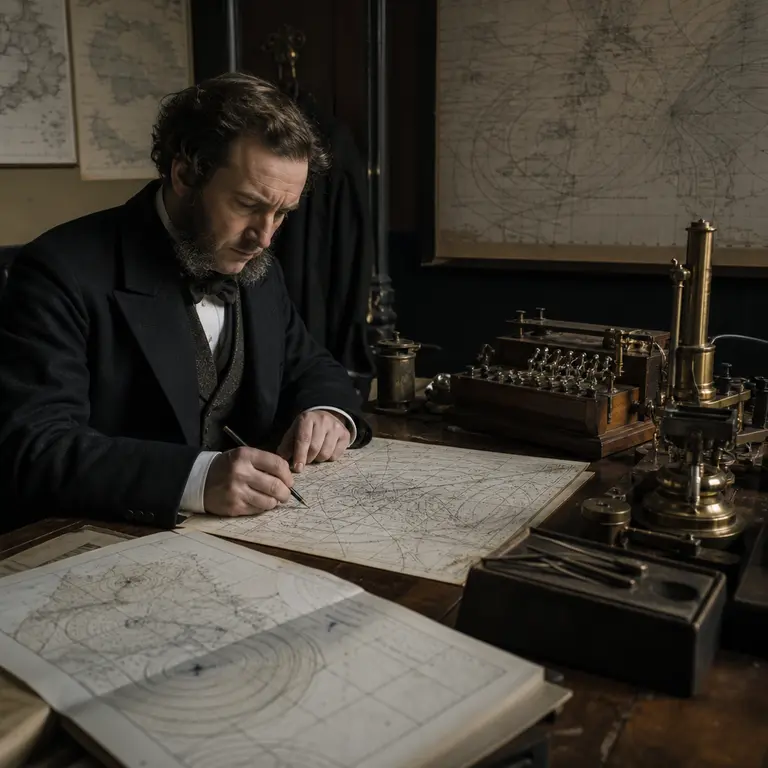
FitzRoy served as the first head of what would become the United Kingdom Meteorological Office, established in 1854. The original mandate of the office was modest and largely commercial: to collect wind and weather data from ships’ logs in order to help the Board of Trade improve the efficiency of British maritime trade routes. FitzRoy, however, had larger ambitions. Working from a small office in London, he assembled a network of fifteen coastal weather stations equipped with barometers, thermometers, and wind gauges, all connected by the newly installed electric telegraph. Every morning, station observers telegraphed their readings to London. FitzRoy and his small team then plotted the data by hand onto charts, analyzed pressure gradients and wind patterns, and issued warnings to ports and fishing communities about incoming gales.
The telegraph was essential to the enterprise in a way that is easy to underestimate from a modern vantage point. Before the telegraph, weather information was inherently local and retrospective. A storm that had passed through Liverpool the previous night could not warn anyone in Newcastle of what was coming. The telegraph collapsed that time lag, allowing FitzRoy to construct a picture of atmospheric conditions across hundreds of miles and reason forward about where pressure systems were likely to travel. The result was something that had never existed before: a real-time, spatially distributed picture of the atmosphere over Britain, updated daily and acted upon operationally. Between 1861 and 1865, his storm warnings are estimated to have saved hundreds of lives along the British coastline.
The Science Behind the Ink
FitzRoy’s method was not merely intuitive. He drew on the work of Heinrich Wilhelm Dove, a Prussian physicist who had identified the behavior of rotating storm systems in the 1820s and 1830s, and on the American meteorologist Matthew Fontaine Maury, who had compiled vast atlases of ocean winds and currents from ships’ logs gathered across decades of naval and merchant voyages. FitzRoy synthesized these ideas into a practical operational system, translating theoretical physics into procedures that a harbor master or a telegraph clerk could act on without advanced scientific training. His 1863 book, The Weather Book: A Manual of Practical Meteorology, laid out the physical reasoning behind his forecasting rules in accessible language and sold widely to a general readership. He described how falling barometric pressure combined with backing winds — winds shifting counterclockwise — reliably preceded storms over the British Isles, a principle still taught in basic meteorology courses today.
FitzRoy also designed an instrument that bore his name. The FitzRoy barometer, a tall cistern barometer with printed scales and explanatory text etched directly onto the wooden case, was installed in fishing villages and harbors across Britain so that ordinary people could interpret pressure changes themselves without needing to consult a scientist or wait for a telegraph message. The instructions on the case told users what a rapid fall in pressure meant, what a slow rise suggested, and how to combine barometric readings with observations of wind direction and cloud type. Several hundred original FitzRoy barometers survive in museums and private collections today. The Science Museum in London holds a notable example. These instruments democratized atmospheric observation in a way that had no real precedent, turning weather awareness from an elite scientific pursuit into a practical skill available to anyone who could read.
It is worth pausing on the ambition embedded in that design choice. FitzRoy was not simply building a forecasting service for institutions. He was trying to distribute the capacity for meteorological reasoning to the widest possible population, particularly the coastal communities most exposed to sudden and lethal weather. The barometer was, in this sense, as much a piece of public health infrastructure as a scientific instrument. That combination of rigorous methodology and genuine concern for ordinary lives distinguishes FitzRoy from many of his contemporaries, who were primarily interested in meteorology as an academic discipline rather than an applied one.
Ridicule, Tragedy, and Vindication
FitzRoy’s forecasts were not universally welcomed. The Times, which initially printed his daily forecasts, faced complaints from readers who found them inaccurate or too vague to be useful. Fishermen who had gone out based on a favorable forecast and encountered storms were furious. Scientists at the Royal Society, including Francis Galton, questioned whether the forecasts had any legitimate scientific basis and argued that FitzRoy was overstating the predictability of weather systems with the data and methods then available. Galton was not entirely wrong in his technical criticisms — FitzRoy’s methods were imprecise by later standards — but the institutional pressure the criticism generated went far beyond what the evidence warranted. The forecasts were demonstrably useful. The criticism was relentless and, for a man of FitzRoy’s temperament, devastating.
He had long suffered from what contemporaries described as severe depression — a condition that had also afflicted his uncle, Viscount Castlereagh, who died by suicide in 1822. FitzRoy was aware of this family history and had spoken of it. He was also carrying the weight of a separate, more personal grief: his relationship with Darwin had grown strained over the years following the Beagle voyage, partly because FitzRoy was a deeply devout Christian who came to regard the theory of natural selection as a direct attack on scripture. He had reportedly stood up at a meeting of the British Association in 1860, the year after the publication of On the Origin of Species, and held a Bible above his head while urging the audience to reject Darwin’s conclusions. The gesture was met with derision. For a man who prized scientific credibility, being publicly mocked in defense of religious conviction must have compounded an already unbearable sense of isolation.
On April 30, 1865, Robert FitzRoy took his own life at his home in Norwood, south London. He was 59 years old. Within months of his death, the Meteorological Office suspended his public forecasting service under pressure from critics. The suspension lasted until 1879, when the service was quietly reinstated after it became undeniable that gale warnings reduced maritime casualties. By then, FitzRoy’s name had faded from public consciousness, overshadowed by Darwin’s fame and by the institutional embarrassment of having canceled a service that turned out to work.
A Legacy Written in Pressure and Wind
The rehabilitation of FitzRoy’s reputation has been gradual and incomplete. In 2002, the British Broadcasting Corporation renamed the sea area Finisterre — part of the famous Shipping Forecast broadcast by BBC Radio 4 — to FitzRoy in his honor. The Shipping Forecast, first broadcast in 1924 and still transmitted four times daily at fixed hours, is a direct descendant of the warning system FitzRoy built. Millions of listeners in Britain have grown up hearing the rhythmic recitation of sea areas, wind speeds, and pressure readings — Dogger, Fisher, German Bight, Viking, North Utsire, South Utsire — without knowing that the man who invented the concept died in obscurity and disgrace. The broadcast has acquired a cultural resonance that goes well beyond its practical function, inspiring poetry, music, and a particular kind of quiet national attachment. That resonance is, in a roundabout way, FitzRoy’s afterlife.
Modern numerical weather prediction, which began in earnest with the work of Lewis Fry Richardson in 1922 and became computationally practical after World War Two with the advent of electronic computers, rests on mathematical foundations that FitzRoy could not have imagined. Richardson’s 1922 book Weather Prediction by Numerical Process described, in theoretical terms, a system in which the atmosphere would be divided into a three-dimensional grid of cells and the equations of fluid dynamics applied to each cell simultaneously. He estimated that the calculation would require sixty-four thousand human computers working in parallel to produce a forecast faster than the weather itself evolved. By the 1950s, early electronic computers had made that vision practical, and the first machine-generated weather forecast was produced in 1950 by a team that included the mathematician John von Neumann.
Yet the operational architecture FitzRoy established — distributed observation networks, centralized analysis, rapid public dissemination — remains the skeleton of every national meteorological service on Earth. The European Centre for Medium-Range Weather Forecasts, founded in 1975 and now widely regarded as the world’s leading forecasting institution, operates on principles of data aggregation and ensemble modeling that are conceptually continuous with FitzRoy’s telegraph network, scaled by a factor of millions. Where FitzRoy had fifteen coastal stations, modern forecasting draws on tens of thousands of surface stations, weather balloons, ocean buoys, commercial aircraft, and a constellation of meteorological satellites. The logic is the same: gather observations from as many points as possible, integrate them into a coherent picture, and reason forward in time.
What FitzRoy understood, and what his critics missed, was that weather prediction is not a matter of certainty but of probability and risk reduction. A forecast that is right seventy percent of the time still saves lives if the stakes are high enough. A gale warning that turns out to be unnecessary is a minor inconvenience. A gale warning that is not issued and should have been is a catastrophe. That asymmetry of consequences, embedded in the word he invented, shapes how meteorologists communicate uncertainty today — from hurricane track cones to avalanche danger ratings to air quality indices. The ink FitzRoy used to draw his first synoptic charts has long since dried, but the logic behind it has never stopped running.
Conclusion
Robert FitzRoy stands as one of the more poignant figures in the history of applied science: a man who built something that worked, was told it did not, and did not live to see himself proved right. His story is a reminder that the history of knowledge is not simply a record of discoveries and the people who made them. It is also a record of resistance, of institutional inertia, and of the personal costs borne by those who push against both. The weather forecast has become so ordinary a feature of daily life that it is nearly invisible, consulted and discarded dozens of times a day on smartphones, television screens, and radio broadcasts, without a moment’s thought for its origins. Behind that invisibility is a man standing at a telegraph machine in a small London office in the winter of 1861, watching numbers arrive from the coast and trying to read the future in them — not through prophecy, but through science, and at considerable personal cost.
Sources & Further Reading
- Gillian Turner. The Man Who Forecast the Weather: Robert FitzRoy and the Making of Meteorology. Endeavour, 2010.
- John Gribbin and Mary Gribbin. FitzRoy: The Remarkable Story of Darwin's Captain and the Invention of the Weather Forecast. Yale University Press, 2003.
- MetOffice.gov.uk. Robert FitzRoy and the birth of the Met Office. UK Met Office, 2023. https://www.metoffice.gov.uk/about-us/who-we-are/our-history/robert-fitzroy
- Peter Moore. The Weather Experiment: The Pioneers Who Sought to See the Future. Farrar, Straus and Giroux, 2015.