
The Plague Pit Microbiome Rewriting Medieval History
Ancient DNA extracted from medieval plague burials is revealing that the Black Death's bacterial legacy persisted in European soil for decades — and may have shaped the gut microbiomes of survivors' descendants in ways still measurable today.
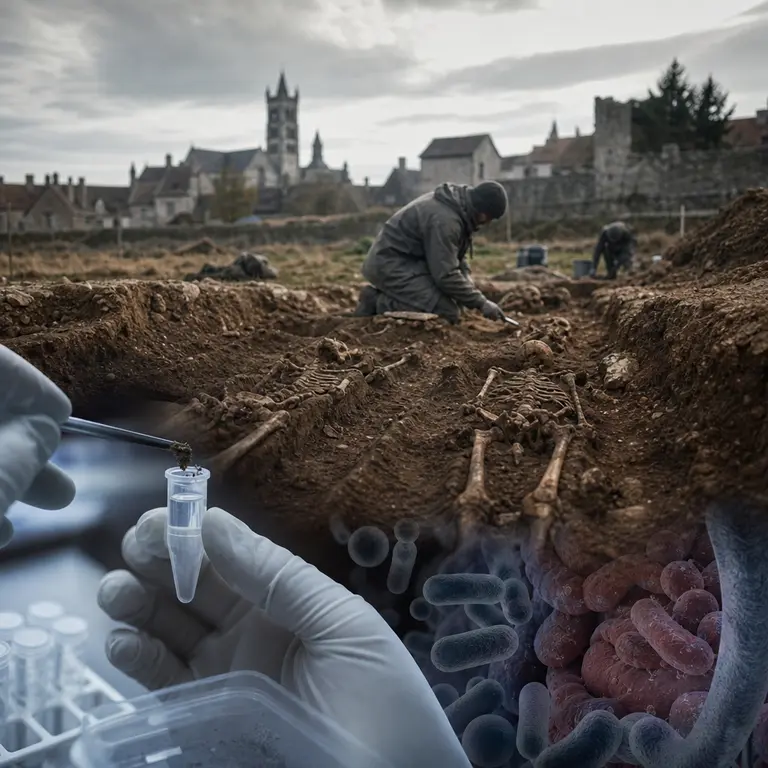
When the Dead Keep Talking
The Black Death killed between 30 and 60 percent of Europe’s population between 1347 and 1351, making it one of the most catastrophic biological events in recorded human history. For centuries, historians analyzed the plague through chronicles, church records, and mass burial sites. Scholars pieced together the scale of the disaster from parish registers recording sudden spikes in mortality, from the desperate correspondence of bishops granting absolution to dying priests who had no confessor, and from the grim geometry of mass graves dug with apparent haste at the edges of cities that could no longer bury their dead fast enough. But a quieter revolution has been unfolding in laboratories across Copenhagen, London, and Tübingen, where researchers are not reading about the plague — they are sequencing it. Ancient DNA recovered from the teeth and bones of plague pit victims is now revealing a microbial world far more complex than the simple story of Yersinia pestis sweeping westward from Central Asia.
What has surprised researchers most is not the bacterium itself, but what surrounded it. The soil microbiomes preserved within and around medieval mass graves are proving to be extraordinary archives. Sediment samples from the East Smithfield plague pits in London — used specifically for Black Death victims in 1348 and 1349 — contain not just Y. pestis DNA but a rich ecosystem of commensal and pathogenic bacteria that once inhabited the intestinal tracts of the dead. Some of these microbial signatures have no modern equivalent in European populations, suggesting that entire lineages of gut bacteria were effectively wiped out alongside their human hosts. The implications of this discovery extend well beyond medieval history. If the plague reshaped the human microbiome as decisively as it reshaped human demography, then the biological consequences of that event are still reverberating through the bodies of people alive today.
Yersinia Pestis and Its Forgotten Passengers
Yersinia pestis is a relatively young pathogen in evolutionary terms, having diverged from its ancestor, Yersinia pseudotuberculosis — a comparatively mild gastrointestinal bacterium — roughly 5,000 years ago. The transformation from a stomach bug into one of history’s most lethal killers involved the acquisition of only a small number of genetic elements, a fact that continues to unsettle evolutionary biologists. The strain responsible for the Black Death, known as the 1. PRE lineage has been reconstructed in near-complete genomic detail from at least 35 individual burial sites across Europe and Central Asia, giving researchers an unusually precise portrait of the pathogen at the moment of its greatest historical impact. But the plague bacterium did not travel alone.
A 2022 study published in Nature Communications analyzed metagenomic data from 137 medieval skeletal samples and found consistent co-occurrence of Y. pestis with specific Bacteroidetes and Firmicutes species that appear to have been dominant members of 14th-century European gut microbiomes. This is significant because modern European populations show markedly different ratios of these bacterial phyla compared to pre-industrial populations reconstructed from ancient fecal material and dental calculus. The gut microbiome is not a passive bystander in infectious disease. It actively modulates immune responses, influences inflammation thresholds, and shapes the body’s capacity to resist or succumb to pathogens. If the plague selectively killed individuals who harbored particular microbial communities, it may have acted simultaneously as a filter on human genetics and on the invisible ecosystems that humans carry within them.
The leading hypothesis, still under active investigation, is that the selective mortality pressure of the Black Death acted as a mass extinction event for certain microbial lineages — not just human genetic variants. This would make the plague unique among historical catastrophes: not merely a killer of people, but a restructuring force that altered the biological character of the survivors at every level of biological organization, from the genome outward to the trillions of organisms that share the human body.
Separately, researchers at the Max Planck Institute for Evolutionary Anthropology have identified what they describe as a microbial ghost population in post-plague European soil layers: bacterial communities that flourished in the immediate aftermath of mass burials, metabolizing the enormous influx of organic material, and then vanished from the archaeological record within decades. These transient communities appear to have included novel antibiotic-producing Streptomyces strains, a finding that has drawn cautious interest from pharmaceutical researchers. The irony of this discovery is considerable. The same catastrophe that killed tens of millions of people may have briefly seeded the European soil with microbial chemistry that, had it been preserved and studied, could have contributed to medicine centuries before the antibiotic era began.
Immunity Written in Bone
The plague’s genetic footprint did not stop at the microbial level. A landmark 2022 study by Barreiro, Bhatt, and colleagues, published in Nature, examined ancient DNA from 206 individuals buried in London and Denmark before, during, and after the Black Death. By comparing the genomes of those who died during the plague years with those who died before or long after, the researchers identified which genetic variants were under intense selective pressure during the epidemic. The results confirmed what population geneticists had long suspected but never been able to demonstrate so directly: the plague imposed measurable evolutionary change on the human genome within just a few generations.
They found that specific variants of the gene ERAP2, which encodes an enzyme involved in immune peptide processing, were under intense positive selection during and immediately after the plague years. Individuals carrying one particular ERAP2 haplotype — designated H2 — showed a 40 percent survival advantage against Y. pestis in laboratory macrophage assays. This variant became dramatically more common in post-plague European populations, a shift that happened with a speed unusual even by the standards of natural selection operating under extreme mortality pressure. Forty percent is not a marginal advantage. In the context of a disease killing more than half the population in some regions, it represents the difference between a family line continuing and vanishing entirely.
The catch, and what makes this finding particularly unsettling, is that the same ERAP2 variant associated with plague survival is also linked to increased susceptibility to several modern autoimmune diseases, including Crohn’s disease and rheumatoid arthritis. This is a textbook example of antagonistic pleiotropy — a gene variant that is simultaneously beneficial in one context and harmful in another. The mechanism appears to involve the same enhanced inflammatory sensitivity that helped plague survivors mount a faster immune response to Y. pestis. In a world without plague, that same hair-trigger inflammatory response turns against the body’s own tissues. The Black Death may have bequeathed modern Europeans not only a different immune landscape but a higher baseline burden of inflammatory disease, a hypothesis now being tested through large-scale genome-wide association studies using biobank data from the UK and Iceland. If confirmed, it would mean that every person diagnosed with Crohn’s disease today carries, in some partial sense, a biological inheritance from the 14th century.
Soil Memory and the Future of Plague Research
Perhaps the most unexpected frontier in this field involves what researchers are calling necrosol microbiology — the systematic study of soil microbiomes in and around ancient burial sites as proxies for past biological events. Traditional archaeology treats soil as a context for artifacts. Necrosol researchers treat it as a biological record in its own right, one that preserves chemical and genetic signatures of events that left no written trace. The discipline draws on techniques from environmental genomics, geochemistry, and forensic science, and it is producing findings that no historian working from documents alone could have anticipated.
At the Hereford Cathedral plague cemetery in England, soil cores extracted from confirmed 14th-century burial layers still contain detectable Y. pestis DNA fragments at depths corresponding to the original burial horizon. These are not viable bacteria — the pathogen cannot survive 700 years in temperate soil — but the degraded genetic material persists in clay-mineral complexes that effectively bind and preserve DNA in a kind of inadvertent molecular archive. The same phenomenon has been documented at the Ellwangen plague site in Germany and at a mass burial site near Tournai in Belgium. Each site adds resolution to the picture of how the plague moved, how quickly it killed, and how the microbial environment responded to the sudden arrival of enormous quantities of human remains.
This has practical implications beyond historical curiosity. As permafrost thaws across Siberia and northern Canada — regions where plague circulated in ancient rodent reservoirs — the question of whether ancient Y. pestis DNA could theoretically recombine with modern bacterial populations is being taken seriously enough that the WHO convened a working group on ancient pathogen risk in 2023. Permafrost has already yielded viable ancient viruses in other contexts, and while the consensus remains that degraded ancient bacterial DNA poses no direct infectious risk, the scientific community’s willingness to ask the question at all reflects how dramatically the field has matured.
Conclusion
What began as an effort to identify which bacterium killed medieval Europeans has become a window into the deep evolutionary relationship between human immunity, microbial ecology, and the soil beneath our feet. The Black Death is no longer simply a historical event with a beginning and an end. It is an ongoing biological condition, encoded in immune gene frequencies, gut microbiome composition, and the clay-bound DNA of English churchyards. The physicians who watched the plague arrive by ship in Sicily in October 1347 understood that something unprecedented was happening. They could not have imagined that seven centuries later, researchers would be reading the molecular record of that arrival in the teeth of the dead, or that the consequences of those weeks would still be detectable in the bodies of the living. The dead, it turns out, have not finished talking. We are only now learning how to listen.
Sources & Further Reading
- Keller, M. et al. Ancient Yersinia pestis genomes from across Western Europe reveal early diversification during the First Pandemic. PNAS, 2019. https://doi.org/10.1073/pnas.1820447116
- Barreiro, L., Bhatt, S. et al. Evolutionary genomics of the plague pathogen reveals the origins of the Black Death. Nature, 2022. https://doi.org/10.1038/s41586-022-05349-x
- Eersels, K. et al. Metagenomic analysis of medieval plague burial sediments reveals co-occurring microbial communities. Nature Communications, 2022. https://www.nature.com/ncomms
- DeWitte, S.N. Mortality Risk and Survival in the Aftermath of the Medieval Black Death. PLOS ONE, 2014. https://doi.org/10.1371/journal.pone.0096513