
How a Surprising Mishap Led to the Creation of Safety Glass
Safety glass, widely used in car windshields today, was an accidental discovery by French chemist Édouard Bénédictus in 1903.
 Watch on YouTube
 Watch on Rumble
The Accidental Invention That Made the Modern World Safer: The Story of Laminated Glass
In the history of science and technology, some of the most consequential discoveries have arrived not through deliberate experimentation but through the quiet drama of an unexpected moment. The invention of laminated safety glass is one such story. It begins not in a grand research institution or with a government-funded initiative, but in the modest Paris laboratory of a French chemist named Edouard Benedictus, where a dropped flask and a curious mind combined to produce one of the most enduring safety innovations of the twentieth century. What Benedictus stumbled upon in early 1903 would eventually find its way into automobiles, skyscrapers, banks, courtrooms, and spacecraft, quietly protecting millions of lives across more than a century of use.
The Accident and the Observation That Changed Everything
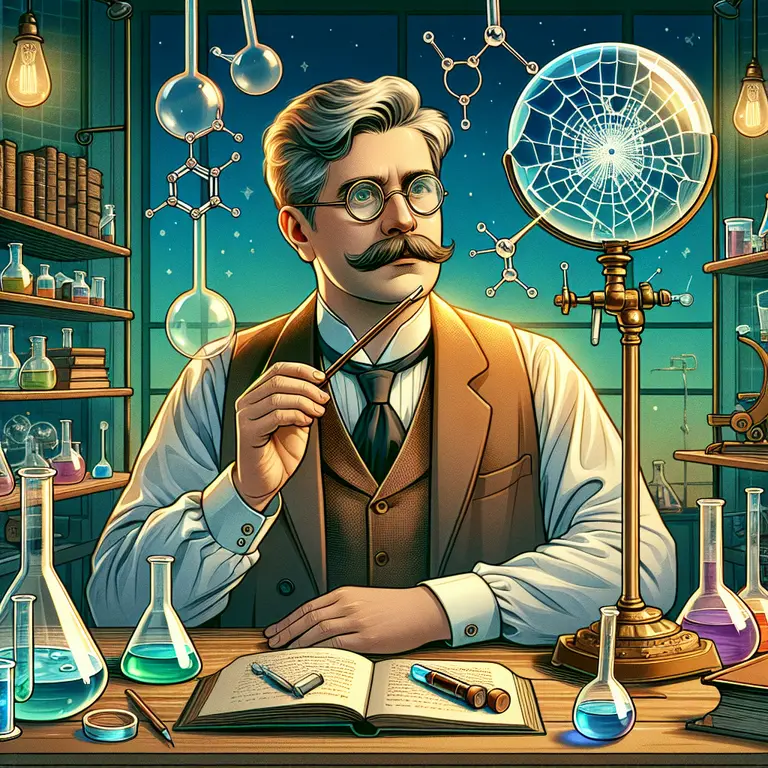
The moment of discovery was disarmingly ordinary. Benedictus, while moving about his laboratory, accidentally knocked a glass flask from a shelf. Anyone who has worked in a lab knows the instinctive dread that follows such a moment, the anticipation of a shower of broken glass across the floor. But the flask did not shatter as expected. It cracked, fractured even, but held together. The broken pieces remained in place, bound by some invisible force, forming a web of cracks rather than a scatter of dangerous shards.
Benedictus examined the flask carefully and discovered that it had previously contained cellulose nitrate, an organic compound derived from cellulosic materials such as cotton and treated with nitric acid. The solution had long since evaporated, but it had left behind a thin, nearly transparent film coating the glass's interior surface. This residue, unremarkable on its own, had acted as an adhesive in the moment of impact, holding the fractured pieces together and preventing them from flying apart.
What is remarkable about this moment is not simply that Benedictus noticed the flask had not shattered, but that he chose to take the observation seriously. A lesser scientist, or simply a busier one, might have swept the flask aside and moved on. Benedictus instead paused, examined the evidence, and began asking questions. Why had the flask behaved this way? Could this behavior be replicated intentionally? And if it could, what might that mean for the safety of people who encountered broken glass in their daily lives?
From Curiosity to Patent: The Development of a Practical Material
Benedictus did not simply file his observation away as an interesting footnote. He began experimenting with the deliberate application of cellulose nitrate to glass surfaces, working to understand the conditions under which the coating would most effectively hold broken glass together. The challenge was to produce a material that was not only structurally coherent when fractured but also transparent, durable, and practical enough to manufacture at scale.
After several years of development, Benedictus filed a patent in 1909 for what he described as glass laminated with cellulose, a process in which a layer of the adhesive compound was sandwiched between two sheets of glass. This structure meant that when the glass was struck or broken, the cellulose layer would hold the fragments in place, preventing them from scattering. The resulting product was far safer than ordinary glass, particularly in situations involving sudden impact or breakage.
To bring this invention to market, Benedictus established La Triplex, the first company dedicated to producing safety glass. The name itself gestures toward the product's three-layered nature: two sheets of glass bound by a central adhesive layer. Despite the clear logic of the invention, early commercial interest was modest. The public and industry had not yet developed sufficient awareness of the dangers posed by conventional glass, and the added cost of laminated glass made it a harder sell in peacetime markets where safety was not yet a regulatory or cultural priority.
War, Windshields, and the Wider World
It was the catastrophe of the First World War that finally demonstrated the material’s value to a skeptical world. Laminated glass was adopted for use in the lenses of gas masks worn by soldiers in the trenches, where the glass's ability to resist shattering under pressure or impact could mean the difference between protection and injury. The war effort provided both the urgent demand and the manufacturing infrastructure needed to produce safety glass at scale, and by the time the conflict ended, the material had proven itself under some of the most extreme conditions imaginable.
The postwar expansion of the automobile industry gave laminated glass its most lasting and widespread application. As cars became faster and more common, the dangers of windshield glass became increasingly apparent. Conventional glass windshields shattered violently in collisions, and the resulting fragments caused severe facial and bodily injuries to drivers and passengers. The adoption of laminated glass in automobile windshields transformed this equation entirely. When a laminated windshield breaks, it fractures into a pattern of small, relatively blunt pieces held together by the interlayer, dramatically reducing the risk of lacerating injuries.
This single application alone accounts for an enormous reduction in road accident injuries throughout the twentieth century. By the mid-twentieth century, laminated glass in windshields had become a regulatory requirement in many countries, a testament to how thoroughly the material had demonstrated its life-saving potential. Beyond automobiles, safety glass found its way into bank teller windows, where security and impact resistance were paramount, into shower enclosures, architectural facades, and public buildings, where the consequences of glass failure could affect large numbers of people.
The Evolution of Laminated Glass and Its Modern Applications
The laminated glass that exists today is a far more sophisticated material than the cellulose nitrate composite that Benedictus first patented. Modern laminated glass typically uses a layer of polyvinyl butyral, commonly known as PVB, as the interlayer bonding the glass sheets together. PVB offers superior optical clarity, flexibility, and adhesion compared to early cellulose-based compounds, and it can be engineered to meet a wide variety of performance specifications.
Contemporary applications of laminated glass extend into a territory that Benedictus could not have anticipated. Bulletproof glass, used to protect heads of state, bank vaults, and military vehicles, is a form of laminated glass in which multiple layers of glass and polymer are bonded together to absorb and dissipate the energy of a projectile. Acoustic laminated glass, which incorporates a specially formulated interlayer, is used in urban architecture to reduce noise transmission through windows and facades. In the aerospace industry, laminated glass is used in aircraft cockpit windows, where it must withstand extreme temperature differentials, pressure changes, and the occasional impact from bird strikes at high speed.
There is also a growing role for laminated glass in sustainable architecture. When combined with solar-control coatings or embedded photovoltaic cells, laminated glass can enhance energy efficiency in buildings by reducing heat gain and even generating electricity from sunlight. These developments represent a long evolution from the thin, invisible film of cellulose nitrate that clung to the inside of a dropped flask in a Paris laboratory.
Conclusion
The story of Edouard Benedictus and the invention of laminated glass carries lessons that extend well beyond chemistry or materials science. It is a story about the conditions under which discovery happens, about the role of attentiveness in a world that constantly presents us with unexplained phenomena. Benedictus did not set out to invent safety glass. He set out to understand something that had surprised him, and he followed that thread of curiosity with enough patience and rigor to produce a result that mattered.
More than a century after that flask hit the laboratory floor, laminated glass continues to evolve and find new applications in a world that has grown increasingly dependent on transparent, resilient materials. It is present in the car you drive, the building you work in, and perhaps the phone in your pocket. Its ubiquity is a measure of how completely it has been absorbed into the fabric of modern life, so thoroughly that most people never think about it at all. That invisibility, in a way, is the highest form of success for a safety material. The best protection is the kind you never notice, because nothing has gone wrong.